

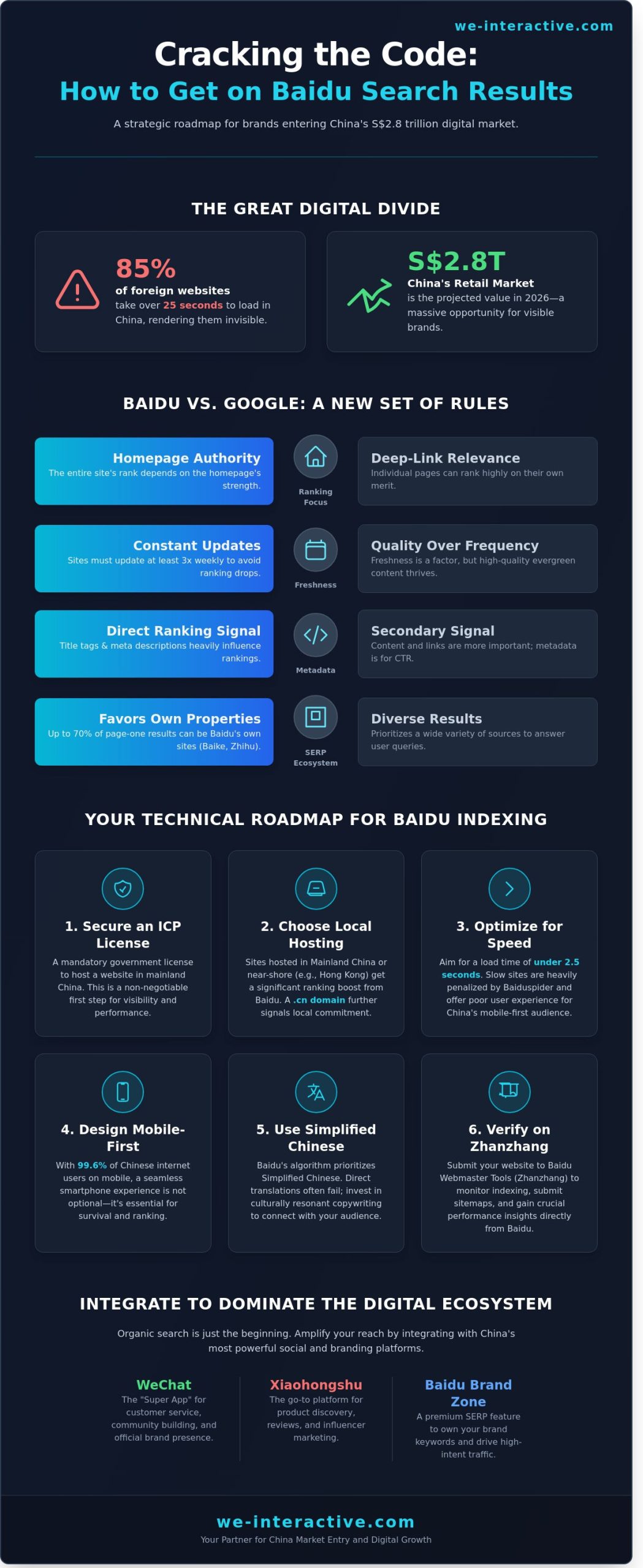
Did you know that 85% of non-Chinese websites experience load times exceeding 25 seconds when accessed from mainland China? For a Singaporean brand eyeing a slice of China’s S$2.8 trillion retail market in 2026, learning how to get on baidu search results is the difference between invisible failure and scalable success. You probably recognize that the Great Firewall isn’t just a filter but a sophisticated digital ecosystem that demands its own set of rules. At WE Interactive, we believe your brand deserves to be seen, not blocked by technicalities you can’t control.
This guide empowers you with the exact strategy to bypass regulatory hurdles that stall most international expansions. We’ll show you why securing an ICP license is the first step to unlocking visibility and how to navigate non-English webmaster tools with confidence. From technical indexing to strategic content alignment, we’re providing the roadmap to elevate your ROI in the world’s most dynamic digital economy. Let’s transform your digital presence into a powerful force for growth.
Key Takeaways
- Unlock the Chinese market by navigating essential technical prerequisites, from securing mandatory ICP licenses to selecting optimal hosting solutions near Singapore to bypass the Great Firewall.
- Master the nuances of the Baidu algorithm and learn exactly how to get on baidu search results by leveraging local keyword research tools and Zhanzhang platform verification.
- Elevate your visibility through expert Chinese copywriting that prioritizes cultural resonance over direct translation, ensuring your brand story connects with 1.4 billion users.
- Amplify your digital presence by integrating organic SEO with high-impact social platforms like WeChat and Xiaohongshu for a comprehensive, data-driven marketing strategy.
- Discover how to dominate the SERP and maximize growth using the Baidu Brand Zone, turning search impressions into meaningful brand conversions and sustainable ROI.
Understanding the Baidu Ecosystem: Why Google Rules Don’t Apply
WE Interactive has spent over 15 years helping brands scale across borders. For Singaporean firms looking north, the digital border is a physical reality. With a market share consistently exceeding 80%, Baidu’s dominant position in China makes it the non-negotiable entry point for 1.4 billion users. You can’t simply port a Singaporean SEO strategy to Beijing. The “Sovereign Internet” model means the Great Firewall filters out external noise, prioritizing content hosted within the mainland. To understand how to get on baidu search results, you must first accept that Baiduspider values local signals above all else.
In 2026, the shift toward AI-driven search via ERNIE Bot has redefined E-E-A-T. Experience and Trust now require verifiable Chinese credentials and local hosting. WE helps you bridge this gap through our China market entry marketing services, ensuring your brand isn’t just visible but authoritative. We transform your digital presence into a powerful force that resonates with the unique cultural nuances of the Chinese consumer.
Baidu vs. Google: Key Algorithmic Differences
Baidu prioritizes homepage authority over the deep-link relevance Google prefers. If your homepage isn’t a powerhouse, your subpages won’t rank. Freshness is a survival trait; sites that don’t update content at least 3 times weekly often see their rankings plummet. Unlike Google’s move toward semantic understanding, Baidu still places heavy weight on traditional metadata. Title tags and meta descriptions act as direct ranking signals. We’ve seen brands boost visibility by 40% simply by optimizing these tags for simplified Chinese keywords. This data-driven approach is essential for anyone learning how to get on baidu search results effectively.
The Role of User Experience in Chinese Search
Mobile-first is an understatement in a region where 99.6% of users access the web via smartphones. Your site must integrate with the “Super App” ecosystem, including WeChat and Alipay. Speed is the ultimate metric. If your site takes longer than 2.5 seconds to load, Baiduspider may penalize you. This usually requires a local CDN or an ICP license, which can cost between S$1,000 and S$5,000 depending on your corporate structure. Consider these factors:
- Baidu Properties: Up to 70% of page-one results often link to Baidu’s own sites like Baike or Zhihu.
- Local Hosting: Sites with a .cn domain and local servers receive a significant ranking boost.
- Simplified Chinese: Baiduspider struggles with traditional Chinese or English content, preferring localized dialects.
By connecting strategy and performance, WE ensures your brand navigates these technical hurdles to achieve sustainable growth.
The Technical Prerequisites for Baidu Indexing
Getting your site indexed by Baidu requires more than just good content. You need to clear specific regulatory and technical hurdles that don’t exist in Western markets. Understanding China’s internet regulations is the first step toward long-term visibility. Without the right setup, Baiduspider might never even see your homepage. Baidu prioritizes sites that demonstrate local commitment through infrastructure and legal compliance.
Navigating the ICP License Process
To host a website on a mainland Chinese server, you must obtain an Internet Content Provider (ICP) license. An ICP Filing (Beian) is mandatory for non-commercial sites, while an ICP Commercial License is required if you plan to process payments directly on your platform. Since 2000, these regulations have governed every site within the borders. Foreign entities often find the documentation intensive, requiring a local business license or a Chinese legal representative. WE Interactive helps brands streamline China market entry by managing these compliance hurdles, ensuring your digital presence is legally sound from day one.
Mainland hosting offers the lowest latency, but near-shore options like Hong Kong or Singapore provide a viable alternative for brands without a local entity. While a .cn domain signals local commitment, a high-authority .com can still perform well if the site is optimized correctly. However, your content must be in Simplified Chinese. Baidu’s NLP (Natural Language Processing) is built specifically for Simplified characters. Using Traditional Chinese or English as your primary language is a guaranteed way to fail at how to get on baidu search results.
Optimizing Site Architecture for the Great Firewall
The Great Firewall creates a unique environment where standard Western web elements become liabilities. Scripts from Google Fonts, YouTube, or Facebook will time out, causing your site to hang for 10 seconds or more. This lag kills your ranking. You must replace these with local equivalents like Youku for video or local font hosting. Mastering these technical basics is the only way to ensure you know how to get on baidu search results effectively in 2026.
- Implement a China-friendly CDN like Alibaba Cloud or Baidu Cloud to reduce latency across different provinces.
- Use a flat URL structure. Baiduspider prefers shallow hierarchies; pages more than three clicks from the home page often go unindexed.
- Ensure your server response time is under 200ms within China to avoid crawl errors.
Investing roughly S$2,000 to S$5,000 in initial technical localization can prevent a 40% bounce rate caused by slow loading. If you’re unsure where to start, our team can help you optimize your site architecture for maximum performance and speed.
On-Page SEO: Optimizing Content for Baidu’s Algorithm
Understanding how to get on baidu search results requires a fundamental shift from Western SEO mindsets. Baidu isn’t Google. The algorithm rewards precision, local relevance, and strict adherence to technical preferences. While Google has moved toward intent-based semantic search, Baidu still places heavy weight on traditional on-page signals. Success starts with data from Baidu Index rather than Google Keyword Planner. This tool provides the raw insights needed to capture the attention of China’s 1.01 billion internet users, offering a localized view of search volume that Western tools simply cannot replicate.
Strategic placement of keywords is non-negotiable for Baidu visibility. The crawler prioritizes the first 100 words of your text and the H1 to H3 header tags. If your primary keywords aren’t front-loaded, the spider may miss the context of your page entirely. Compliance is another pillar of visibility; understanding the technical nuances of search censorship in China ensures your content meets local regulatory standards while remaining discoverable to your target audience. We combine the art of storytelling with the science of algorithm optimization to ensure your brand resonates.
Localized Keyword Strategy
Direct translation is a recipe for failure in the Chinese market. A 2023 analysis revealed that localized content achieves 40% higher engagement than translated English copy. Chinese consumers use unique long-tail queries that often focus on “authenticity” or “official” status. You must use Simplified Chinese exclusively for the Mainland, as Traditional Chinese is primarily for Hong Kong and Taiwan. At WE Interactive, we help you optimize your SEO strategy by identifying these regional nuances and linguistic triggers that drive conversions. We don’t just translate; we transform your message to fit the local culture.
Visual and Interactive Content Optimization
Baidu’s search results are increasingly visual, making Alt-text for images more critical than ever. Since the crawler can’t “see” the content of an image, descriptive, keyword-rich Alt-tags are your only way to rank in Baidu Image Search. Incorporating QR codes is also essential for bridging the gap between desktop browsing and mobile ecosystems like WeChat. However, technical restraint is vital. You must avoid Flash and heavy JavaScript frameworks like React or Vue for core content. Baidu’s spider often struggles to render these, frequently resulting in empty pages in the index. We focus on clean, crawlable HTML to ensure your digital presence is a powerful force from day one.
Step-by-Step Guide to Baidu Webmaster Tools (Zhanzhang)
Mastering Baidu Zhanzhang, the Search Resource Platform, is the single most important technical hurdle for any Singaporean brand entering the mainland. This portal acts as your direct line of communication with Baiduspider. Without it, your site remains invisible to the 1 billion users navigating the Chinese web. To understand how to get on baidu search results, you must first claim your digital territory through this dashboard. WE helps you bridge the gap between technical configuration and market dominance by turning raw data into actionable growth.
Verification and Configuration
Navigating the Chinese-only interface requires familiarity with specific terminology. You must locate ‘Zhandian Yanzheng’ (Site Verification) to begin. We recommend the HTML file upload method for its stability. Key terms you need to know include ‘Lianjie Tijiao’ (Link Submission) and ‘Siliu’ (Dead Links). Accuracy here is non-negotiable. Since 2018, Baidu has explicitly favored HTTPS over HTTP; securing your site with a valid SSL certificate can provide up to a 10% boost in initial trust scores.
Use the ‘Crawl Frequency’ (Zhuqu Binfan) tool to manage the load on your Singapore-based servers. If Baiduspider crawls too aggressively, it can trigger 504 errors due to the latency caused by the Great Firewall. Setting a custom crawl rate ensures your site remains responsive for users while staying indexed. We calibrate these settings based on your server’s specific performance metrics to maintain a seamless experience.
Analytics and Performance Tracking
Google Analytics often fails to capture 30% to 40% of traffic data within China due to script blocking. Integrating Baidu Tongji is the only way to gain a transparent view of your audience. This tool differentiates between ‘Keywords’ (Guanjianci), which are the terms you bid on or target, and ‘Search Terms’ (Sousuo Ci), the actual phrases users type. Distinguishing these two is vital for refining your content strategy and understanding how to get on baidu search results for high-intent queries.
Measuring the ROI of your performance marketing efforts requires a localized lens. We track conversion paths across the mainland ecosystem to ensure every S$1,000 spent on digital strategy yields measurable growth. By monitoring the ‘Broken Link’ reports, we quickly identify if the Great Firewall is blocking specific assets, such as external scripts or high-res images, which could otherwise tank your conversion rates.
WE empowers your brand to move from clicks to conversations by optimizing every technical touchpoint. Our team ensures your Zhanzhang dashboard is a catalyst for success rather than a barrier to entry. We combine fifteen years of experience with data-driven precision to unlock your brand’s potential in the East.
Ready to dominate the Chinese search landscape? Unlock your China growth strategy with WE Interactive today.
Beyond Search: A Holistic China Marketing Strategy
Mastering how to get on baidu search results is just the foundation of a successful expansion. In 2026, a siloed SEO approach won’t suffice for Singaporean brands aiming for significant ROI. Success requires an omnichannel ecosystem where search, social, and lead management work in unison. By late 2025, data showed that 84% of successful China market entries utilized a “Search plus Social” hybrid model to build trust with local consumers. You can’t rely on a single channel when the digital landscape is this interconnected.
The Baidu Brand Zone is a critical tool for this integration. It’s a premium paid/organic hybrid that occupies the top of the SERP with rich media, often covering 65% of the mobile screen. This real estate allows you to control the narrative, shielding your brand from competitors while driving traffic directly to your most profitable assets. Beyond the SERP, building authority through off-page SEO remains vital. High-quality Chinese-language backlinks from authoritative news portals like Sina or Sohu provide the trust signals Baidu’s algorithm demands. A single mention on a high-authority site is worth more than 50 low-quality forum links.
The Synergy of Search and Social
Social signals from platforms like Weibo and WeChat now influence Baidu’s trust scores significantly. A brand that’s trending on Xiaohongshu often sees a 22% lift in organic search visibility within weeks. Integrating Social Media Marketing into your SEO strategy creates a virtuous cycle of discovery and validation. When users see your brand on social media, they search for it on Baidu; when they find you on Baidu, they expect a professional social presence to confirm your credibility.
We use CRM and marketing automation to capture and nurture leads from these diverse touchpoints. Instead of a dead-end search result, we design a seamless journey from a Baidu query to a WeChat Mini-program. This allows for immediate conversion and long-term retention. It’s about turning a single search into a lasting relationship through data-driven precision.
Shaping Success with WE Interactive
Since 2009, WE Interactive has helped global brands navigate the complexities of Asia. With over 15 years of experience and 700+ campaigns delivered, we understand that China marketing is both an art and a science. We don’t just deliver traffic. We deliver sustainable growth that impacts your bottom line in the Singapore and China markets.
From clicks to conversations, from impressions to conversions; our team bridges the gap between digital presence and market dominance. We’re ready to help you unlock the potential of the Chinese market with insight and innovation. It’s time to stop guessing how to get on baidu search results and start executing a strategy that wins. Ready to elevate your brand? Partner with WE for your China market entry and let’s start Growing Together.
Master Your Brand’s Future in the China Market
Navigating the Great Firewall requires more than just translating your website; it demands a total shift in digital philosophy. Success hinges on technical compliance through local hosting and mastering Baidu Webmaster Tools to ensure your site remains visible. Understanding how to get on baidu search results is the first step toward capturing a share of a massive consumer landscape. Since 2009, WE Interactive has helped brands bridge this gap by blending data precision with creative storytelling.
We’ve spent 15 years refining these strategies for global leaders like Singapore Airlines and Starbucks. Our team acts as your strategic partner, turning complex regulatory requirements into streamlined growth opportunities. We handle the technical heavy lifting so you can focus on scaling your ROI. Whether you’re a Singapore-based SME or a multinational firm, we provide the end-to-end digital solutions needed to thrive in 2026 and beyond. We don’t just deliver clicks; we drive conversations that matter.
Ready to turn your vision into a measurable competitive advantage? Unlock your growth in China with WE Interactive’s expert entry services today. Let’s grow together.
Frequently Asked Questions
Do I need a Chinese business license to rank on Baidu?
No, you don’t need a mainland Chinese business license to rank organically, but it’s a strategic advantage for long term growth. While international brands can show up in results, 85% of the top performing sites on Baidu hold a local business license or an ICP filing. Without one, you can’t access Baidu’s trust building V-Verification badge. This badge typically costs between S$120 and S$600 per year depending on the verification level you choose.
How long does it take for Baidu to index a new website?
It typically takes between 30 and 45 days for Baidu to index a new website from scratch. Unlike Google’s near instant crawl, the Baiduspider is more cautious with foreign domains. You can accelerate this timeline by submitting your URL through Baidu Webmaster Tools manually. We’ve seen sites that use an API submission tool get indexed 25% faster than those that wait for organic crawling to happen naturally.
Can I rank on Baidu if my website is hosted in Singapore or the US?
You can rank while hosting in Singapore, but US based servers often struggle with the Great Firewall. Proximity is a core factor in how to get on baidu search results because it impacts site speed. Singapore based servers provide a latency of roughly 50 to 100 milliseconds to mainland China. This is significantly better than the 300 millisecond delay seen from US servers, which often leads to a 40% bounce rate.
Why is my website loading so slowly in China even though it’s fast elsewhere?
Your site likely relies on assets blocked by the Great Firewall, such as Google Fonts, Recaptcha, or YouTube embeds. These external calls can delay page load times by 10 to 15 seconds for users in Shanghai or Beijing. To optimize performance, you must remove these dependencies or host them locally. A site that takes longer than 3 seconds to load will lose 53% of its mobile traffic in the China market.
Does Baidu penalize websites that have English content?
What is an ICP license and is it mandatory for SEO?
An ICP license is a state level registration issued by the Chinese Ministry of Industry and Information Technology. It’s not mandatory for organic ranking if you host in Singapore, but it’s required if you want to use a mainland China CDN or server. Obtaining an ICP filing through a consultant typically costs between S$500 and S$1,500. This registration is the only way to ensure 100% accessibility across all Chinese provinces.
How do I track my Baidu rankings from outside of China?
You should use specialized SEO platforms like Dragon Metrics or Baidu Webmaster Tools rather than standard Google centric software. Standard tools often fail to bypass the Great Firewall, leading to inaccurate data. For 100% accuracy, we recommend using a China based proxy to manually check the SERPs. Monitoring your progress is a vital part of learning how to get on baidu search results effectively as the algorithm updates 2 to 3 times per month.
Is Baidu PPC (Pay-Per-Click) necessary to achieve organic rankings?
No, Baidu PPC isn’t a direct ranking factor for organic search. However, running a Tuiguang campaign provides immediate data on high converting keywords that you can then target in your SEO strategy. Data shows that brands appearing in both paid and organic results see a 20% lift in total click through rates. Investing a starting budget of S$2,000 in PPC can provide the insights needed to accelerate your long term organic growth.