

In Singapore’s dynamic digital marketplace, the pursuit of measurable growth is relentless. For many brands, the concept of affiliate marketing Singapore presents a powerful opportunity, yet it’s often shrouded in questions: Is it a viable strategy for this market? How do you navigate the landscape of local platforms to build a high-ROI program? The uncertainty can be a significant barrier to unlocking a channel known for its performance-driven results and turning partnerships into a predictable revenue stream.
This is your definitive 2026 guide, created to provide clarity and empower action. We will demystify the complete ecosystem, from the top affiliate networks dominating the region to the emerging trends you need to leverage for a competitive edge. You will discover actionable strategies to find and recruit the right partners, build a high-impact program from the ground up, and track your investment with confidence. It’s time to elevate your brand and unlock sustainable growth through strategic partnerships.
Key Takeaways
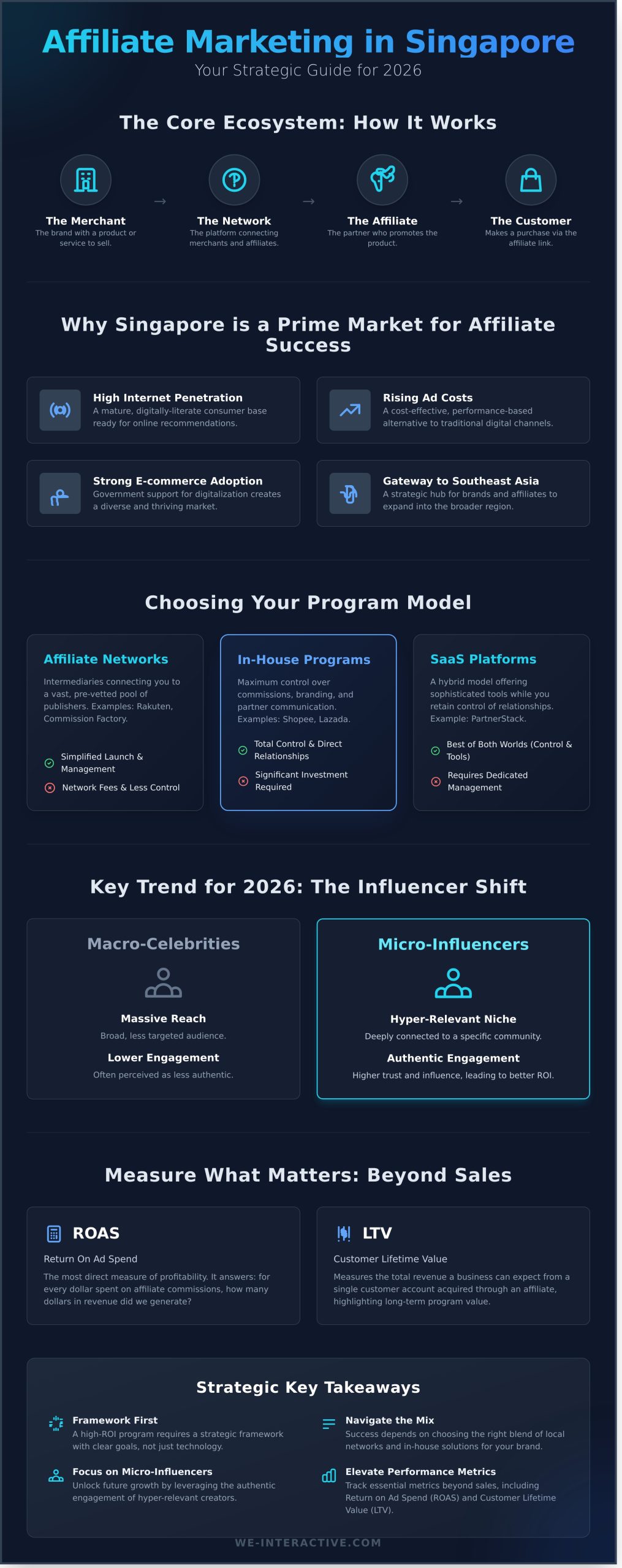
- A high-ROI program for affiliate marketing singapore requires a strategic framework built on clear goals and KPIs-not just technology.
- Success in affiliate marketing singapore depends on navigating the right mix of local networks and in-house solutions for your brand.
- Unlock future growth by shifting focus from macro-celebrities to the authentic engagement of hyper-relevant micro-influencers.
- Elevate your performance measurement by tracking essential metrics beyond sales, including Return on Ad Spend (ROAS) and Customer Lifetime Value (LTV).
What is Affiliate Marketing and Why is it Booming in Singapore?
At its core, affiliate marketing is a performance-driven strategy where a business rewards one or more affiliates for each visitor or customer brought by the affiliate’s own marketing efforts. It’s not about paying for clicks or impressions; it’s about paying for tangible results. This model transforms marketing from a cost centre into a powerful, ROI-focused revenue driver. For those new to the concept, understanding what affiliate marketing is involves recognising it as a strategic partnership built on mutual growth and measurable success.
The Core Components of Affiliate Marketing Explained
This dynamic ecosystem operates through the collaboration of four key players, each with a distinct role:
- The Merchant (Advertiser): The brand or business that creates and sells the product or service. This could be an e-commerce giant like Lazada or a local SME aiming to amplify its reach.
- The Affiliate (Publisher): The strategic partner who promotes the merchant’s product. Affiliates can be content creators, bloggers, influencers, or established review sites who leverage their audience to drive traffic and sales.
- The Network (Platform): The intermediary technology that connects merchants with affiliates. Networks like Involve Asia or Rakuten Advertising handle tracking, reporting, and payments, ensuring transparency and efficiency for both parties.
- The Customer: The end-user who discovers the product through the affiliate’s content and makes a purchase via a unique affiliate link, completing the conversion cycle.
Why Singapore is a Prime Market for Affiliate Success
The landscape of affiliate marketing in Singapore is not just growing; it’s thriving. This boom is fueled by a confluence of powerful market forces. Singapore’s exceptionally high internet penetration and mature, digitally literate consumer base create a fertile ground for online recommendations to flourish. As customer acquisition costs on traditional digital channels like Google and Meta continue to rise, savvy businesses are turning to affiliate marketing as a more cost-effective, performance-based solution to unlock sustainable growth.
Furthermore, strong government support for digitalisation has accelerated e-commerce adoption, creating a diverse market with countless niches for affiliates to target. From finance and tech to beauty and travel, the opportunities are vast. This makes Singapore not only a lucrative domestic market but also a strategic gateway for brands and affiliates looking to expand their footprint into the broader Southeast Asian region.
The Singaporean Affiliate Ecosystem: Key Platforms & Partners
To unlock sustainable growth through affiliate marketing in Singapore, you must navigate its dynamic ecosystem with precision. Success isn’t just about launching a program; it’s about choosing the right operational model and forging strategic partnerships that amplify your brand’s story. From powerful networks to independent creators, understanding the key players is your first step toward elevating your digital presence.
Major Affiliate Networks vs. In-House Programs
Choosing how to manage your affiliate program is a foundational decision. Your choice shapes your control, reach, and resource allocation. Most brands in Singapore select one of three primary models:
- Affiliate Networks: Platforms like Commission Factory (Awin) and Rakuten Advertising act as intermediaries, connecting you to a vast, pre-vetted pool of publishers. They handle tracking, payments, and reporting, which simplifies launch. However, this convenience comes with network fees and less direct control over affiliate relationships.
- In-House Programs: E-commerce giants like Shopee and Lazada run highly successful in-house programs. This model offers maximum control over commission structures, branding, and partner communication. The trade-off is the significant investment required for tracking technology, recruitment, and dedicated program management.
- SaaS Platforms: A hybrid solution, platforms like PartnerStack empower brands to run their own programs with the sophisticated tools of a network but without relinquishing control. This is an excellent middle ground for scaling businesses that want to own their partner relationships directly.
Types of Affiliates to Recruit in Singapore
The right partners are those who authentically connect with your target audience. In Singapore’s diverse media landscape, these affiliates are a vital component of the growing Singapore’s digital advertising market, offering brands credible access to engaged communities.
- Content Creators: This includes authoritative bloggers, niche site owners (e.g., in finance, travel, or parenting), and YouTubers who produce high-value content that educates and influences their followers.
- Social Media Influencers: Personalities on Instagram and TikTok can drive significant awareness and conversions through authentic recommendations, tutorials, and lifestyle integrations.
- Coupon and Deal Sites: In a value-conscious market, platforms that aggregate discounts and offers are powerful tools for converting price-sensitive shoppers and driving sales volume.
- Review Sites & Comparison Engines: For products with a longer consideration cycle, these affiliates guide consumer decisions by providing detailed analysis, comparisons, and trusted reviews.
Ultimately, selecting your partners is about more than just traffic and clicks; it’s about brand alignment. The most successful affiliate marketing strategies are built on partnerships that reflect your company’s values and foster mutual growth, turning transactions into true brand advocacy.
How to Build a High-ROI Affiliate Program: A Strategic Framework
Launching a successful affiliate program is more than deploying technology; it’s about architecting a growth engine powered by strategic partnerships. To unlock the full potential of affiliate marketing in Singapore, a structured approach is non-negotiable. It requires a clear vision, compelling incentives, and the right partners to amplify your brand’s story. This framework moves beyond simple link-sharing to build a sustainable, high-return channel for your business.
Step 1: Define Your Goals and Commission Structure
Your strategy begins with a clear definition of success. Are you aiming to elevate brand awareness, generate qualified leads, or drive direct sales? Your primary objective will shape your entire program. Defining these goals is a core tenet of effective affiliate marketing strategies and dictates your commission model. Common structures in Singapore include:
- Percentage of Sale (Cost-Per-Sale): The most common model, offering affiliates a percentage (e.g., 8-15%) of each sale they generate.
- Flat Fee Per Lead (Cost-Per-Lead): Ideal for service-based businesses, offering a fixed payout (e.g., S$10) for every valid form submission or sign-up.
- Tiered Rewards: A powerful motivator that increases commission rates as partners reach higher performance milestones.
Research competitor programs in the local market to ensure your offer is not just competitive but compelling.
Step 2: Recruit and Onboard the Right Partners
The success of your program hinges on the quality of your affiliates. Look for partners whose audience demographics and values align perfectly with your brand. You can discover them through affiliate networks or by manually reaching out to influential bloggers, content creators, and niche-specific websites in Singapore. When vetting potential partners, evaluate their audience relevance, engagement rates, and overall content quality. A smooth onboarding process with clear terms, a welcome kit, and easy access to resources will empower them to start promoting effectively from day one.
Step 3: Track, Analyze, and Optimize Performance
A data-driven approach is essential for maximizing ROI. Utilize your affiliate network’s dashboard or dedicated tracking software to monitor key metrics like clicks, conversion rates, and revenue per affiliate. This insight allows you to identify your top-performing partners and understand the tactics that resonate most with their audiences. From clicks to conversions, this continuous cycle of analysis and optimization is where a dedicated performance marketing agency can amplify your results, managing the entire process to ensure sustainable growth.
Top Affiliate Marketing Trends in Singapore for 2026
To elevate your strategy, you must look beyond today’s tactics. The digital landscape is in constant motion, and the future of affiliate marketing in Singapore is being shaped by powerful shifts in consumer behaviour and technology. Staying ahead of these trends is not just an advantage; it’s essential for unlocking sustainable growth and maximizing your ROI.
From clicks to conversions, the affiliate journey is becoming more sophisticated. Here are the pivotal trends your brand must embrace to thrive.
The Rise of Social Commerce and Influencer Affiliates
The line between social media and e-commerce is dissolving. Platforms like TikTok Shop and Instagram Shopping are empowering creators to become powerful sales channels. The key shift is from macro-influencers with broad appeal to hyper-relevant micro- and nano-influencers. These creators command deep trust within their niche communities, making their recommendations feel authentic, not advertised. This convergence of content and commerce underscores the value of a holistic social media marketing strategy that integrates affiliate partnerships directly into the consumer’s discovery journey.
Content is King: The Power of Niche Blogs and SEO
While video content commands attention, high-value, evergreen content remains a cornerstone of successful affiliate marketing singapore. Top-performing affiliates are often content creators who dominate search engine results for niche topics, from financial product comparisons to local travel guides. Their high-ranking articles capture an audience with strong purchase intent, delivering consistent, qualified traffic. For brands, partnering with these SEO-savvy affiliates is a powerful way to amplify organic visibility. This synergy highlights how expert SEO services can empower both your brand and your affiliate partners to achieve shared growth.
Data-Driven Decisions and Personalization
The era of “last-click wins” is giving way to more intelligent frameworks like multi-touch attribution. This model provides a complete view of the customer journey, fairly rewarding all affiliate touchpoints that contributed to a conversion. Forward-thinking brands are leveraging data to:
- Identify partners who drive high-lifetime-value customers, not just one-off sales.
- Personalize offers and landing pages for different affiliate segments to optimize conversion rates.
- Focus on the quality and intent of traffic, moving beyond purely quantitative metrics.
Ultimately, the future is about using insight to build more effective and profitable affiliate relationships.
Measuring Success and Avoiding Common Pitfalls
Launching your affiliate program is the first step; optimizing it for sustainable growth is where true success is forged. A data-driven approach is non-negotiable. It allows you to move beyond assumptions and make strategic decisions that elevate performance. This isn’t just about tracking sales-it’s about understanding the entire value chain, from the first click to long-term customer loyalty.
Key Metrics That Truly Matter
To unlock the full potential of your program, you must look beyond top-line revenue. These core metrics provide the insight needed to refine your strategy and empower your partners:
- Click-Through Rate (CTR): This measures how compelling your brand and offers are to an affiliate’s audience. A low CTR may signal a mismatch between your creative assets and their followers.
- Conversion Rate (CR): The ultimate measure of traffic quality. A high CTR with a low CR indicates that while the offer is attractive, the landing page or user experience may need optimization.
- Return on Ad Spend (ROAS): This calculates your profitability. For every S$1 you pay in commissions, how much revenue do you generate? This simple metric is critical for scaling your investment confidently.
- New vs. Returning Customers: Are your affiliates acquiring genuinely new customers or simply converting existing ones? This data is vital for understanding the incremental value of your program.
Common Mistakes to Avoid
Navigating the landscape of affiliate marketing in Singapore requires avoiding common pitfalls that can hinder growth. By proactively addressing these challenges, you can build a resilient and high-performing program.
- Setting Unattractive Commissions: In a competitive market, commissions that don’t motivate top-tier affiliates will leave your program struggling to gain traction.
- Poor Communication & Support: Affiliates are your partners. Failing to provide them with clear guidelines, marketing assets, and responsive support is a recipe for disengagement.
- Ignoring Mobile Traffic: Singapore is a mobile-first nation. Ensure your entire customer journey, from affiliate link to checkout, is flawlessly optimized for mobile devices.
- Failing to Monitor Compliance: Protect your brand by actively monitoring for affiliate fraud, such as cookie stuffing, and ensuring partners adhere to your brand guidelines.
Ultimately, affiliate marketing is not a set-it-and-forget-it channel; it is a dynamic partnership that thrives on collaboration, transparency, and continuous optimization. Success lies in mastering both the science of data and the art of relationship management. By growing together with your partners, you can transform this channel into a powerful engine for sustainable growth. If you’re ready to build a strategic program, WE can help you shape its success.
Unlock Your Growth: Mastering Affiliate Marketing in Singapore
As we look towards 2026, it’s clear that affiliate marketing is no longer a peripheral channel but a central pillar of digital growth in the Lion City. The key to success lies not just in understanding the local ecosystem, but in deploying a sophisticated, data-driven strategy that anticipates future trends. By focusing on high-value partnerships and measurable ROI, your brand can harness the full potential of affiliate marketing singapore to achieve remarkable results.
Turning this potential into performance requires a strategic partner. Since 2009, WE Interactive has been empowering brands across Asia with proven expertise in performance marketing. We build data-driven strategies that maximize ROI, transforming clicks into conversions and impressions into sustainable growth. We are not just an agency; we are your strategic partner for growth.
Ready to elevate your brand with a results-driven affiliate strategy? Let’s talk. The future of your brand’s success story is waiting to be written. Let’s shape it together.
Frequently Asked Questions About Affiliate Marketing in Singapore
How much does it cost to start an affiliate marketing program in Singapore?
The initial investment to launch an affiliate program in Singapore varies based on your approach. Joining an established affiliate network may involve a one-time setup fee from S$500 to S$2,000, plus ongoing commissions. Alternatively, self-hosting with affiliate software can range from S$100 to S$500 per month. These costs are the foundation for building a scalable, performance-based revenue channel that delivers measurable ROI and empowers your brand to grow strategically.
What is the difference between affiliate marketing and influencer marketing?
While both leverage third-party voices, their core objectives differ. Affiliate marketing is a performance-based model where partners earn commissions for driving specific actions, like sales or leads, through a trackable link. It’s about converting intent into results. Influencer marketing often focuses on brand awareness and engagement, typically involving a flat fee for content creation and exposure. Essentially, one is a direct sales driver, while the other amplifies your brand’s story.
Can B2B or service-based businesses use affiliate marketing?
Absolutely. Affiliate marketing is a highly adaptable strategy that B2B and service-based businesses can leverage to unlock significant growth. Instead of commissioning product sales, you can reward affiliates for generating qualified leads, booking demonstrations, or securing new client contracts. For example, a Singapore-based SaaS firm could offer a S$150 commission for every successful subscription referral. This performance-based approach ensures you only pay for tangible, high-value results, optimizing your marketing spend.
How do I pay affiliates in Singapore?
Paying affiliates in Singapore is streamlined and efficient. Most businesses use direct bank transfers via FAST or PayNow for local partners, while PayPal is a common choice for international affiliates. If you partner with an affiliate network, they manage the entire payment process, from tracking commissions to disbursement, simplifying your administrative workload. Establishing clear payment terms, such as a net-30 schedule, is crucial for building trust and fostering strong, collaborative partnerships.
How long does it take to see results from an affiliate program?
While initial sales can appear within the first month, building sustainable momentum typically takes three to six months. This period is vital for recruiting quality affiliates, allowing them to create and promote content, and optimizing your program for conversions. Affiliate marketing is a long-term strategy, not an overnight solution. The goal is to cultivate a powerful network that delivers consistent, scalable, and significant growth over time, elevating your brand’s digital presence.
What are the most profitable niches for affiliate marketing in Singapore?
The landscape for affiliate marketing in Singapore is dynamic, with several high-growth niches. Finance, including credit cards and investment platforms, consistently performs well due to high commission payouts. E-commerce remains a powerhouse, particularly in electronics, fashion, and beauty through major platforms like Lazada and Shopee. Additionally, the travel, health and wellness, and digital education sectors offer significant opportunities for affiliates to connect with engaged audiences and drive substantial revenue through strategic partnerships.