

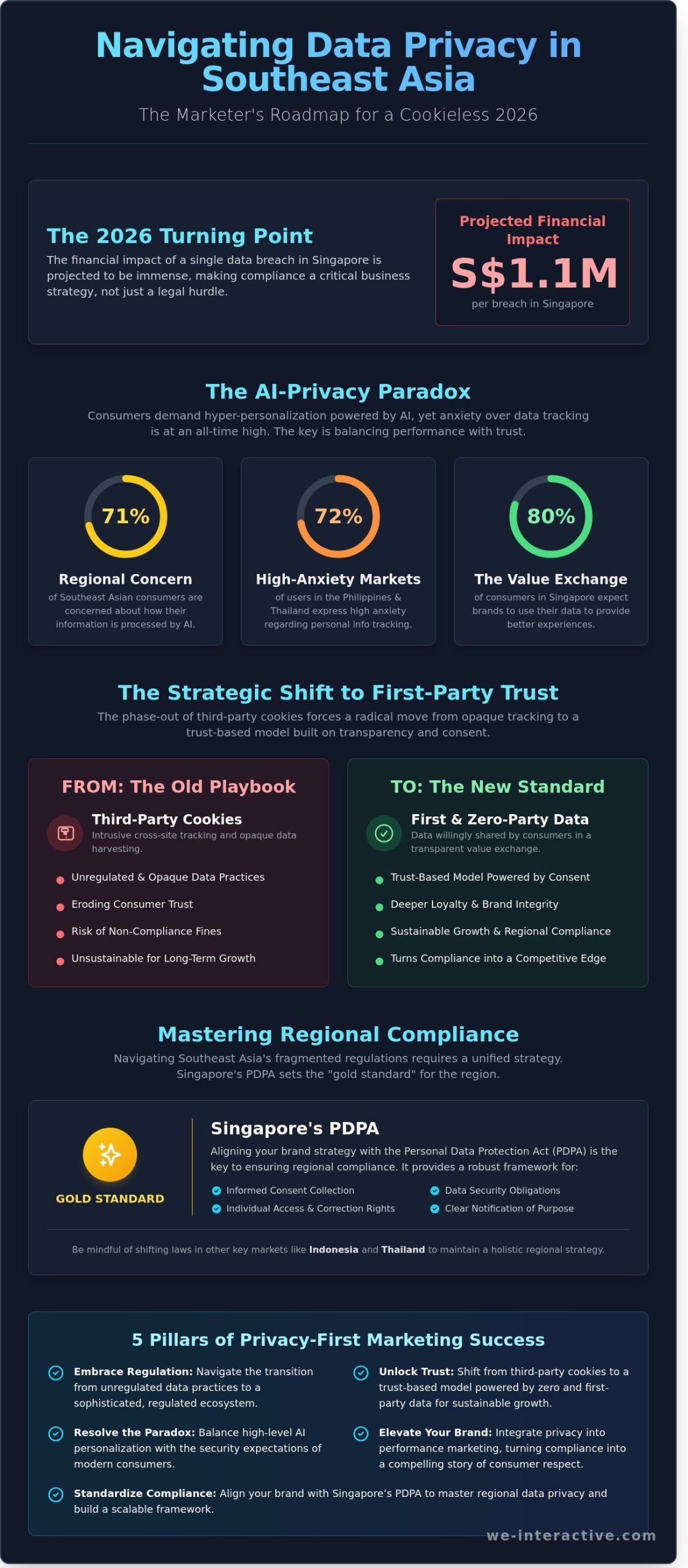
By 2026, the financial impact of a data breach in Singapore can reach a staggering S$1.1 million, yet many organizations still view compliance as a hurdle rather than a competitive edge. If you’re feeling the weight of evolving digital standards, you’re in good company. Mastering data privacy in marketing southeast asia is now the essential foundation for any brand looking to scale with confidence. As third-party cookies crumble, the old playbook for reaching audiences is no longer effective. You’re likely struggling with the fear of non-compliance fines or the confusion of balancing Singapore’s PDPA with shifting laws in Indonesia and Thailand.
We agree that navigating these fragmented regulations feels overwhelming and risky for your ROI. However, this shift is your chance to unlock deeper loyalty by putting consumer trust at the heart of your brand story. This strategic guide promises to help you master the balance between data-driven growth and regional privacy regulations to build lasting consumer trust. We’ll provide a clear roadmap for first-party data collection and the insights needed to maintain high performance in a cookieless world.
Key Takeaways
- Navigate the transition from unregulated data practices to a sophisticated, regulated ecosystem that defines the 2026 digital landscape.
- Resolve the AI-privacy paradox by balancing high-level personalization with the security expectations of consumers in markets like Thailand and the Philippines.
- Align your brand strategy with the gold standard of Singapore’s PDPA to master data privacy in marketing southeast asia and ensure regional compliance.
- Unlock sustainable growth by shifting from third-party cookies to a trust-based model powered by zero-party and first-party data.
- Elevate your brand by integrating privacy into the science of performance marketing, turning compliance into a compelling story of consumer respect.
The Evolution of Data Privacy in Southeast Asia’s Marketing Landscape
The digital frontier in Southeast Asia has matured. We’ve moved past the era of unrestricted data harvesting into a sophisticated, regulated ecosystem where trust is the primary currency. In 2026, data privacy in marketing southeast asia represents more than a legal hurdle. It’s a strategic pillar that distinguishes market leaders from those left behind. Marketers are moving away from the “wild west” of opaque tracking. They’re embracing frameworks like Singapore’s Personal Data Protection Act (PDPA), which sets the gold standard for regional compliance.
Consumer anxiety reached a peak in late 2025. While AI tools offer incredible personalization, 71% of regional consumers express concern over how their information is processed. The cost of ignoring these fears is steep. In Singapore, financial penalties for data breaches can reach S$1 million or 10% of an organization’s annual turnover. Beyond the ledger, the damage to brand reputation is often permanent. We believe in turning these challenges into opportunities to elevate your brand through transparency.
- Regulatory Maturity: Transitioning from voluntary guidelines to strict enforcement.
- AI Ethics: Balancing algorithmic power with individual rights.
- Brand Integrity: Recognizing that a single breach can erase decades of brand equity.
Why 2026 is a Turning Point for SEA Marketers
The total phase-out of third-party cookies has forced a radical shift toward first-party data strategies. This transition requires a blend of technical precision and creative empathy. AI-driven marketing now demands strict ethical guardrails to ensure algorithms don’t cross the line from helpful to intrusive. Privacy-First Marketing is the standard for 2026, defining how we balance the science of automation with the art of human connection.
The Consumer Value Exchange
Consumers across Singapore and the broader region no longer accept “free” content as a fair trade for their personal details. They’re skeptical. They demand to know exactly how their data fuels their experience. We’ve shifted from passive collection to active, informed consent. This is where our “Growing Together” philosophy becomes essential. By using transparent data practices, we help brands build CRM and customer marketing strategies that empower the user. We focus on creating a narrative where data usage is a mutual benefit, ensuring your audience feels valued rather than targeted. It’s about shaping digital success with insight and innovation while respecting the boundaries of every individual.
Navigating the AI-Privacy Paradox: What Consumers Expect
Modern consumers in the region present a complex challenge for brands. They demand instant, tailored experiences, yet 72% of users in the Philippines and Thailand express high anxiety regarding how their personal info is tracked. This tension defines the current state of data privacy in marketing southeast asia. To succeed in 2026, marketers must recognize that privacy isn’t a barrier to AI, it’s the foundation for it. AI allows brands to process data through anonymized cohorts rather than individual surveillance. This shift moves the needle from “tracking” to “predicting,” allowing for sophisticated engagement that respects boundaries.
Transparency serves as the essential bridge between performance and privacy. When a brand is clear about its data intent, it removes the “black box” fear that often leads to opt-outs. In high-growth markets, consumers are willing to trade data for value, provided they understand the terms of the exchange. WE Interactive believes in balancing the art of creative storytelling with the science of secure data management to unlock this potential.
The Personalization-Privacy Matrix
Delivering hyper-relevant content requires a delicate balance. In Singapore, 80% of consumers expect brands to use their data to provide better experiences, but they draw the line at intrusive cross-site tracking. You can achieve this by using zero-party data, where users voluntarily share preferences for better rewards. Following guidelines from Singapore’s Personal Data Protection Commission helps brands stay compliant while building these high-value datasets. For social media campaigns in Indonesia, brands should clearly state why they need specific permissions. Transparency at the point of collection reduces bounce rates by 30% compared to hidden tracking methods used in 2023.
Building Trust Through Ethical Data Use
Ethical data storytelling represents the intersection of art and science. It’s about moving away from “creepy” retargeting that follows a user for weeks after a single click. Instead, use automated customer journeys to be “helpful.” For instance, a travel brand might send a weather-based packing list instead of just a generic “buy now” reminder. When you align data usage with genuine user utility, you transform a cold transaction into a lasting relationship. Trust serves as the primary driver for long-term ROI because loyal customers in Singapore often spend 2.5 times more than one-time buyers. Optimizing your strategy for this new era requires a partner who understands the nuances of CRM and customer marketing in a privacy-first world.
A Comparative Look at SEA Privacy Regulations: PDPA and Beyond
Singapore’s Personal Data Protection Act (PDPA) remains the definitive anchor for data privacy in marketing southeast asia. Since the 2020 amendments, the Personal Data Protection Commission (PDPC) has increased financial penalties to up to S$1 million or 10% of an organization’s annual turnover in Singapore. This shift forces brands to move beyond basic compliance toward a proactive, strategic posture. WE believe that treating privacy as a competitive advantage, rather than a legal hurdle, is what separates market leaders from their peers.
Indonesia’s Personal Data Protection (PDP) Law, or Law No. 27 of 2022, enters its full enforcement phase in late 2024 and through 2026. It mirrors the GDPR in many ways; however, it introduces unique administrative fines of up to 2% of annual revenue for violations. For marketers, this means Indonesian campaigns now require rigorous data processing logs and explicit consent mechanisms that are often more stringent than those used in neighboring markets. WE help our partners bridge these gaps by aligning creative ambition with local legal precision.
Thailand’s PDPA, enforced since June 1, 2022, has provided valuable lessons regarding “consent fatigue.” Brands found that overly complex pop-ups led to a 30% drop in user engagement during the first year. Success in Thailand now relies on “lean data” strategies; collecting only what’s vital for the immediate experience. Meanwhile, Malaysia is modernizing its framework. The 2024 amendments to the PDPA 2010 introduced mandatory data breach notifications and the official appointment of Data Protection Officers (DPOs), bringing it closer to the regional gold standard.
Compliance Checklist for Regional Brands
While each nation has its own nuances, three pillars remain constant: Consent, Purpose, and Limitation. You must ensure that data is only used for the specific reason it was collected. Indonesia differs from Singapore by requiring more localized data storage and specific “processing impact assessments” for high-risk activities. WE ensure that your website development integrates these compliance requirements by design, building secure foundations before the first visitor arrives.
- Explicit Consent: Avoid pre-ticked boxes; they’re invalid in almost every SEA jurisdiction.
- Right to Erasure: Ensure your CRM can fully purge a user’s data within the statutory 30-day window.
- Purpose Specification: Clearly state if data is for “newsletter updates” versus “targeted performance advertising.”
Managing Cross-Border Data Flows
Running a regional campaign across four jurisdictions creates a complex web of transfer rules. Singapore allows data transfers if the recipient country provides a comparable level of protection, whereas Indonesia requires specific contractual clauses to be in place. Centralizing data management through a unified regional hub is the only way to maintain control. It allows for a single source of truth while applying localized filters to stay compliant with specific national laws.
Building trust in this environment requires absolute transparency in digital advertising across every touchpoint. WE advocate for localized DPO insights to navigate these waters. A DPO based in Jakarta understands the cultural nuances of “privacy” differently than one in Singapore. By combining these local perspectives with a centralized strategy, WE help you amplify your brand’s reach without compromising your customers’ trust or your legal standing.
Strategic Shifts for Marketers: From Third-Party Cookies to First-Party Trust
The digital landscape is undergoing a fundamental transformation. As Google continues to refine its Privacy Sandbox and Apple’s App Tracking Transparency (ATT) remains a standard, the old methods of “tracking” are being replaced by “asking.” Success in data privacy in marketing southeast asia now depends on how effectively brands can pivot from intrusive surveillance to permission-based engagement. WE believe that this shift is the ultimate catalyst for building a more resilient, high-performance marketing ecosystem.
Marketers must prioritize the collection of zero-party data, which is information customers intentionally and proactively share with a brand. This data is gold because it eliminates guesswork. By integrating a robust CRM and customer marketing strategy, businesses can unify these insights into a single, compliant view of the customer. This enables personalized experiences that respect boundaries while driving significant ROI.
Implementing Zero-Party Data Strategies
Winning trust starts with a fair exchange of value. Brands are now using interactive tools like quizzes, preference centers, and polls to understand their audience’s needs directly. For example, a Singaporean skincare brand might offer a S$10 discount in exchange for a completed “Skin Type Quiz.” This provides the brand with immediate, actionable data while giving the consumer a tangible benefit. Effective social media marketing plays a vital role here, acting as the primary channel to drive users toward these organic data collection touchpoints through engaging, community-focused content.
The Power of First-Party Data in Performance
First-party data has become the most valuable asset for any performance marketing campaign. Unlike third-party data, which is often diluted and shared among competitors, first-party data is unique to your brand. It allows for precise retargeting and lookalike modeling that actually converts. WE leverage comprehensive SEO services to capture top-of-funnel intent data. When a user searches for specific solutions and lands on your site, their behavior provides a roadmap for their future needs. First-party data assets remain sustainable and compliant long after third-party tracking methods have been rendered obsolete by browser updates.
The role of SEO has expanded beyond mere rankings; it’s now a privacy-first lead generation engine. By attracting users through high-intent keywords, you gather data from people who are already looking for you. This reduces the need for aggressive tracking and aligns perfectly with the evolving standards of data privacy in marketing southeast asia. WE help you turn these initial clicks into long-term conversations through strategic nurturing and transparent data practices.
Ready to transform your data strategy into a competitive advantage? Unlock your data potential with WE Interactive.
Elevating Your Brand with Privacy-First Performance Marketing
Privacy isn’t a barrier to growth. It’s the foundation of it. At WE Interactive, we don’t see compliance as a legal checklist. We see it as a strategic opportunity to build a brand that people actually trust. By 2026, data privacy in marketing southeast asia will be the primary differentiator between market leaders and those left behind. We help you stay on the winning side by transforming data protection into a competitive advantage.
We believe in the Science of Marketing. This means every click, every lead, and every conversion is backed by ethical data practices. When you prioritize the user’s right to choose, you don’t just avoid penalties from the PDPC; you foster a sense of security that encourages deeper engagement. We turn these technical requirements into a creative brand story, showing your audience that you value their privacy as much as they do.
The WE Interactive Approach to Data
We connect strategy, creativity, and performance through a lens of ethical data. Our team has successfully delivered over 700 campaigns across SEA since 2009. We’ve seen the digital landscape evolve and we know how to adapt. We don’t just collect data; we curate it. This ensures your marketing spend is optimized for high-intent audiences who have actively opted into your brand experience. If you’re looking for a partner to guide this journey, see our strategic guide to digital marketing agencies in Singapore.
Building Lifelong Customers through CRM
Retention is the new acquisition. High-growth brands in Singapore know that keeping a customer is more cost-effective than finding a new one. Effective CRM and customer marketing ensures you maintain long-term retention by delivering personalized value without overstepping. We leverage HubSpot to manage regional data compliance across multiple jurisdictions. This automation keeps your lifecycle marketing compliant and your data organized.
Using a centralized CRM allows us to track consent across every touchpoint. This transparency builds confidence. When a customer knows how their data is used, they’re 40 percent more likely to share preferences that lead to better personalization. For a deeper dive into scaling your reach through data-backed strategies, read our pillar guide on performance marketing in Singapore.
Ready to take the next step in your regional growth strategy? WE Interactive is here to help you unlock the full potential of your digital presence. Let’s work together to create work that speaks louder than words. We’ll help you navigate the complexities of data privacy in marketing southeast asia while driving measurable ROI. Contact us today to start growing together.
Future-Proof Your Brand for 2026 and Beyond
The marketing landscape in Singapore and across the region is undergoing a permanent shift. Success no longer depends on invasive tracking; it thrives on first-party trust and strategic transparency. By 2026, the brands that win will be those that successfully navigate the PDPA and evolving regional regulations while leveraging AI responsibly. We’ve seen that moving from third-party reliance to owned data ecosystems isn’t just a compliance hurdle. It’s a massive opportunity to build deeper, more authentic connections with your audience.
Mastering data privacy in marketing southeast asia requires a blend of technical precision and creative insight. Since 2009, WE Interactive has pushed boundaries as a strategic partner for iconic brands like Singapore Airlines and Starbucks. With over 15 years of regional expertise, we help you turn complex data laws into a competitive advantage. We bridge the gap between performance marketing and consumer protection, ensuring your growth remains both significant and sustainable.
Ready to unlock your brand’s full potential? Empower your brand with a privacy-first marketing strategy; contact WE Interactive today.
Let’s grow together and turn these digital shifts into your greatest success story.
Frequently Asked Questions
What is the most important data privacy law in Southeast Asia?
Singapore’s Personal Data Protection Act (PDPA) is the most influential framework in the region, particularly since the 2020 amendments introduced mandatory breach notifications. Indonesia’s Law No. 27 of 2022 (PDP Law) is also a critical pillar as it protects the data of 278 million people. These regulations are central to managing data privacy in marketing southeast asia by setting strict standards for how brands collect and process consumer information.
How does Singapore’s PDPA affect digital marketing campaigns?
The PDPA requires brands to obtain clear, opt-in consent before sending any marketing messages to consumers in Singapore. You’ve got to check the Do Not Call (DNC) Registry regularly, as sending unsolicited messages can lead to fines of up to S$1 million or 10% of your annual turnover. It forces a shift from mass broadcasting to precision-targeted experiences that rely on verified permission and transparent data usage.
Can I still use AI for marketing under Indonesia’s PDP law?
You can use AI for marketing in Indonesia if you follow the transparency requirements outlined in the 2022 PDP Law. Article 35 mandates that data controllers ensure security and accountability when using automated processing systems. Brands should conduct a Data Protection Impact Assessment (DPIA) when using AI for high-risk profiling. This ensures your innovation remains ethical while you use data-driven insights to empower your brand’s growth.
What is the difference between First-Party and Zero-Party data?
Zero-party data is information that a customer intentionally and proactively shares with you, such as their product preferences or communication interests. First-party data is gathered through observing a user’s behavior on your own platforms, including purchase history and website interactions. Both are vital for navigating data privacy in marketing southeast asia because they allow you to build direct relationships without relying on intrusive third-party tracking.
How do I run a regional campaign if every country has different privacy laws?
Adopt a highest common denominator strategy by aligning your regional operations with Singapore’s PDPA or Thailand’s PDPA (2022) standards. This unified approach simplifies governance across diverse markets like Malaysia and Vietnam. By building a single, robust compliance framework, you’re able to scale campaigns rapidly. It turns legal complexity into a streamlined process that allows us to grow together across borders.
Will privacy-first marketing decrease my conversion rates?
Privacy-first marketing often increases the quality of your conversions even if total lead volume initially dips. A 2023 Cisco study found that 94% of organizations believe customers won’t buy from them if their data isn’t properly protected. When people trust your brand, they engage more deeply with your content. This shifts the focus from simple impressions to meaningful conversations that deliver significant, sustainable growth.
What happens if a brand fails to comply with SEA data regulations?
Failure to comply results in heavy financial penalties and a total loss of consumer trust. In Singapore, the PDPC can issue fines of up to S$1 million or 10% of your company’s annual turnover in the country. Beyond the money, 80% of consumers will stop engaging with a brand after a data breach. Compliance isn’t just a legal necessity; it’s a strategic move to protect your brand’s story.
How can a marketing agency help with data privacy compliance?
A strategic partner like WE Interactive audits your marketing technology stack to ensure every tool meets regional standards. We help you transition from third-party cookies to sophisticated zero-party data strategies that respect user boundaries. By balancing the art of social media with the science of marketing automation, we unlock new opportunities for ROI while keeping your data-driven strategies secure and compliant.