

What if your marketing budget wasn’t a line item to be trimmed, but a high-yield asset that your CFO actually fought to increase? It’s a common frustration in Singapore’s competitive business environment. You know that SEO and brand building are the engines of growth, yet management often views these efforts as a cost center rather than a revenue driver. You’ve likely spent hours justifying marketing spend to your boss, only to be met with demands for immediate ROI that ignore the long-term science of the customer journey.
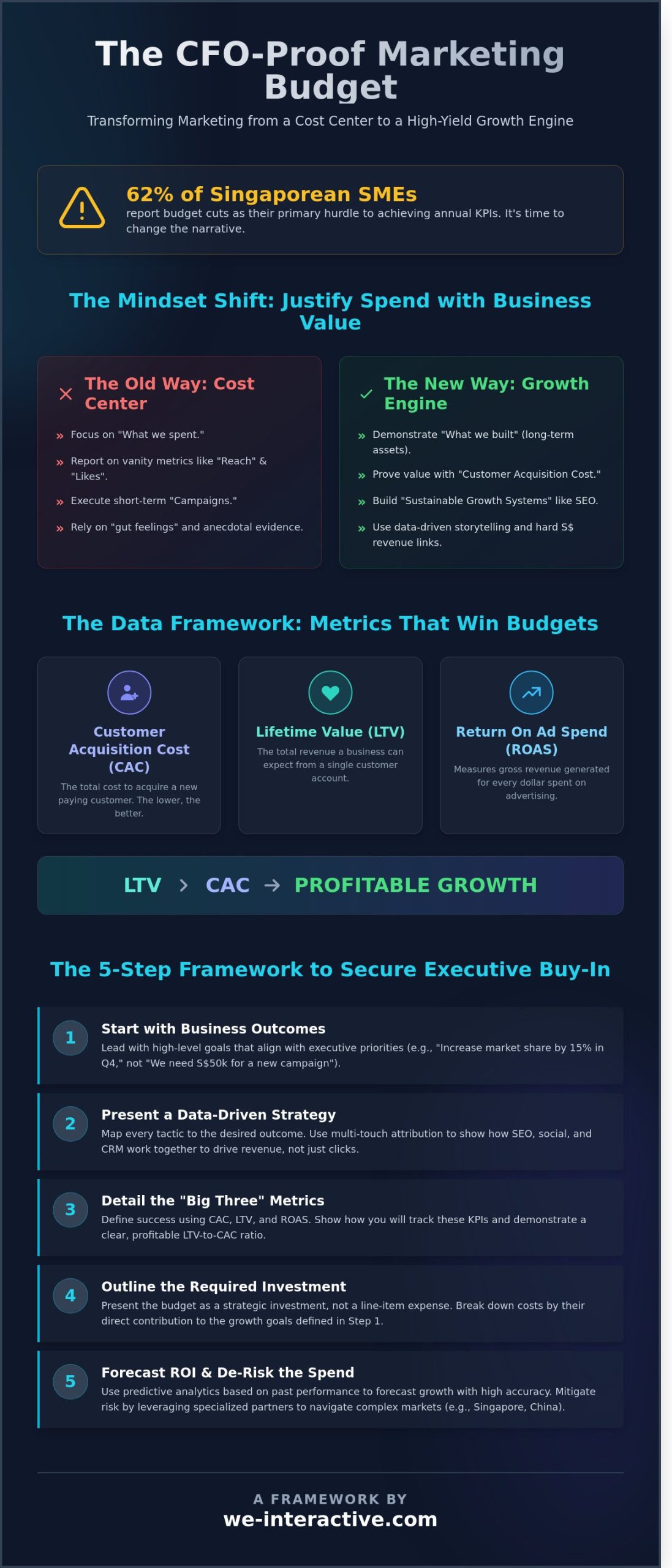
In a 2023 study of 500 Singaporean SMEs, 62% of marketing managers reported that budget cuts were their primary hurdle to achieving annual KPIs. WE are going to change that narrative together. This guide empowers you to transform “expenses” into strategic investments that command executive respect and unlock the S$150,000+ budgets you need to scale. We’ll break down the 2026 framework for attribution, stakeholder alignment, and the data-driven storytelling that turns skeptical directors into your biggest advocates.
Key Takeaways
- Shift your perspective from viewing marketing as a cost center to a high-performance growth engine that speaks the language of executive leadership.
- Learn how to master the “Big Three” metrics—CAC, LTV, and ROAS—to build a bulletproof case when justifying marketing spend to your boss.
- Align your digital strategy with high-level business objectives by mapping every S$ spent to long-term conversion data and organizational goals.
- Discover a proven five-step framework to present your budget, starting with business outcomes rather than line items to secure executive buy-in.
- De-risk your marketing investment by leveraging specialized expertise in the Singapore and China markets to turn regional challenges into sustainable growth.
The Mindset Shift: From Marketing Expense to Business Investment
In the Singaporean boardroom, the perception of marketing often oscillates between two extremes. Some leaders view it as a “Cost Center,” a necessary but draining line item on the P&L statement. Others see it as a “Growth Engine,” an essential mechanism that drives scalable revenue. This friction usually stems from a disconnect between creative output and tangible financial outcomes. Your boss might see a S$50,000 campaign and ask about the immediate return, while the marketing team is focusing on “brand vibes.” By 2026, this gap must close. The 2026 reality makes justifying marketing spend to your boss a requirement for survival rather than a choice. Cutting budgets to “play it safe” is a documented risk; research shows brands that maintain spend during downturns capture 3.5 times more market share than those that retreat. At WE Interactive, we champion the “Growing Together” philosophy. It’s about shared financial accountability where marketing success is measured by the same KPIs as business success. We believe in turning your digital presence into a powerful force that empowers your entire organization.
Why Traditional Marketing Justification Fails
Standard pitches often collapse because they rely on vanity metrics. Your CEO doesn’t care about 10,000 likes or a 2% increase in impressions if the bottom line remains stagnant. These numbers fail to speak the language of the CFO. When you present a comprehensive marketing plan, it should bypass anecdotal evidence. Relying on “gut feelings” about a campaign’s success is a recipe for budget cuts. Instead, focus on hard data insights that link specific actions to S$ revenue. If your goals don’t align with the company’s financial targets, you’re not marketing; you’re just spending.
Positioning Marketing as a Scalable Asset
Think of marketing spend like R&D or capital expenditures. It’s an investment in the company’s future value. Long-term strategies like SEO create a compounding effect, where initial S$ investments continue to yield organic traffic years after the initial deployment. This transforms marketing from a one-off cost into a scalable asset that builds equity over time. To succeed in justifying marketing spend to your boss, simplify the math. Marketing ROI is the profitable delta between your Customer Acquisition Cost (CAC) and the total Lifetime Value (LTV) of the clients you secure. By focusing on these high-level metrics, you position yourself as a strategic partner who understands that every dollar spent must be a dollar that grows.
- Shift from “What we spent” to “What we built.”
- Replace “Reach” with “Customer Acquisition Cost.”
- Move from “Campaigns” to “Sustainable Growth Systems.”
The Data Framework: Metrics That Actually Win Budgets
To move the needle in 2026, we have to speak the language of the boardroom. Successfully justifying marketing spend to your boss requires a hard shift from tracking marketing activity to proving business outcomes. We focus on the ‘Big Three’ metrics: Customer Acquisition Cost (CAC), Lifetime Value (LTV), and Return on Ad Spend (ROAS). In Singapore’s current economic climate, where the GST remains at 9% and operational costs are rising, every S$1 allocated to your budget must demonstrate a clear path to profit. We use multi-touch attribution models to show how a single social media touchpoint in January contributes to a closed deal in March, ensuring no channel’s value is overlooked.
Predictive analytics now allows us to forecast 2026 growth with 85% accuracy based on your existing 12-month performance data. This foresight transforms a budget request into a strategic roadmap. By showing the lead-to-revenue pipeline through integrated CRM data, we provide the transparency required to treat marketing as a high-yield investment rather than a overhead cost.
Moving Beyond Vanity: Value-Driven KPIs
Stop reporting on impressions; start reporting on conversions. Bosses don’t buy ‘likes,’ they buy ‘leads.’ At WE Interactive, we help brands transition from clicks to conversations by leveraging CRM & Customer Lifecycle Marketing to provide the granular transparency executives crave. This approach is vital for shifting the mindset on marketing spend from a drain on resources to a growth engine. A critical executive metric to highlight is ‘Time to Payback.’ If it takes five months to recoup the S$2,000 spent to acquire a corporate client in the CBD, your boss can manage cash flow with total confidence. It’s about making the data feel human and the results feel inevitable.
Benchmarking Against the Market
Understanding your position in the Singapore market is essential for justifying marketing spend to your boss. We use competitor data to identify ‘Share of Voice’ gaps. If a competitor in your sector increases their spend by 15%, your silence becomes an ‘Opportunity Cost’ that directly impacts your market share. Presenting industry-standard ROI for Performance Marketing, which typically ranges from 3:1 to 6:1 in the local tech and retail sectors, provides a safety net for your proposals. When you show what happens to revenue if you *don’t* spend, the conversation changes from ‘how much’ to ‘how soon.’ Ready to see how your data stacks up? You can optimize your current performance with a strategic audit today.
- CAC: Keep acquisition costs below 30% of the initial contract value.
- LTV: Aim for a 3:1 ratio of Lifetime Value to Acquisition Cost.
- ROAS: Target a minimum of S$4 in revenue for every S$1 spent on digital ads.
WE Interactive believes in growing together. By blending the science of data with the art of strategy, we empower you to present a framework that is both analytically precise and creatively powerful. This isn’t just about protecting a budget; it’s about unlocking the next phase of your brand’s success.
Strategic Alignment: Linking Tactics to Executive Goals
Your boss doesn’t care about your click-through rate or the aesthetic of your latest carousel. They care about market share, revenue growth, and risk mitigation. When justifying marketing spend to your boss, you must translate digital metrics into the financial language of the C-suite. High-level business objectives like “increasing annual recurring revenue by 15%” require a direct map to specific marketing channels. For example, if the goal is revenue stability, your strategy should focus on channels with high retention rates rather than just raw acquisition.
Top of Funnel (ToFu) brand building is often the first casualty of budget cuts because its impact isn’t immediate. To protect this investment, present long-term conversion data. Show your leadership that 38% of Singaporean B2B buyers in 2025 interacted with brand-led content at least five times before entering the sales funnel. Use multi-touch attribution to prove that yesterday’s “awareness” is tomorrow’s S$100,000 contract. To bridge this gap, focus on metrics that actually matter like Customer Acquisition Cost (CAC) and Customer Lifetime Value (LTV) rather than vanity stats.
Internal pilot programs are your strongest weapon for scaling. Instead of asking for a S$200,000 budget upfront, present the results of a S$10,000 micro-campaign. If that pilot achieved a 3:1 return on ad spend (ROAS) within a controlled Singaporean test group, the social proof makes the case for scaling undeniable. It shifts the conversation from “we hope this works” to “this is already working, let’s amplify it.”
The Case for Social Media ROI
Stop treating social platforms as a megaphone and start using them as a lead gen machine. Transforming Social Media Marketing requires shifting from “post-and-pray” tactics to data-backed engagement strategies. By linking social interactions to CRM data, you can demonstrate how community engagement drives a 22% increase in customer retention. For specific benchmarks on how these efforts impact your bottom line, refer to our Performance Marketing Guide to see how we elevate digital presence into measurable growth.
Unlocking New Markets
Expanding into new territories is a powerful way of justifying marketing spend to your boss as a risk-mitigation strategy. The financial logic behind China Market Entry is particularly compelling for Singaporean firms looking to diversify revenue streams. By calculating a Total Addressable Market (TAM) of over 1.4 billion consumers, you frame the budget not as an expense, but as an essential move to unlock massive capital. This diversification protects the company from local market fluctuations while positioning the brand as a global player.
The Pitch: How to Present Your Marketing Budget in 5 Steps
Securing approval for your 2026 budget requires a shift in perspective. You aren’t asking for a cost center; you’re proposing a profit engine. When justifying marketing spend to your boss, follow this structured five-step sequence to build an unshakeable case.
- Step 1: Start with the Business Objective. Align your proposal with the company’s North Star. If the goal is a 25% increase in Singapore market share by Q4, lead with that. The budget is merely the fuel for this specific engine.
- Step 2: Present the Evidence of Impact. Use historical data to prove what works. If a previous campaign delivered a 4:1 ROI, highlight it. WE Interactive has delivered over 700 campaigns; we know that data is the strongest weapon in any boardroom.
- Step 3: Lay Out the Strategy. Explain the “how” without getting lost in technical jargon. Detail how you’ll move prospects from clicks to conversations.
- Step 4: Detail the Resource Requirements. Be transparent about the costs. Break down the S$50,000 or S$500,000 investment into clear categories like media spend, creative production, and technology.
- Step 5: Define Success Milestones. Create a roadmap of accountability. Set specific check-in dates at the 30, 60, and 90-day marks to review performance against KPIs.
Creating a Persuasive Business Case
Use a “Three Scenario” approach to demonstrate strategic thinking. Present a Conservative growth plan (10% lift), an Expected plan (25% lift), and an Aggressive plan (45% lift). This gives your boss a sense of control over risk and reward. When they claim “we don’t have the money,” pivot immediately to ROI projections. Show them that cutting the S$20,000 lead generation budget actually costs the company S$80,000 in lost revenue. Data visualization is key here. Your Website Development must be the hub of your data story, acting as the primary source for conversion metrics and user behavior insights.
The Script: What to Say in the Meeting
Your vocabulary dictates your authority. Replace passive language with phrases that build confidence. Use terms like “Data-driven insights,” “Optimized funnel,” and “Predictable growth.” If you’re asked about a past campaign that underperformed, don’t be defensive. Instead, frame it as a “test and learn” phase. Explain how the S$5,000 spent on that pilot provided the specific insights needed to make this new S$50,000 investment a success. Shift the conversation from “I need” to “We can achieve.” This collaborative “WE” mindset shows you’re invested in the company’s bottom line, not just your department’s headcount.
Mastering the art of justifying marketing spend to your boss turns you from a tactical executor into a strategic partner. It’s about connecting the science of marketing automation with the art of persuasion.
De-Risking the Spend: Why a Strategic Partner is the Ultimate Justification
The most effective method for justifying marketing spend to your boss is demonstrating how you’ve minimized risk while maximizing output. Building an internal team in Singapore is a massive commitment. A mid-level marketing specialist often commands a salary of S$6,000 to S$8,000 per month, and that’s before accounting for CPF, office space, and specialized software. Partnering with a strategic agency eliminates these heavy overheads and the expensive trial and error phase that often drains 40% of new marketing budgets. We provide immediate access to a full suite of experts for a fraction of the cost of a full-time department.
Success in high-stakes markets like China requires more than simple translation. It demands deep cultural fluency and technical platform expertise that takes years to master. WE Interactive provides a secure bridge for Singaporean brands to scale, using insights from 700+ delivered campaigns to ensure every S$1 spent hits its mark. Our performance-based models align our incentives directly with your corporate KPIs. We don’t just deliver reports; we deliver outcomes. This shared risk approach transforms your budget request into a compelling business case that focuses on profit, not just presence.
Efficiency Through Automation and Insight
We slash manual labor costs by deploying sophisticated AI-driven performance tools and robust CRM integrations. This level of automation allows your internal team to step away from repetitive tasks and focus on high-level creative strategy. To keep your brand ahead of the curve, our SEO Singapore Guide offers the essential roadmap for search dominance in 2026. We combine the science of marketing automation with the art of social connection to ensure your digital presence becomes a powerful force. This data-driven approach is the ultimate tool for justifying marketing spend to your boss because it proves efficiency at every touchpoint.
Ready to Secure Your 2026 Growth?
You’ve moved from being a spender to a strategist. You’ve shown that marketing isn’t a drain on resources but a fuel for expansion. Leading with innovation and data-backed insights is the only way to remain relevant in a shifting economy. We invite you to book a comprehensive strategy audit with our team. Together, we’ll build a boss-proof budget that drives significant, sustainable growth. At WE Interactive, we believe your work should speak louder than words. Let’s start growing together.
Secure Your Seat at the Decision-Making Table
Navigating the 2026 fiscal landscape requires a bold transition from defending costs to demonstrating value. By aligning your tactics with high-level executive goals and utilizing a rigorous data framework, you transform the perception of your department. Success in justifying marketing spend to your boss comes down to proving that every S$1 invested is a catalyst for sustainable revenue. It’s about showing how your strategy bridges the gap between digital impressions and actual business growth in the competitive Singapore market.
At WE Interactive, we’ve been refining this science since 2009. With over 700 campaigns delivered, our expertise in Singapore and China markets ensures your budget isn’t just spent; it’s optimized. We specialize in data-driven performance marketing that prioritizes measurable ROI over vanity metrics. We’ll help you de-risk your spend by applying insights from fifteen years of regional success. Your budget shouldn’t be a hurdle. It’s the fuel for your brand’s next major evolution.
Let’s Build Your Growth Strategy Together
The roadmap to your most successful year yet is ready when you are.
Frequently Asked Questions
What is the best way to justify marketing spend for long-term SEO?
The most effective method involves framing SEO as a high-yield digital asset rather than a recurring expense. In Singapore, where competitive CPCs for sectors like finance often exceed S$12, organic search provides a sustainable shield against rising ad costs. By 2026, SEO focuses on capturing “Search Generative Experience” real estate. This strategy ensures your brand remains visible without the perpetual tax of paid media, effectively lowering your long-term cost per acquisition.
How do I explain Brand Awareness value to a numbers-focused CFO?
Translate awareness into measurable “Direct Traffic” and “Brand Search Volume” growth. A 12% rise in brand searches typically triggers a 15% reduction in blended customer acquisition costs because familiar users convert faster. Explain that brand equity serves as a conversion multiplier across every channel you use. It’s the science of performance marketing meeting the art of storytelling to create a more efficient, data-driven sales funnel.
What should I do if my boss asks me to cut the marketing budget by 20%?
Present a predictive impact model showing exactly how a S$10,000 reduction leads to a S$40,000 revenue shortfall. Use your 2025 performance data to identify the 20% of experimental spend that carries the highest risk. Suggest reallocating those funds to high-performing core channels instead of a flat cut. This collaborative approach protects the company’s growth engine while demonstrating your commitment to fiscal responsibility and ROI optimization.
How can I prove that social media marketing is driving real sales?
Implement multi-touch attribution models that track the journey from the first social impression to the final S$200 checkout. Since social commerce in Singapore is projected to grow by 18% in 2026, focusing on “Assisted Conversions” in your analytics is vital. Show how social content nurtures leads through the middle of the funnel. This proves that social media isn’t just about likes; it’s about moving prospects from clicks to conversations.
Is it better to ask for a monthly budget or a project-based budget?
A monthly recurring budget is superior for maintaining the momentum required for sustainable growth. Project-based funding creates “start-stop” inefficiencies that can waste 20% of your total budget on re-learning and setup costs. A consistent monthly spend allows us to optimize campaigns in real-time based on live data. It transforms your marketing into a powerful, compounding force that elevates your brand presence every single day.
How do I justify the cost of hiring a digital marketing agency versus an in-house hire?
Compare the S$130,000 total cost of one senior hire against a S$9,000 monthly agency retainer. For a lower annual investment, an agency provides a full squad of specialists, from data analysts to creative directors. Justifying marketing spend to your boss becomes simple when you highlight that an agency brings S$250,000 worth of proprietary tools and cross-industry insights that a single internal employee cannot provide.
What metrics should I prioritize in my first budget meeting of 2026?
Focus on Customer Lifetime Value (CLV) and the Marketing Contribution to Revenue (MCR). In your January 2026 session, demonstrate how your proposed S$100,000 spend targets a 5:1 return ratio. Use “Share of Search” as a primary indicator of your market position in Singapore. These metrics prove you’re a strategic partner focused on the bottom line, not just a service provider managing a cost center.
Can I use competitive benchmarking to justify a larger spend?
Yes, use data to show that your primary competitors increased their digital share of voice by 22% over the last 12 months. If the industry standard for marketing spend is 11% of gross revenue and you’re at 6%, you’re effectively conceding market share. When justifying marketing spend to your boss, use these benchmarks to show that an increased investment is necessary to unlock new growth and protect your current territory.