

Could a single creative oversight really cost your brand 10% of its annual turnover in Singapore? For most marketing leaders, the fear of a S$1 million PDPC fine isn’t just a hypothetical risk; it’s a constant weight on every campaign launch. WE understand that mastering marketing compliance in singapore often feels like trying to paint a masterpiece while trapped in a cage of MAS, ASAS, and PDPC regulations. It’s easy to feel that these rigid frameworks exist only to stifle your performance and slow down your growth.
WE believe that compliance shouldn’t be a barrier to innovation. It’s actually the foundation of sustainable brand trust. This 2026 strategic guide empowers you to elevate your brand by turning complex legal requirements into a competitive edge. You’ll discover how to balance cutting-edge data strategies with absolute privacy, ensuring your path from clicks to conversations remains bulletproof. WE’ll provide a clear roadmap to help you avoid brand-damaging pitfalls while driving the significant, sustainable ROI your business demands.
Key Takeaways
- Navigate the “Triple Threat” of PDPA and ASAS to build a bulletproof regulatory foundation that protects your brand and empowers your storytelling.
- Discover how to master marketing compliance in singapore across the entire funnel, ensuring your social media and CRM strategies remain both ethical and high-performing.
- Learn to tailor your approach for high-risk sectors like finance and health, where specialized regulations require more than a “one-size-fits-all” strategy.
- Elevate your brand by transforming compliance from a legal hurdle into a creative constraint that drives innovation and sustainable ROI.
- Unlock the WE Interactive methodology for integrating regulatory precision into your performance marketing to grow together with confidence and insight.
The Landscape of Marketing Compliance in Singapore for 2026
In 2026, marketing compliance in singapore represents the strategic intersection of legal precision and creative ambition. It’s no longer a reactive checklist or a hurdle for legal teams to clear. Instead, it’s the foundational science that empowers the art of modern storytelling. At WE Interactive, we believe that clear regulatory guardrails don’t stifle innovation; they provide the safety necessary for brands to push digital boundaries. The Singaporean ecosystem has evolved into a sophisticated mesh of data protection and ethical advertising standards that demand a proactive approach from every strategic partner.
The regulatory environment shifted significantly following the Smart Nation 2.0 updates in late 2024. These initiatives introduced stricter digital advertising standards, particularly regarding AI-generated content and automated targeting. The Personal Data Protection Act (PDPA) remains the cornerstone of this framework, but its application has become more rigorous. We’ve seen the Personal Data Protection Commission (PDPC) and the Advertising Standards Authority of Singapore (ASAS) move away from simple warnings toward immediate, data-driven enforcement. This shift ensures that the “Smart Nation” isn’t just technologically advanced, but ethically sound and secure for every citizen.
The High Cost of Non-Compliance
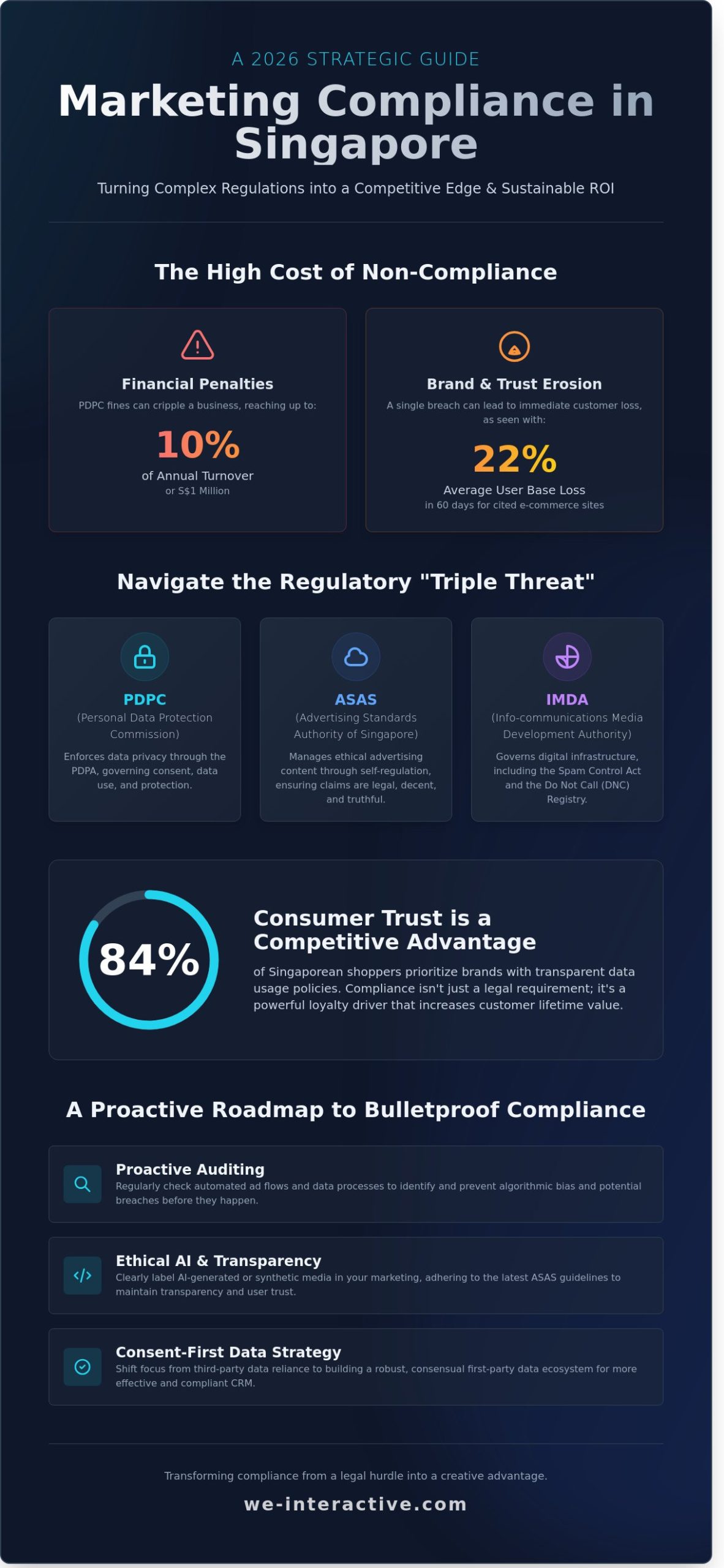
Financial penalties in 2026 are substantial. For organizations with an annual turnover exceeding S$10 million, the PDPC can impose fines up to 10% of that turnover. For others, the cap remains at S$1 million. However, the intangible damage often outweighs the check written to the regulator. A single breach erodes years of brand equity in an instant. Lessons from the July 2025 regulatory crackdown on “dark patterns” showed that three major e-commerce platforms lost an average of 22% of their active user base within sixty days of being cited for misleading countdown timers and hidden subscription fees.
Consumer Trust as a Competitive Advantage
Singaporean consumers are more privacy-conscious than ever before. Recent 2026 market data indicates that 84% of local shoppers prioritize brands that offer transparent data usage policies. This makes marketing compliance in singapore a powerful tool for increasing customer lifetime value. When you position your brand as a “Safe Harbor,” you aren’t just following rules; you’re building a relationship. WE Interactive leverages CRM and customer marketing solutions to turn compliance into a loyalty driver. By ensuring every touchpoint is consensual and transparent, we transform clicks into conversations and impressions into long-term conversions.
- Proactive Auditing: Regular checks of automated ad flows to prevent algorithmic bias.
- Ethical AI: Clear labeling of synthetic media as per the 2025 ASAS guidelines.
- Consent-First Data: Shifting from third-party reliance to robust first-party data strategies.
The Regulatory Framework: PDPA, ASAS, and Beyond
Mastering marketing compliance in singapore requires a strategic approach to the “Triple Threat” of local regulation. This framework consists of the Personal Data Protection Commission (PDPC), the Advertising Standards Authority of Singapore (ASAS), and the Info-communications Media Development Authority (IMDA). These agencies don’t operate in silos; they form a cohesive net that ensures every digital interaction is secure and every claim is substantiated. WE Interactive views these regulations not as hurdles, but as the foundation for building authentic connections. By aligning your strategy with Singapore’s marketing and trade laws, you elevate your brand from a mere service provider to a trusted partner.
The PDPC enforces data privacy, while ASAS manages the ethical content of your campaigns through self-regulation. Simultaneously, the IMDA governs the digital infrastructure, including the Spam Control Act and the Do Not Call (DNC) Registry. Integrating these rules into a single internal policy turns compliance into a competitive advantage. It’s about blending the art of creativity with the science of legal precision to empower your brand’s growth.
Mastering the Personal Data Protection Act (PDPA)
The PDPA is built on 9 core obligations that every marketer must internalize: Consent, Purpose Limitation, Notification, Access and Correction, Accuracy, Protection, Retention Limitation, Transfer Limitation, and Accountability. Following the 2020 amendments, managing “Deemed Consent” has become vital for brands using AI for automated prospecting. You must ensure that data is only kept as long as there’s a business or legal purpose. Holding onto legacy data indefinitely isn’t just risky; it’s a liability that can lead to fines of up to S$1 million or 10% of your annual turnover in Singapore. Effective CRM and customer marketing strategies help automate this lifecycle, ensuring you stay compliant while you scale.
The Singapore Code of Advertising Practice (SCAP)
The SCAP, managed by ASAS, dictates that all advertisements must be legal, decent, honest, and truthful. This isn’t just a suggestion. ASAS has the power to pull ads that mislead the public or exploit “vulnerable” audiences, such as children under 12 or the elderly. For example, any claim of “Number 1” or “Best in Singapore” must be backed by independent research or sales data from the current or preceding year. We help brands navigate these nuances to ensure their work speaks louder than words without crossing ethical lines. From clicks to conversations, your message must remain transparent to maintain long-term ROI and consumer loyalty.
Compliance Across the Funnel: From Social Media to CRM
Compliance requirements evolve as your prospect moves from awareness to conversion. At the Top of the Funnel (TOFU), the focus remains on transparency and broad disclosures. By the time they reach the Bottom of the Funnel (BOFU), the stakes shift toward rigorous data protection and explicit consent. Strategic marketing compliance in singapore ensures that your brand doesn’t just avoid a S$1 million PDPC fine; it builds a foundation of radical transparency that attracts higher-quality leads. WE believe that integrity is the ultimate competitive advantage in a crowded digital marketplace.
Social Media and Influencer Marketing Disclosure
Trust is the primary currency on platforms like TikTok and XiaoHongShu (XHS). By 2026, the Advertising Standards Authority of Singapore (ASAS) expects even stricter adherence to #ad and #spid identifiers. You are legally responsible for every claim an influencer makes about your product. If an influencer omits a disclosure, your brand carries the liability. Effective social media marketing requires a robust vetting process and clear contracts that mandate compliance. This protects your reputation while ensuring your content remains ethical on emerging “walled garden” platforms where organic and paid content often blur.
CRM Automation and the Spam Control Act
Precision matters when you transition from clicks to conversations. Your CRM and customer marketing workflows must integrate real-time checks against the Do Not Call (DNC) Registry. Under the Spam Control Act, sending unsolicited commercial messages can lead to statutory damages of S$10 per message, capped at S$1 million. We recommend following the MAS Guidelines on Digital Marketing Conduct to ensure your digital prospecting meets the highest standards of professional conduct. This is especially vital for brands in the financial and professional services sectors.
- Automated Consent Management: Implement 2026-ready software stacks like OneTrust or Cookiebot to synchronize consent across every digital touchpoint.
- The Art of the Unsubscribe: Make the exit as polished as the entry. A clear, one-click unsubscribe process reduces spam reports and maintains brand grace even when a user chooses to leave.
- Data Minimization: Only collect what you need. Reducing data intake at the lead-gen stage minimizes your liability and streamlines your marketing compliance in singapore.
Compliance acts as a natural filter for lead quality. Users who engage despite rigorous consent barriers are often 40% more likely to convert than those who click through deceptive “dark patterns.” You aren’t just checking boxes; you’re qualifying your audience through integrity. Growing Together means building a database of people who actually want to hear from you, turning compliance into a tool for sustainable ROI.
Industry-Specific Marketing Regulations in Singapore
A one-size-fits-all strategy fails because Singapore’s regulatory framework is highly segmented. Mastering marketing compliance in singapore requires more than a standard checklist; it demands a deep understanding of sector-specific nuances. High-risk sectors like finance and healthcare face intense scrutiny, where a single misstep can lead to heavy fines or reputational damage that takes years to repair.
Brands using Singapore as a regional base often face a complex dual-compliance challenge. If you’re expanding north, our China market entry services help you balance the requirements of Singapore’s PDPA with China’s PIPL. This strategic approach ensures your brand remains protected while scaling across borders. WE act as your strategic partner, ensuring your growth is both ambitious and legally sound.
Financial Services and MAS Guidelines
Financial institutions must align with the Monetary Authority of Singapore (MAS) Guidelines on Standards of Conduct for Digital Advertising Activities. These rules demand absolute transparency in every ad. By 2026, MAS will introduce enhanced digital prospecting safeguards to protect consumers from aggressive or misleading tactics. You must avoid “Dark Patterns” in your UI/UX design, such as hidden fees or false urgency timers. WE ensure your digital presence is built on trust, turning clicks into long-term conversations through ethical performance marketing.
Health, Food, and Children’s Advertising
The Health Promotion Board (HPB) maintains strict control over F&B advertising, especially regarding products high in fat, sugar, or salt. Protecting younger audiences is a priority; the Sale of Infant Food Ethics Committee Singapore (SIFECS) code strictly governs how infant formula is marketed. In 2022, the Advertising Standards Authority of Singapore (ASAS) handled 237 cases, many involving misleading health claims. You can’t promise “miracle” results for supplements. Every claim must be backed by verifiable data. WE help you amplify your message without crossing these critical legal lines.
- Finance: Compliance with MAS 2026 prospecting safeguards is mandatory.
- Healthcare: Claims must be substantiated by scientific evidence, not anecdotes.
- F&B: Strict adherence to HPB guidelines for children’s advertising is required.
At WE Interactive, we don’t just follow rules; we use them to build stronger, more credible brands. We combine the art of storytelling with the science of marketing compliance in singapore to unlock sustainable growth for our partners. It’s about making people feel confident in your brand while delivering significant ROI.
Ready to protect your brand while you scale? Elevate your performance marketing with our compliance experts today.
Strategic Compliance: Turning Regulation into ROI with WE Interactive
WE Interactive doesn’t view regulation as a cage. We see it as a blueprint for excellence. In a digital environment where trust is the most valuable currency, adhering to marketing compliance in singapore becomes a powerful competitive advantage rather than a bureaucratic hurdle. We view these legal frameworks as creative constraints that breed innovation. When you know exactly where the boundaries are, you can push the limits of creativity within those lines to build authentic, high-impact campaigns.
We integrate rigorous regulatory checks directly into our performance marketing workflow. This ensures your budget isn’t drained by non-compliant ads that get flagged, paused, or banned by platforms. By aligning every campaign with ASAS guidelines and PDPA requirements, we unlock higher quality leads and more sustainable growth. In 2023, the PDPC issued financial penalties totaling over S$100,000 for data breaches; our proactive approach ensures your brand stays out of those headlines.
Growing Together is our core philosophy. It means we treat your brand’s reputation as if it were our own. Protecting our clients from legal and reputational risk is the foundation of our partnership. We’re currently pioneering the use of AI-driven compliance monitoring to offer real-time ad auditing. This technology analyzes content against local regulations before it goes live, providing a safety net that allows your brand to move fast without breaking things.
Future-Proofing Your Digital Presence
Building a Compliance-First culture within your internal team is essential for long-term success. We empower your staff to understand the nuances of the Consumer Protection (Fair Trading) Act, ensuring every claim is substantiated. Our SEO services play a vital role here. We focus on creating transparent, authoritative content that satisfies both search engine algorithms and the strict standards of marketing compliance in singapore. To stay ahead, we recommend every brand conducts a 2026 marketing compliance audit now. This forward-looking review identifies gaps in data consent and content disclosures before they become liabilities.
Ready to Elevate Your Strategy?
Partnering with an experienced agency is the ultimate risk mitigation strategy for any ambitious brand. Since 2009, WE Interactive has mastered the art of balancing data-driven results with ethical standards. We help you turn potential liabilities into strategic assets that build lasting consumer confidence. From clicks to conversations, from impressions to conversions, we ensure every touchpoint is secure, transparent, and high-performing. Partner with WE Interactive for compliant, high-growth marketing and unlock the next level of your digital success.
Unlock Sustainable Growth: Your 2026 Compliance Roadmap
Success in 2026 requires more than just creative flair; it demands a deep integration of legal standards into your digital DNA. Navigating the evolving complexities of PDPA and ASAS guidelines ensures your brand builds lasting trust while avoiding costly penalties. Effective marketing compliance in singapore transforms regulatory hurdles into a competitive advantage that protects your reputation across every touchpoint, from social media engagement to CRM automation. It’s about balancing the art of storytelling with the science of data protection.
WE Interactive brings over 15 years of experience navigating the local regulatory landscape. We’ve delivered 700+ successful campaigns for global leaders like Singapore Airlines and Starbucks, proving that high performance and strict compliance go hand in hand. We’re a strategic partner dedicated to growing together by safeguarding your brand equity and maximizing ROI. From clicks to conversations, we ensure your strategy is as secure as it is impactful.
Elevate your brand with a compliant, high-performance strategy. Connect with WE Interactive today.
Let’s turn these regulations into your brand’s strongest asset for long-term success.
Frequently Asked Questions
What is the maximum fine for a PDPA breach in Singapore in 2026?
The maximum fine for a PDPA breach in 2026 is 10% of an organization’s annual turnover in Singapore or S$1 million, whichever is higher. This penalty applies to companies with an annual local turnover exceeding S$10 million. WE ensure your brand avoids these heavy costs by integrating rigorous marketing compliance in Singapore into every campaign. It’s about protecting your reputation while we amplify your digital presence and drive sustainable growth.
Do influencers in Singapore need to disclose paid partnerships?
Yes, influencers must clearly disclose paid partnerships according to the ASAS guidelines updated in 2016. You’re required to use visible identifiers like #ad, #sponsored, or #paidpartnership at the start of social media posts. This transparency builds authentic connections between creators and your audience. WE believe clear communication transforms simple impressions into lasting trust. It’s the art of social media combined with the science of ethical marketing to empower your brand.
What is the difference between the PDPA and the Spam Control Act?
The PDPA governs how you collect and use personal data, while the Spam Control Act regulates the sending of bulk commercial messages. Specifically, the Spam Control Act targets unsolicited messages sent to more than 500 recipients in a single day. Compliance involves providing a clear unsubscribe link and a valid contact number. WE balance the art of engagement with the science of legal precision to keep your digital strategies both effective and lawful.
How does the Singapore Code of Advertising Practice (SCAP) apply to digital ads?
The SCAP applies to digital ads by requiring all content to be legal, decent, honest, and truthful. ASAS monitors digital platforms to ensure that any performance claims are substantiated with concrete evidence. If your social media ad claims a specific ROI, you must have the data to back it up. WE focus on elevating your brand through credible storytelling that meets these standards. It’s how we turn clicks into loyal conversations.
Can I send marketing emails to customers who have previously purchased from me?
You can send marketing emails to existing customers under the PDPA’s “legitimate interests” provision, but you must offer a clear opt-out. The Spam Control Act requires every commercial message to include a functional unsubscribe link and a valid contact identity. If you ignore these requirements, you face potential statutory damages of S$25 per message. WE help you master this balance, turning simple impressions into conversions through respectful and compliant communication strategies.
What are the MAS guidelines for digital marketing in the financial sector?
MAS guidelines require financial institutions to ensure digital marketing is clear, fair, and not misleading under the Fair Dealing Guidelines. All promotional materials must prominently display risk warnings and avoid promising guaranteed returns. Since 2022, MAS has also restricted the use of social media influencers for promoting complex financial products. WE empower financial brands to unlock growth by blending performance marketing with these strict regulatory insights to ensure significant, sustainable success.
How does Singapore’s marketing compliance differ from the GDPR?
Marketing compliance in Singapore differs from the GDPR primarily because the PDPA is less prescriptive regarding the “right to erasure.” While GDPR requires breach notification within 72 hours, Singapore’s PDPA allows up to three business days once a breach is determined to be notifiable. Singapore also focuses heavily on the “Reasonableness Purpose” for data collection. WE help global brands adapt their strategies to these specific local nuances, ensuring your digital presence remains a powerful force.
What should be included in a Singapore-compliant privacy policy?
A Singapore-compliant privacy policy must include the specific purposes for data collection and the contact details of your Data Protection Officer. You need to state how individuals can withdraw consent or access their data. If you’re transferring data across borders, you must ensure the receiving party provides a standard of protection comparable to the PDPA. WE design transparent policies that protect your ROI and empower your customers’ digital experiences through insight and innovation.