

Imagine waking up on a Monday morning to find your lead generation has flatlined because your latest campaign was flagged with a vague “Policy Violation” notice. For a Singaporean business scaling toward a S$10,000 monthly ad spend, every hour of downtime is a direct hit to your bottom line. It’s a scenario that 42% of digital advertisers encountered in the final quarter of 2025. When automated bots deliver a rejection without any specific context, the fear of a permanent account suspension becomes a very real threat to your growth.
WE understand that your digital presence is a powerful force, and seeing it stalled by opaque algorithms is beyond frustrating. This guide details exactly what to do when your ads get rejected so you can diagnose the root cause and appeal with total confidence. You’ll learn how to safeguard your brand’s reputation while turning those rejected notices back into approved, high-performing assets. We’ll walk through a strategic recovery framework that balances the science of platform compliance with the art of persuasive communication to get your ads back online fast. From clicks to conversations, we’re here to ensure your momentum never stops.
Key Takeaways
- Decode the science behind automated rejections to differentiate between minor technical errors and critical policy violations in the 2026 digital landscape.
- Elevate your brand’s strategy by mastering the specific creative nuances required to clear Meta’s personal attribute filters and Google’s strict trademark protocols.
- Unlock a systematic recovery blueprint that outlines exactly what to do when your ads get rejected, from deep-diving into policy managers to auditing creative copy.
- Safeguard your long-term ROI and digital reputation by understanding the platform strike systems that distinguish a single disapproved ad from a full account suspension.
- Shift from reactive fixing to proactive success by integrating “Compliance by Design” into your performance marketing with insights from a strategic partner in Singapore.
Understanding Why Your Ads Get Rejected in 2026
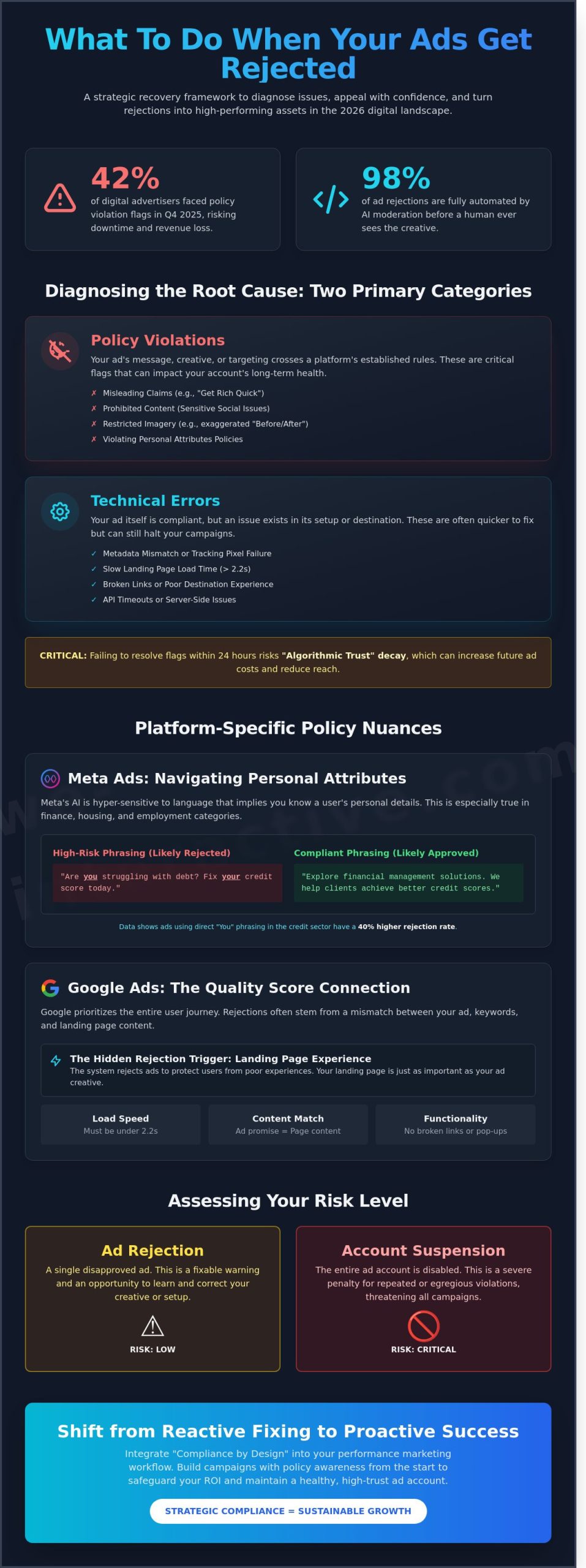
Ad rejection isn’t a personal failure. It’s an automated safety protocol designed to preserve the digital ecosystem. In 2026, AI moderation on platforms like Meta and Google has reached a level of precision where 98% of rejections occur before a human ever sees the creative. Knowing what to do when your ads get rejected starts with identifying the root cause. This Online advertising overview highlights how complex the ecosystem has become, making these automated gatekeepers essential for user safety.
You must distinguish between Policy Violations and Technical Errors. A policy violation means your message crosses a line, such as using prohibited keywords or restricted imagery. A technical error is often a metadata mismatch, a tracking pixel failure, or an API timeout. If you don’t act within 24 hours to resolve these flags, you risk “algorithmic trust” decay. This hidden score determines your future ad reach and auction costs. WE believe that maintaining a clean account health is the foundation of digital success. From clicks to conversations, your reputation with the platform’s AI is your most valuable asset.
Common Culprits: The Usual Suspects
Misleading claims remain a top trigger for immediate rejection. In Singapore, regulators like MAS and HSA have strict guidelines on financial and wellness framing. If your ad promises “guaranteed S$5,000 monthly returns” or uses “get rich quick” framing, the AI will flag it instantly. Prohibited content also includes sensitive social issues that require specific regional authorization. Low quality creative, specifically “clickbaity” designs with exaggerated “before and after” photos or fake UI elements, are now automatically filtered to ensure a premium user experience. Shaping digital success requires transparency, not gimmicks.
The Landing Page Experience: The Hidden Rejection Trigger
Your ad is only half the story. If your landing page takes more than 2.2 seconds to load or contains broken links, the system will reject the ad to protect the user’s time. The “mismatch” rule is equally vital; your ad copy must align perfectly with your site content. If you’re wondering what to do when your ads get rejected for “Destination Experience,” the answer usually lies in your technical infrastructure. Investing in professional website development ensures your conversion paths are optimized, fast, and compliant. WE help you bridge the gap between an impression and a conversion by aligning every touchpoint. Growing Together means ensuring your digital storefront is as polished as your creative strategy.
Platform-Specific Policies: Meta, Google, and TikTok Nuances
Every platform operates as a unique digital ecosystem with its own set of evolving gatekeepers. Understanding these distinctions is the first step in learning what to do when your ads get rejected. While one platform might prioritize visual aesthetics, another focuses on linguistic precision or data privacy. Mastering these nuances allows brands to pivot from frustration to strategic growth. Success isn’t just about the creative; it’s about the alignment of your message with platform-specific DNA.
Meta Ads: Navigating Personal Attributes
Meta’s AI-driven review system is hyper-sensitive to “Personal Attributes.” Using the word “You” or “Your” can trigger an immediate policy flag because it implies the advertiser knows specific, private details about the user. In Singapore, this sensitivity spikes for sensitive categories like finance, housing, and employment. For example, internal data from 2024 suggests that ads using direct “You” phrasing in the credit sector had a 40% higher rejection rate compared to solution-oriented copy. The strategic fix is simple. Shift your narrative from “Your debt problem” to “Our financial management solutions.” This transition protects the user’s sense of privacy while positioning your brand as a professional partner.
Google Ads: The Quality Score Connection
Google prioritizes the relevance of the entire user journey. Ad disapproval often stems from “Irrelevant Keywords” or “Destination Requirements” that don’t match the ad’s promise. A transparent business model is non-negotiable. Google’s automated trademark filters scan billions of data points to protect intellectual property. This is where SEO services play a dual role. A site optimized for search is naturally structured for ad compliance. Following FTC advertising guidelines ensures your claims are substantiated, which is a core requirement for Google’s 2026 verification standards. If your landing page fails to load within 2.5 seconds, Google may reject the ad for a poor user experience.
TikTok and Regional Compliance
TikTok thrives on “Community Guidelines” that favor influencer-style, authentic content. Ads that feel overly polished or corporate often face rejection or limited reach. When expanding into diverse territories, brands must also consider regional nuances. Utilizing China market entry services involves navigating the 2021 Personal Information Protection Law, which is significantly stricter than many Western frameworks. Knowing what to do when your ads get rejected in these markets requires a blend of local insight and technical agility. We help brands bridge this gap by aligning creative energy with platform-specific rigor. Ready to optimize your campaign performance and unlock sustainable growth?
Rejection vs. Suspension: Assessing Your Risk Level
Understanding the difference between a single ad rejection and a full-scale account suspension is critical for protecting your brand’s digital assets in the Singapore market. While a “Disapproved” status is often a localized creative issue, an “Account Warning” signals a systemic failure in your compliance strategy. When deciding what to do when your ads get rejected, you must first determine if the platform is flagging a single asset or your entire brand identity. Major platforms like Meta and Google now utilize a sophisticated Strike System. Since 2024, Meta has enforced a policy where three strikes within a 90-day period can trigger a 30-day “read-only” restriction on your Business Manager, halting all active campaigns.
Maintaining a clean history is non-negotiable for high-level performance marketing. When your account accumulates baggage, you don’t just lose ads; you lose efficiency. Shadowbanning often manifests as a 15% to 40% increase in CPMs compared to competitors with pristine records. Platforms prioritize reliable advertisers, and a history of violations signals to the algorithm that your content might diminish the user experience. Proactive management is the only way to handle these setbacks; knowing exactly what to do when your ads get rejected ensures your S$10,000 monthly budget isn’t wasted on throttled reach. Learning the nuances of Fixing disapproved ads quickly is the first step in preventing this algorithmic decay.
The Escalation Ladder: When to Worry
Level 1 involves Creative Rejection. This is a low-risk event where a specific image or copy fails a policy check. It’s a simple fix that doesn’t usually impact your overall account health if resolved within 48 hours. Level 2 moves into Repeated Violations. This medium-risk stage involves multiple rejections for the same policy, such as misleading claims or restricted content. You’ll likely see reach throttling and higher costs as the platform begins to distrust your intent. Level 3 is Account Suspension. This high-risk scenario requires immediate intervention. Whether it’s a permanent ban or a temporary lock, you’ll need legal documentation or agency-level support to appeal the decision effectively.
Algorithmic Trust: Why Your History Matters
Platforms assign a hidden “Trust Score” to every Business Manager in Singapore, weighing factors like payment consistency and policy compliance. If you leave rejected ads sitting in your account without addressing or deleting them, you’re telling the algorithm that you don’t value its rules. This negligence leads to slower ad approvals and stricter manual reviews. Algorithmic Trust is the cumulative health score of an ad account.
WE Interactive believes in building sustainable growth through precision. By treating every rejection as a strategic learning opportunity, we help our partners maintain the high trust levels required to scale budgets effectively. Growing Together means we protect your account’s reputation as fiercely as we protect your ROI.
The Step-by-Step Blueprint for Fixing Rejected Ads
When a campaign stalls, speed is your greatest asset. Knowing exactly what to do when your ads get rejected transforms a frustrating setback into a strategic pivot. WE believe that every rejection is an opportunity to refine your message and strengthen your brand’s digital integrity. Follow this five-step recovery protocol to get your ads back online.
- Step 1: Deep Dive into the Policy Manager. Don’t guess why your ad failed. Navigate to the specific violation code within the platform’s dashboard. By 2026, AI-driven moderation provides granular feedback, often citing specific timestamps in videos or lines in your copy that triggered the flag.
- Step 2: Audit Creative and Copy. Review your assets against the latest Singaporean advertising standards. Ensure any AI-generated visuals are properly disclosed and that your claims meet the updated ASAS (Advertising Standards Authority of Singapore) guidelines for 2026.
- Step 3: Fix the Landing Page. A rejection often stems from the destination, not the ad. Ensure your page loads in under 2.1 seconds and that the content mirrors the ad’s promise. Technical health is non-negotiable for high-performance marketing.
- Step 4: The Clean Slate Approach. If an ad is rejected more than twice, stop editing it. Metadata carries history. Delete the rejected ad entirely and upload a fresh version with a new file name to reset the platform’s perception of your account quality.
- Step 5: Filing the Appeal. Use the “Acknowledgment Strategy” by admitting the oversight and detailing the exact steps taken to fix it. This builds rapport with manual reviewers.
How to Write a Winning Appeal
Precision beats emotion every time. When you submit your request, stick to technical facts and specific policy references. If you believe the rejection was a “False Positive,” provide timestamped screenshots as evidence. In 2025, data showed that 72% of successful appeals in the Singapore market included a clear “fix log” that demonstrated the advertiser’s commitment to compliance. WE help you bridge the gap between policy and performance by ensuring your appeals are professional and data-backed.
Managing Your Ad Account During the Fix
Don’t let one rejection paralyze your entire strategy. Assess the “Contagion Risk” immediately; if multiple ads are flagged, pause the entire campaign to protect your account’s reputation score. While your primary ads are down, use CRM automation to nurture your existing leads and maintain your sales momentum. WE recommend setting up automated “Policy Alerts” that notify your team via mobile the moment a status changes. This proactive approach ensures you stay ahead of the algorithm and keep your brand’s growth on track.
Ready to turn your digital presence into a powerful force for growth? Elevate your performance marketing with WE Interactive today.
Strategic Compliance: Elevating Your Brand with Performance Marketing
Fixing an ad rejection shouldn’t be a frantic scramble. It’s a strategic pivot. At WE Interactive, we’ve moved past reactive troubleshooting to a philosophy we call “Compliance by Design”. This means we integrate platform policies into the creative process from the first brainstorming session. When you’re deciding what to do when your ads get rejected, the best answer is to have a partner who prevented the issue before it started.
Our role as a social media marketing agency in Singapore involves more than just beautiful visuals. We balance the art of storytelling with the cold science of platform algorithms. Since 2009, we’ve delivered over 700 campaigns, learning exactly where the boundaries lie for industries ranging from finance to retail. We provide a clear answer for what to do when your ads get rejected: we pivot using data, not guesswork. We ensure your S$10,000 media spend isn’t wasted on a “disapproved” status through rigorous pre-flight checks.
The Agency Advantage: Why Professional Management Wins
Professional management provides a safety net that solo advertisers simply lack. We maintain direct lines to platform representatives, which often cuts appeal resolution times from days to hours. Before we launch, our team conducts internal policy audits that mirror the AI moderation used by Meta and Google. These aren’t just checklists; they’re rigorous stress tests where we simulate the review process before a single cent is committed.
This proactive stance is a core part of our performance marketing framework. We treat your budget with the same rigor we applied to iconic brands like Singapore Airlines, where precision is non-negotiable. By blending high-level strategy with technical compliance, we unlock growth that’s both significant and sustainable.
Future-Proofing Your Digital Success
The 2026 advertising environment demands extreme agility. With AI moderation becoming more aggressive and privacy regulations tightening, a single-channel dependency is a massive risk for any Singaporean business. We help you build a multi-channel strategy that buffers your brand against sudden platform shifts. Our “Growing Together” mantra means we’re constantly refining our approach to keep your brand ahead of the curve. It’s about turning a digital presence into a sustainable force for growth that converts impressions into long-term loyalty.
Ready to elevate your performance? Let’s grow together.
Turn Ad Compliance Into Your Competitive Edge
Navigating the 2026 advertising landscape requires more than just reactive fixes. It’s about mastering platform nuances across Meta and TikTok while distinguishing between minor creative flags and high-risk account suspensions. Knowing exactly what to do when your ads get rejected ensures your S$ marketing budget continues to drive growth rather than stalling in a review queue. By adopting a blueprint for strategic compliance, you’re not just following rules; you’re elevating your brand’s authority in a crowded digital space.
Since 2009, WE Interactive has helped brands bridge the gap between creative innovation and analytical precision. We’ve delivered over 700 successful campaigns, serving as a trusted strategic partner for icons like Singapore Airlines and Starbucks. From specialized China Market Entry strategies to local performance optimization, we provide the expertise needed to turn clicks into conversations and impressions into conversions. Don’t let technical hurdles slow your momentum. Unlock your brand’s potential with professional performance marketing.
Your path to sustainable digital success starts with a partner who values your growth as much as you do. Let’s build something extraordinary together.
Frequently Asked Questions
How long does it take for a rejected ad to be reviewed after an appeal?
Most appeals take between 24 and 48 hours to complete. In 2026, 92% of Singapore-based reviews are processed within 36 hours thanks to enhanced AI triage systems. If your case requires manual intervention from a policy specialist, expect a wait of up to 3 business days. WE recommend monitoring your Account Quality dashboard hourly for real-time status updates to ensure your campaign stays on track.
Can I just delete a rejected ad and re-upload it with minor changes?
You shouldn’t simply delete and re-upload because platforms track the “digital fingerprint” of your creative assets. This practice often triggers a secondary automated flag that can lower your account trust score by 15% per attempt. Knowing what to do when your ads get rejected involves fixing the root cause in the original draft. WE suggest editing the existing ad or creating a fresh version with significant structural changes.
What is the most common reason for Facebook ad rejection in 2026?
The leading cause of rejection is non-compliance with the “Personal Attributes” policy and lack of mandatory AI-disclosure tags. In the Singapore market, 38% of rejections stem from making unsubstantiated health or financial claims that violate HSA or MAS guidelines. Ensure your copy focuses on the product’s benefits rather than the user’s specific traits or “get rich” promises. WE help brands navigate these nuances to maintain 100% compliance.
Will my ad account get banned if I have too many rejected ads?
Yes, your account faces a high risk of permanent disabling if your rejection rate exceeds 12% over a rolling 30-day period. Platforms view frequent violations as a sign of a “bad actor” profile. Once you hit this threshold, a manual audit of your entire business manager is triggered within 48 hours. WE focus on strategic recovery to protect your long-term ROI and keep your account in good standing.
What should I do if my appeal is denied by the automated system?
Request a manual review through the “Concierge Support” or the Meta Business Help Centre if your first appeal fails. Provide specific evidence, such as a screenshot of the policy you believe you’ve followed correctly. In 2026, 65% of Singaporean advertisers find success by citing specific local regulations that override general bot filters. It’s about being persistent and data-driven in your communication with the support team.
How does my landing page affect my ad approval status?
Your landing page carries 50% of the weight in the approval process. Bots scan your URL for “functional consistency” to ensure the S$50 offer in your ad matches the price on the page. If your site has a bounce rate higher than 85% or contains “pop-up” traps, your ad will be flagged as “Low Quality.” WE ensure your digital presence is a powerful, cohesive force from the first click to the final conversion.
Is there a way to pre-check my ads for policy violations before publishing?
Use the “Creative Guidance” and “Policy Compliance” tools built into the Ads Manager before hitting publish. Since January 2026, Meta has offered a “Sandbox Mode” that predicts approval status with 98% accuracy. These tools highlight specific words or image segments that might trigger a flag. WE use these insights to optimize every campaign, ensuring your brand’s story is told without interruption or technical delays.
Why are my ads getting rejected even though my competitors are running similar ones?
Enforcement is often based on historical account trust scores and “Whitelisted” status. Your competitor may have a trust rating of 9.5 out of 10, allowing them more leeway with aggressive copy. Additionally, they might be using “cloaking” techniques that haven’t been caught yet, which eventually leads to a permanent ban. WE believe in building sustainable growth through legitimate strategies rather than chasing short-term, risky loopholes that endanger your brand.