

In the dynamic landscape of digital marketing, the endless stream of acronyms-SEO, PPC, CPC-can feel more like a barrier than a roadmap to success. It’s easy to get lost, but what if one of these terms held the key to unlocking immediate, measurable growth for your business? This is the power of Search Engine Marketing, or sem, a strategy designed to place your brand directly in front of customers at the very moment they are ready to act.
This guide is designed to cut through the complexity. We will demystify SEM, providing a clear definition of what it is and how it functions within the competitive Singapore market. You will learn to confidently distinguish it from SEO, understand the fundamentals of paid search campaigns, and discover how this powerful tool can be leveraged to amplify your reach. It’s time to transform confusion into a clear, actionable strategy for growth.
Key Takeaways
- Instantly elevate your brand’s visibility by appearing at the top of search results the moment customers are actively looking for solutions.
- A winning sem strategy is a dynamic cycle of data-driven research, precise execution, and continuous optimisation to maximise your ROI.
- Discover the strategic difference between SEM and SEO, and learn how to leverage both to build a powerful digital growth engine.
- Unlock the power of paid search to drive immediate, measurable results, turning search intent into tangible business growth.
Decoding SEM: What Is Search Engine Marketing?
At its core, Search Engine Marketing is a powerful digital strategy designed to elevate your brand’s visibility on search engine results pages (SERPs). When a potential customer in Singapore searches on Google for a product or service you offer, the primary goal of sem is to ensure your website appears prominently. Its power lies in its precision; it connects your business with users who have high purchase intent at the exact moment they are actively seeking a solution. This strategic positioning transforms search engines from simple information tools into dynamic platforms for customer acquisition and significant, sustainable growth.
The Two Pillars of SEM: PPC and SEO
Traditionally, Search Engine Marketing is an umbrella term encompassing two core disciplines: Pay-Per-Click (PPC) advertising and Search Engine Optimization (SEO). PPC involves paying for ad placements, while SEO focuses on earning visibility through organic, non-paid methods. However, in modern digital marketing, the term ‘SEM’ is now most commonly used to refer specifically to paid search activities. A helpful analogy is to think of PPC as renting prime real estate at the top of the SERPs, while SEO is the long-term strategy of building and owning your own property there.
Why SEM Is More Than Just Ads
To unlock true digital potential, it’s crucial to understand that SEM is a comprehensive, data-driven process, not just the act of running an ad. It is a continuous cycle of strategy, execution, and optimization aimed at driving qualified traffic that converts. This strategic framework involves several critical activities:
- In-depth Keyword Research: Uncovering the precise terms your target audience uses to find solutions.
- Strategic Campaign Creation: Crafting compelling ad copy and structuring campaigns for maximum impact and ROI.
- Audience Targeting & Bid Management: Ensuring your message reaches the right people at the right cost.
- Performance Analysis & Optimization: Continuously refining campaigns based on data to improve results and drive growth.
From clicks to conversations and from impressions to conversions, this meticulous approach is what turns a simple search into a valuable business opportunity.
How Does SEM Work? The Ad Auction Explained
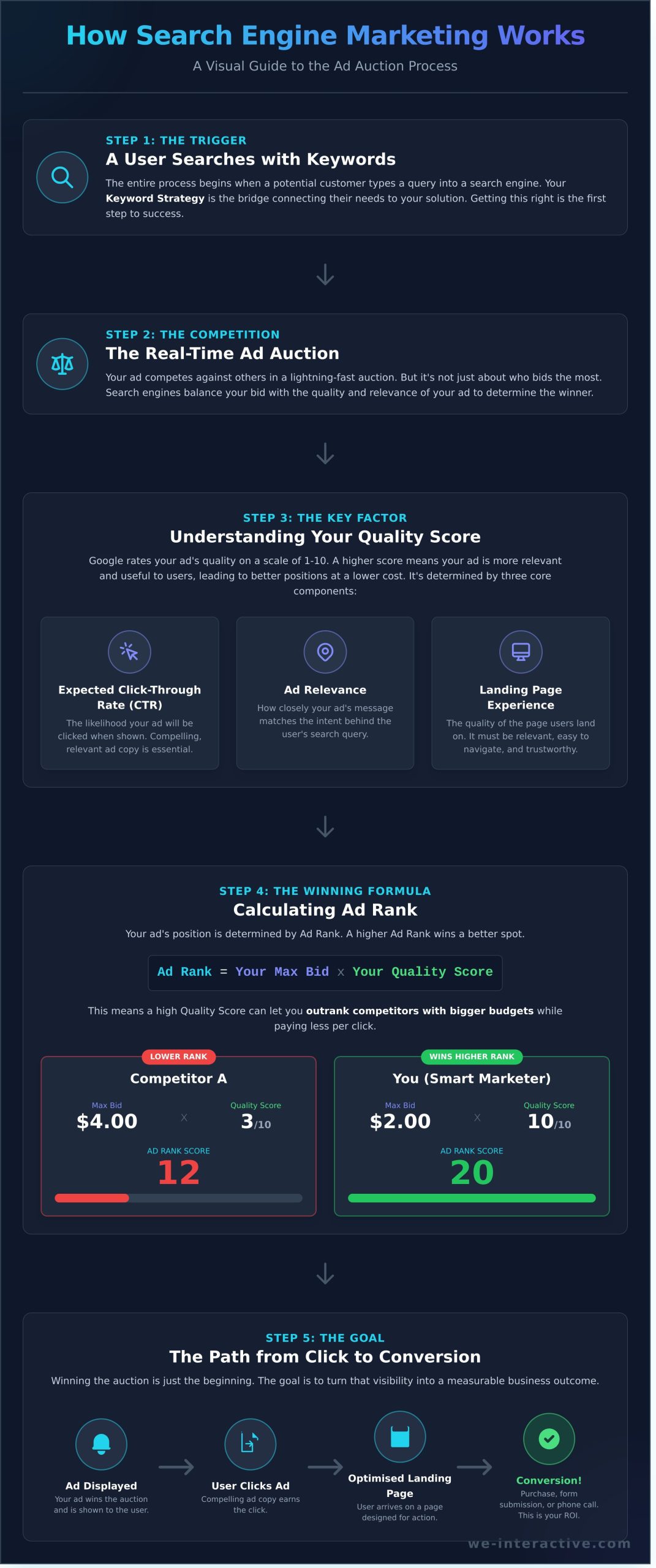
At the heart of every successful sem campaign is a lightning-fast, sophisticated process that begins the moment a user types a query into a search engine. This simple action triggers a digital auction where businesses bid in real-time for the opportunity to have their ad displayed. This sophisticated process, detailed in many a Search Engine Marketing Guide, is what powers the ads you see at the top of your search results. However, it’s a common misconception that the advertiser willing to pay the most automatically wins the top spot. The reality is a strategic balance between your bid and the quality of your ad.
The Role of Keywords in SEM
Keywords are the foundational bridge connecting what your potential customers are searching for with the solutions you provide. A successful strategy isn’t just about choosing popular terms; it’s about identifying high-intent keywords that signal a user is ready to take action. Search platforms use match types to control how closely a user’s query must align with your keyword, from broad match for wider reach to exact match for pinpoint precision. Your keyword strategy is the engine of your campaign, and getting it right is the first step to unlocking significant growth.
Winning the Auction: Quality Score and Ad Rank
To ensure users see relevant and helpful ads, Google evaluates more than just your bid (in S$). It assigns a Quality Score to your ads, a rating from 1-10 based on three core components:
- Expected Click-Through Rate (CTR): The likelihood your ad will be clicked when shown.
- Ad Relevance: How closely your ad matches the intent behind a user’s search.
- Landing Page Experience: The relevance and usability of the page users land on after clicking.
Your ad’s position is ultimately determined by its Ad Rank, calculated as: Your Max Bid x Your Quality Score. This means a high Quality Score can help you achieve a better ad position at a lower cost per click, empowering you to outperform competitors with larger budgets.
From Click to Conversion: The User’s Path
Once your ad wins the auction and captures a user’s attention, the journey shifts from visibility to action. Compelling ad copy that directly addresses the search query is crucial for earning the click. But the work doesn’t stop there. This click shouldn’t lead to a generic homepage, but to a dedicated, optimised landing page designed to facilitate the final step: conversion. A conversion is the desired action that drives your business forward-whether it’s a product purchase, a form submission, or a phone call. It’s the metric that transforms impressions into measurable ROI.
The Core Components of a Winning SEM Strategy
Understanding what SEM is provides the foundation; mastering its components is how you achieve digital dominance. A winning sem strategy is not a one-time setup but a continuous, data-driven cycle of insight-led research, precise execution, and relentless optimization. This approach transforms ad spend from an expense into a strategic investment, unlocking measurable growth and elevating your brand above the competition. These three pillars are essential to building a campaign that delivers significant ROI.
Comprehensive Keyword Research
The bedrock of any successful campaign is understanding what your audience is searching for. We move beyond basic search terms to decode user intent-distinguishing between an informational query like “best staycation deals in Singapore” and a commercial one like “book Marina Bay Sands room”. Analysing competitor keywords reveals strategic opportunities, while implementing negative keywords (e.g., ‘free’, ‘jobs’) is crucial to prevent wasted ad spend on irrelevant clicks. Tools like Google’s Keyword Planner are indispensable for this foundational discovery phase.
Compelling Ad Copy and Creatives
Your ad is your digital handshake-it must be powerful and persuasive. We craft copy using the AIDA model to guide users from awareness to conversion:
- Attention: A powerful, relevant headline that stops the scroll.
- Interest: A description that addresses a pain point or highlights a key benefit.
- Desire: Language that creates an emotional connection and showcases unique value.
- Action: A clear, strong call-to-action (CTA) like “Book Your Demo Now” or “Shop the Sale”.
Through rigorous A/B testing of different ad variations and the strategic use of ad extensions, we continuously optimize for the highest click-through and conversion rates.
Targeting and Bidding Strategies
Success in sem lies in reaching the right person at the perfect moment. We leverage granular targeting to connect with your ideal customers, whether they are in a specific location like Orchard Road, using a particular device, or fit a certain demographic profile. Smart bidding strategies, such as ‘Maximize Conversions’, use machine learning to optimize your ad spend for your primary business goals. Furthermore, remarketing allows us to re-engage past website visitors, nurturing initial interest into brand loyalty and repeat business.
SEM vs. SEO: Which Strategy Is Right for You?
For those new to digital marketing, the distinction between SEM and SEO is a common point of confusion. It’s often framed as a choice between one or the other, but the most powerful digital strategies view them not as competitors, but as two complementary forces designed to elevate your brand’s visibility on search engines.
Understanding their unique strengths is the first step to unlocking a truly holistic search strategy. Here’s a clear breakdown:
- SEM (Search Engine Marketing): The fast lane to visibility. You pay for ads to appear at the top of search results for specific keywords.
- SEO (Search Engine Optimization): The marathon for authority. You earn your placement by optimising your site and content to rank organically.
Speed and Cost
The primary difference lies in immediacy and investment. A well-executed sem campaign can deliver traffic and leads almost instantly, making it ideal for product launches or promotions in the competitive Singapore market. However, this is a ‘pay-to-play’ model; visibility is directly tied to your ongoing ad spend in S$. In contrast, SEO is a long-term investment. It takes time and consistent effort to build authority, but the result is sustainable organic traffic with lower direct costs. At WE Interactive, we craft data-driven strategies for both immediate impact and long-term growth through comprehensive search engine optimization.
Placement on the SERP
On a search engine results page (SERP), SEM ads are prominently displayed at the very top, clearly marked with an “Ad” label. This prime real estate guarantees immediate visibility. Organic SEO listings appear just below these ads. While some users trust and prefer these earned, organic results, a combined approach allows you to dominate the SERP. Occupying both paid and organic slots significantly increases your brand’s footprint, reinforcing credibility and capturing a wider audience.
Sustainability and Control
With SEM, your traffic flow stops the moment you pause your campaigns. Its key advantage, however, is unparalleled control. You can precisely target demographics, A/B test ad copy, and adjust budgets in real-time to optimise for conversions. SEO, once established, delivers a more sustainable stream of traffic that continues to provide value over time. While you have less direct control over how Google displays your listing, a high organic ranking is a powerful and enduring digital asset.
Ultimately, the right choice depends on your unique business goals, budget, and timeline. Often, the most effective solution is not a choice of one over the other, but a synergistic strategy that leverages the strengths of both. Ready to build a strategy that drives significant, sustainable growth? Let’s connect.
Why SEM is a Powerful Engine for Business Growth
Beyond the technicalities of bids and keywords, Search Engine Marketing is fundamentally about one thing: connecting your business with customers at the exact moment they need you. It’s not just about being seen; it’s about being chosen. This strategic precision is what transforms a marketing channel into a powerful, predictable engine for tangible business growth.
Reach Customers at the Perfect Moment
Unlike traditional advertising that pushes messages onto a broad audience, SEM operates on a ‘pull’ basis. You target users who are actively searching for the solutions you provide. This means you’re not interrupting their day; you’re answering their call. This high-intent traffic is significantly more likely to convert, turning search queries directly into qualified leads and sales for your business.
Achieve Immediate Visibility and Traffic
While organic strategies build momentum over time, SEM delivers results with unparalleled speed. Need to drive footfall to a new retail store in Jewel Changi Airport or amplify a limited-time promotion? A campaign can be live within hours, generating a controllable stream of targeted traffic on demand. This agility allows you to test markets, react to competitors, and capitalize on opportunities instantly.
Benefit from Unparalleled Measurability and ROI
In the world of digital marketing, data is currency. Every dollar (S$) you invest in a campaign is tracked, measured, and accounted for. This unlocks critical insights through metrics that matter:
- Cost Per Acquisition (CPA): Understand the exact cost to gain one new customer.
- Return On Ad Spend (ROAS): See the direct revenue generated for every dollar spent.
This level of transparency positions sem as a cornerstone of any results-driven performance marketing strategy, enabling you to continuously optimize campaigns for maximum ROI based on real-time data.
From clicks to conversions, SEM provides the speed, control, and accountability needed to thrive in Singapore’s competitive digital landscape. It’s more than just a marketing tactic; it’s a strategic pillar for growth. When you’re ready to elevate your brand’s presence, harnessing the power of SEM is the definitive next step.
Unlock Your Potential with Strategic Search Engine Marketing
As we’ve explored, Search Engine Marketing is more than just ads; it’s a powerful engine for immediate growth and targeted visibility. By understanding the ad auction and how SEM complements your long-term SEO efforts, you unlock a direct channel to connect with high-intent audiences. A well-executed sem strategy doesn’t just drive clicks-it delivers tangible business results and accelerates your journey to market leadership in Singapore and beyond.
Transforming this knowledge into a winning strategy requires a partner that blends the art of creativity with the science of performance. At WE Interactive, we’ve been shaping digital success in Asian markets since 2009. Our approach is built on data-driven strategies that deliver measurable ROI, ensuring every dollar of your ad spend is optimized for maximum impact. We empower your brand with holistic campaigns designed not just for clicks, but for conversions and sustained growth.
Ready to elevate your digital presence? Discover our performance marketing solutions. Let’s unlock your brand’s true potential, together.
Frequently Asked Questions About SEM
Is SEM the same thing as Google Ads?
Not exactly. Think of Search Engine Marketing (SEM) as the overall strategy and Google Ads as the most powerful tool to execute it. SEM is the discipline of gaining website traffic through paid advertising on search engines. While Google Ads is the dominant platform, a comprehensive SEM strategy may also include other channels like Microsoft Advertising (Bing Ads) to maximise reach and capture different audience segments for holistic brand growth.
How much should I budget for an SEM campaign?
In Singapore, a meaningful starting budget for a small business SEM campaign typically falls between S$1,500 to S$3,000 per month. This allows for sufficient data collection to optimise for performance and ROI. For highly competitive industries like finance or real estate, or for businesses aiming for aggressive growth, budgets can scale significantly higher. The key is to invest enough to generate actionable insights and drive sustainable results.
Can I do SEM myself, or do I need an agency?
While you can manage an SEM campaign yourself, it demands significant time for learning, execution, and continuous data analysis. Partnering with a specialist agency unlocks access to expert strategy, advanced tools, and data-driven insights from day one. An agency acts as a strategic partner, helping you navigate the complexities of sem to accelerate growth and maximise your marketing spend efficiently and effectively.
How long does it take to see results from SEM?
You can see initial results like traffic and impressions almost immediately after your ads are approved and live. However, achieving sustainable, profitable results requires a strategic approach. The first one to three months are crucial for data gathering, A/B testing, and campaign refinement. This optimisation phase is where we turn initial clicks into consistent conversions and unlock long-term growth for your brand, ensuring every dollar is working its hardest.
What is a good click-through rate (CTR) for an SEM ad?
A solid benchmark for CTR on Google Search ads is typically between 3% and 5%, but this varies widely across industries. A more important metric, however, is the quality behind the click. A high CTR is only valuable if it leads to conversions. We focus on optimising ads not just for clicks, but for attracting the right audience-transforming impressions into meaningful customer actions that drive real business growth.
Does SEM help with my SEO efforts?
Absolutely. SEM and SEO are two pillars of a powerful search strategy that work together to elevate your brand’s visibility. SEM delivers immediate traffic and provides invaluable, real-time data on high-performing keywords, ad copy, and user behaviour. These data-driven insights can then be used to inform and accelerate your long-term SEO strategy, helping you target the most profitable terms and user intents with precision.