
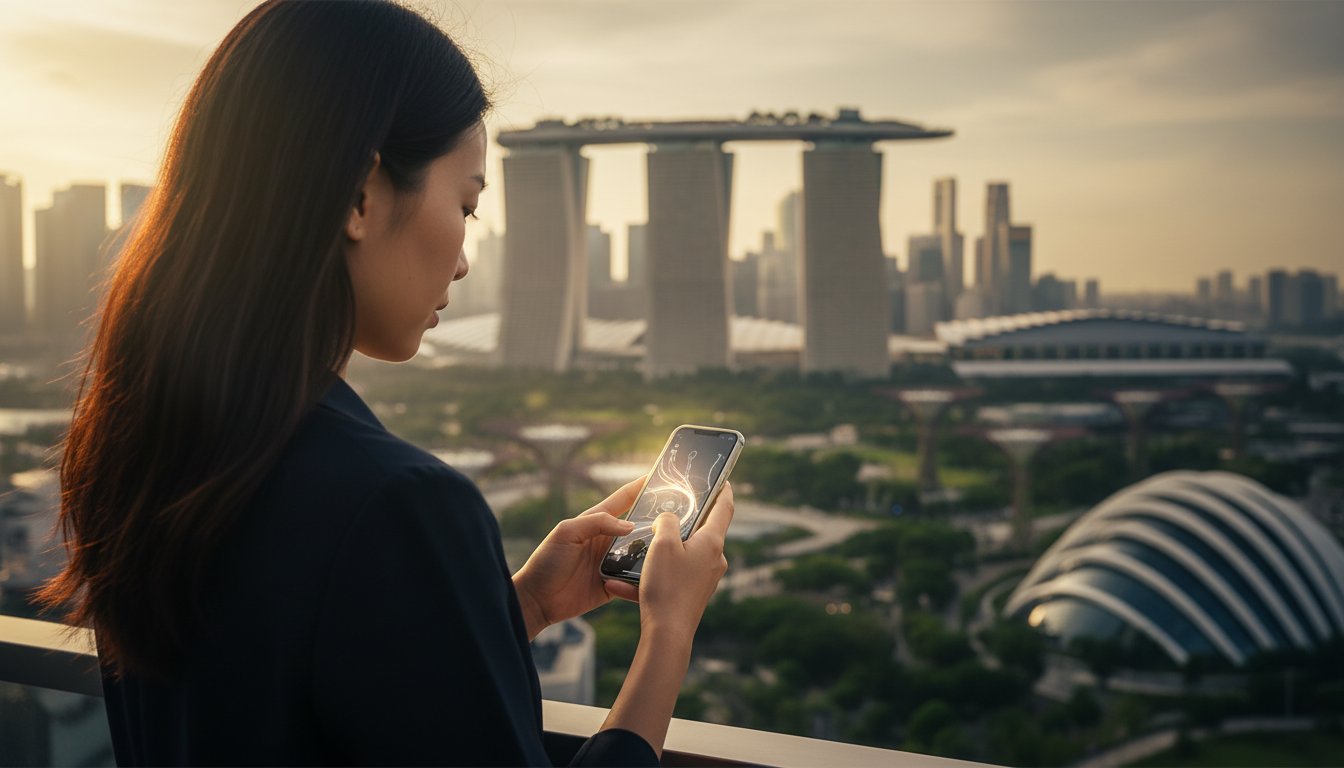
Did you know that by 2026, Chinese outbound travelers are projected to contribute over S$440 billion to the global economy, yet 65% of Singaporean tourism brands still struggle to convert this massive interest into actual bookings? We understand the pressure. You know the potential is there, but the Great Firewall and the constant shift between Xiaohongshu and Douyin makes it difficult to know how to market to chinese tourists effectively. It’s frustrating to see S$5,000 ad campaigns underperform because of a simple cultural nuance or the wrong platform choice.
WE are here to change that narrative. This guide reveals the exact digital strategies and cultural insights you need to master the 2026 outbound market. We’ll provide a clear, actionable roadmap to help you elevate your brand and turn high-intent searches into measurable ROI. From platform-specific tactics to localized content strategies, you’re about to discover how to capture the world’s most lucrative travel market and grow together with a new generation of sophisticated travelers.
Key Takeaways
- Understand the evolution of the ‘New Chinese Traveler’ as the market shifts from traditional tour groups toward high-spending Free Independent Travelers (FITs) by 2026.
- Master the digital “Holy Trinity” of Xiaohongshu and WeChat to learn exactly how to market to chinese tourists through authentic lifestyle inspiration and seamless CRM integration.
- Elevate your brand’s “Phygital” experience by integrating Alipay and WeChat Pay, ensuring a frictionless transaction process for Singapore-based attractions and retailers.
- Pivot your content strategy from celebrity KOLs to trusted Key Opinion Consumers (KOCs) and live-streaming to drive significant, sustainable growth in conversions.
- Navigate complex logistical hurdles like ICP filings and local hosting through a collaborative partnership that scales your brand across borders with insight and innovation.
The 2026 Chinese Outbound Market: Understanding the New Traveler Profile
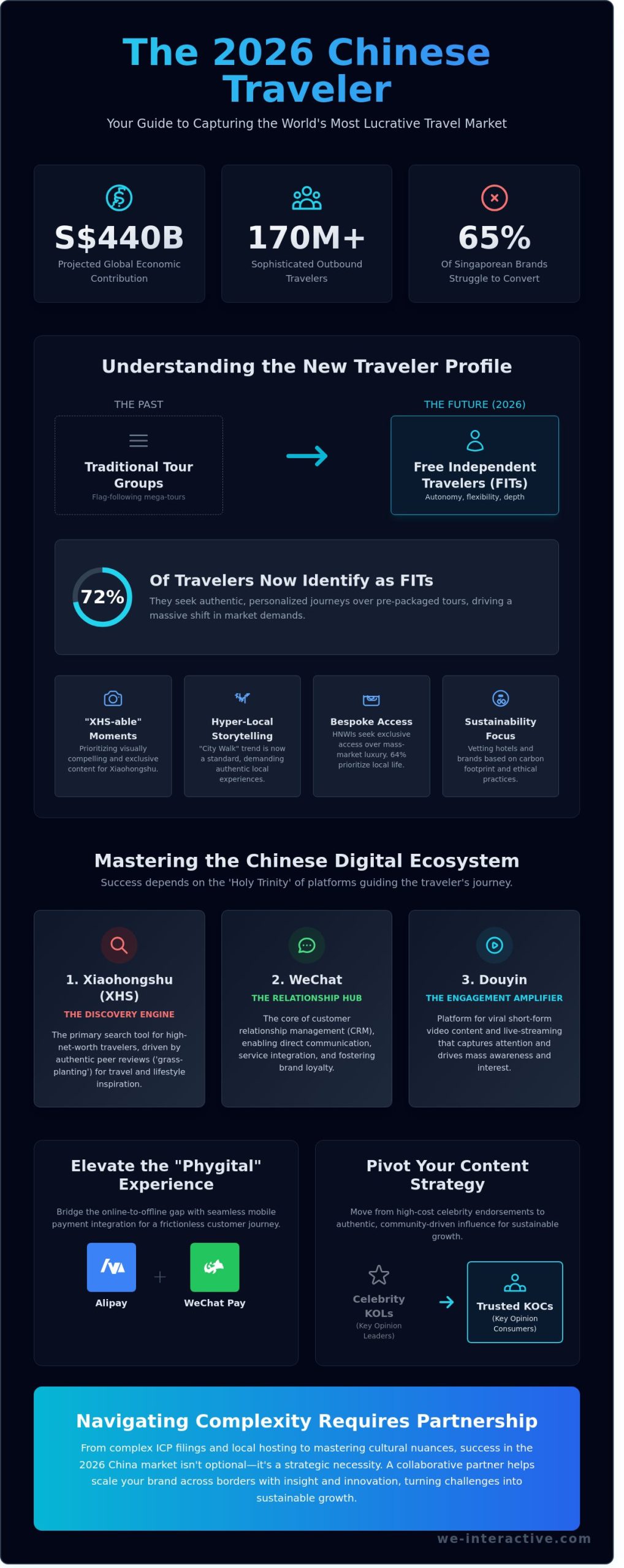
The global travel landscape shifted permanently after the post-pandemic reset. By 2026, the recovery phase has transitioned into a new era of dominance for what we call the “New Chinese Traveler.” This year marks a critical milestone where outbound departures from China are projected to surpass 2019 levels by 15%, driven by a massive middle class with a renewed, sophisticated wanderlust. China has solidified its position as one of the world’s largest outbound tourist markets, but the faces in the crowd look different now. We see a definitive move away from the flag-following mega-tours of the previous decade. Instead, 72% of travelers now identify as Free Independent Travelers (FITs). These individuals seek autonomy, flexibility, and depth in every journey they take.
In 2026, Chinese outbound tourism is defined as a digitally-integrated, high-value sector comprising over 170 million sophisticated travelers who are projected to spend more than S$410 billion globally on immersive and premium experiences.
For the Gen Z demographic, travel isn’t about ticking boxes on a map. It’s about “XHS-able” moments. Xiaohongshu (Little Red Book) has become their primary compass for discovery. If a destination isn’t visually compelling or culturally “exclusive,” it doesn’t exist in their digital ecosystem. They want the hidden cafe in a Singapore heritage shophouse or a private workshop with a local artisan, not just a standard photo op. This shift toward the “Experience Economy” means that the “City Walk” trend, which gained momentum in 2023, is now a standard travel requirement. Understanding this demand for hyper-local storytelling is the first step in learning how to market to chinese tourists effectively.
The Rise of the Sophisticated FIT
High-net-worth individuals (HNWIs) from Tier 1 cities like Shanghai and Shenzhen are leading this charge toward premiumization. They don’t want mass-market retail or generic luxury; they want bespoke access. Data from early 2025 indicated that 64% of millennial Chinese travelers prioritize “authentic local life” over traditional sightseeing. This includes a growing obsession with sustainability. Young travelers now vet hotels based on their carbon footprint and ethical practices. They want to feel like they’re contributing to a destination’s future, not just consuming its resources. WE Interactive helps brands bridge this gap by connecting strategy with these evolving values.
Why Traditional Marketing Fails
Relying on Western platforms is a recipe for total invisibility. Google, Facebook, and Instagram remain irrelevant within the mainland mindset. If your strategy relies on these channels, you’re shouting into a vacuum. Many brands still fall into the trap of “lazy translation,” simply swapping English words for Mandarin without considering cultural nuances. This often leads to brand erosion and missed ROI. To truly resonate, you need a partner that understands the “art and science” of the local digital landscape. Utilizing professional China Market Entry Services is no longer optional; it’s a strategic necessity for brands aiming to unlock long-term, sustainable growth. Knowing how to market to chinese tourists requires a total departure from “business as usual” marketing and a commitment to true cultural adaptation.
Mastering the Chinese Digital Ecosystem: The ‘Holy Trinity’ of Platforms
Understanding how to market to chinese tourists requires more than a simple presence on social media; it demands a deep mastery of a closed digital ecosystem. In Singapore, where Chinese arrivals reached 2.3 million in 2024, the competition for the tourist dollar is intense. Success depends on the ‘Holy Trinity’ of platforms: Xiaohongshu, WeChat, and Douyin. These apps don’t operate in isolation. They form a continuous loop that guides a traveler from initial curiosity to a final S$ transaction at a boutique in Orchard Road or a luxury hotel in Sentosa.
Xiaohongshu (XHS): The Discovery Engine
By 2026, Xiaohongshu will solidify its position as the primary search engine for high-net-worth Chinese travelers. It’s no longer just a photo-sharing app. It’s a trusted encyclopedia for lifestyle and travel inspiration. Users engage in ‘Zhong Cao’ or ‘grass-planting,’ where authentic peer reviews create a powerful desire for specific experiences. When a traveler searches for ‘best cafes in Tiong Bahru,’ they trust XHS influencers over traditional travel guides. To capture this interest, brands must integrate sophisticated Social Media Marketing that prioritizes raw, user-generated content over polished corporate advertisements. The latest China Outbound Travel Market report highlights that AI-powered itinerary planning and visa-free travel trends are driving users to XHS for real-time updates on Singapore’s latest attractions. If your brand isn’t ‘planted’ here, you don’t exist in the traveler’s planning phase.
WeChat: The Ultimate Conversion Tool
If XHS is for discovery, WeChat is where the business happens. This super-app is the bridge between interest and action. For a Singaporean business, the choice between an Official Account and a Mini-Program is vital. Official Accounts are your storytelling hub, while Mini-Programs act as lightweight apps for direct S$ bookings and payments via WeChat Pay. Using WeChat for 24/7 customer service through automated chatbots ensures you never miss a lead due to time zone differences. By linking your CRM & Customer Marketing to WeChat, you can track the entire lifecycle of a guest. This allows you to send personalized vouchers or loyalty rewards directly to their digital wallet, encouraging repeat visits and higher spend per head. It’s the science of marketing automation meeting the art of hospitality.
The final piece of the trinity is Douyin. This short-video powerhouse drives viral awareness through high-impact visual storytelling. A 15-second clip of the light show at Gardens by the Bay can garner millions of views overnight, creating the emotional spark that leads a user to research more on XHS. These platforms interact to create a seamless path to purchase. A traveler sees a viral video on Douyin, validates the experience through reviews on XHS, and finally completes their booking via a WeChat Mini-Program. WE Interactive helps brands align these digital touchpoints to ensure no potential customer falls through the cracks. It’s about being present where your audience lives, speaks, and spends. This integrated approach ensures your marketing spend isn’t just an expense, but a strategic investment in sustainable growth within the lucrative Chinese market.
Bridging the Gap: O2O Strategies and Mobile Payment Integration
The modern Chinese traveler doesn’t see a boundary between their smartphone and the physical store. They live in a ‘phygital’ world where online discovery dictates offline foot traffic. To master how to market to chinese tourists, brands must create a seamless loop that starts on a screen and ends at a Singaporean cash register. This journey is fueled by data and localized convenience. By the time a traveler lands at Changi Airport, they’ve likely already shortlisted brands based on digital reviews and social proof. Your job is to ensure that the final step from the street into your shop is frictionless.
Mobile payments are the heartbeat of this ecosystem. By 2026, relying on traditional credit cards or cash will alienate the majority of this high-spending demographic. According to 2026 Chinese travel trends, over 92% of Chinese tourists prefer using familiar mobile wallets like Alipay and WeChat Pay when abroad. These platforms aren’t just payment tools; they’re marketing engines. Location-based services (LBS) allow your brand to push geo-targeted offers. When a traveler is within 500 meters of your Orchard Road outlet, a well-timed digital coupon or ‘Red Packet’ can trigger an immediate retail action that a static billboard never could.
Alipay vs. WeChat Pay: A Comparison for Merchants
Choosing between these giants isn’t necessary; you need both to maximize your reach. While they share similar tech, their roles in the consumer journey differ. WE help you navigate these nuances to ensure your payment infrastructure drives growth.
| Feature | Alipay | WeChat Pay |
|---|---|---|
| Primary User Base | 1.3 Billion (Focus on Finance/Lifestyle) | 1.1 Billion (Focus on Social/Chat) |
| Transaction Fees (SG) | Typically 1.2% to 1.5% | Typically 1.2% to 1.6% |
| Marketing Strength | “City Discovery” platform and store rankings | Mini-Programs and social sharing circles |
Beyond transactions, these apps offer integrated tax-refund services. A tourist can receive their GST refund directly into their digital wallet in S$ equivalents, removing the hassle of paper forms. This familiarity builds immense trust. When a visitor sees the blue Alipay or green WeChat Pay logo, they feel the same security they do at home in Shanghai or Beijing.
Online-to-Offline (O2O) Tactics
Successful O2O strategies turn digital impressions into physical sales. Start by placing QR codes prominently in-store. These shouldn’t just be for payment; they should lead to your WeChat Official Account. This allows you to maintain a relationship after they leave Singapore. Use Dianping and Baidu Maps to secure your spot on ‘Must-Visit’ lists. These platforms act as the digital compass for tourists seeking authentic experiences.
WE believe in the science of marketing. To truly elevate your brand, you must track the journey from the first click to the final scan. By utilizing sophisticated Performance Marketing, we help you measure offline conversions triggered by digital ads. This data-driven approach ensures your S$ marketing spend delivers a clear, sustainable ROI. It’s about connecting strategy with performance to unlock the full potential of the Chinese market. When you bridge the gap between digital discovery and physical retail, you aren’t just selling a product; you’re shaping a seamless travel experience.
Content Strategy & Influence: Moving from KOLs to KOCs
Understanding how to market to chinese tourists requires a decisive shift from top-down celebrity endorsements to horizontal peer-to-peer trust. While high-profile Key Opinion Leaders (KOLs) still provide massive reach, the real power now lies with Key Opinion Consumers (KOCs). A KOC is a person whose authenticity drives 3x higher engagement than traditional influencers because their content functions as a relatable recommendation rather than a paid script. WE recognize that modern travelers prioritize these “real” voices when planning their itineraries. They want to see the unedited view from a hotel balcony or the actual portion size at a restaurant before they commit their S$500 per night budget.
Live-streaming for travel is no longer a futuristic concept; it’s a 2026 necessity for Singaporean hotels and attractions. This interactive format allows potential visitors to ask questions in real-time about everything from safe-entry procedures to the proximity of the nearest MRT station. It builds immediate, visceral trust that static images cannot replicate. If your brand isn’t broadcasting live on platforms like Xiaohongshu or Douyin, you’re losing a critical window of influence to competitors who are already engaging in these digital conversations.
The requirement for social proof has never been higher. Data indicates that 100 small, honest reviews from verified travelers carry more weight than a single high-budget advertisement. Chinese tourists are savvy; they look for the “social receipt” of others who have gone before them. A single polished ad might catch the eye, but ten organic posts from KOCs showing their authentic experiences will close the sale.
Identifying the Right Partners
Smart budget allocation involves moving away from expensive mega-influencers toward micro-influencers and niche experts. Instead of spending S$15,000 on a single post from a celebrity, WE recommend distributing that investment across twenty micro-influencers. These might be “Art-deco enthusiasts” who focus on Singapore’s heritage architecture or “Glamping experts” looking for luxury outdoor experiences. These creators have smaller but fiercely loyal followings. It’s also vital to ensure this content aligns with Search Engine Optimization on internal platform search engines. When a user searches for “best boutique hotel in Singapore,” your partner’s content must be strategically optimized to appear at the top of the discovery feed. This is the most effective way to learn how to market to chinese tourists who rely on platform-specific searches rather than global search engines.
The Art of ‘Grass-Planting’
In the Chinese digital ecosystem, this strategy is known as “Zhongcao” or grass-planting. It’s the methodical process of seeding organic-looking content that doesn’t feel like a promotional intrusion. You can encourage this behavior by offering guests tangible rewards, such as a S$20 dining credit or a late checkout, in exchange for posting their honest reviews on Xiaohongshu. This creates a self-sustaining cycle of content creation. However, you must also be prepared for “Black Swan” events. A single negative viral post can damage a reputation overnight. Managing this requires a proactive team that monitors social mentions 24/7 and responds with transparency and speed. Addressing a complaint within two hours can often turn a disgruntled visitor into a brand advocate, proving that your brand values the guest experience above all else.
Partner with WE Interactive to transform your digital influence into measurable growth.
Executing Your China Strategy: Why Partnership Matters
Mastering how to market to chinese tourists requires more than a translated brochure or a basic WeChat account. It demands a robust technical and strategic foundation that respects the unique digital borders of the mainland. Success in this space isn’t about short-term wins; it’s about building a sustainable presence that resonates with a sophisticated audience. At WE Interactive, we believe that true growth happens when we align your brand’s DNA with the cultural nuances of the Chinese traveler.
The Complexity of the ‘Great Firewall’
Your existing website likely faces a major hurdle. Most Singaporean sites hosted on international servers load up to 80% slower in Beijing than they do in Orchard Road. In a market where 95% of users access the internet via mobile, a three-second delay means losing a potential customer. Effective Website Development for China involves more than just speed; it requires navigating the legal labyrinth of ICP (Internet Content Provider) filings. Without a valid ICP Bei’an, which typically takes 20 business days to process, your site risks being throttled or blocked entirely.
Compliance is a moving target. By 2026, data privacy regulations under the Personal Information Protection Law (PIPL) will impose even stricter requirements on how Singaporean brands handle the data of Chinese nationals. We ensure your infrastructure isn’t just fast, but fully compliant with local hosting requirements and data residency laws. This technical precision creates the trust necessary for high-value conversions.
Why WE Interactive is Your Strategic Partner
Since 2009, we’ve been at the forefront of the Asian digital landscape. We don’t act as a mere service provider; we operate as a strategic partner committed to our “Growing Together” philosophy. Our team has delivered over 700 successful campaigns, helping brands turn their digital presence into a powerful force for ROI. We understand that knowing how to market to chinese tourists means balancing the art of creative storytelling with the science of performance marketing.
Our process is proven and meticulous. We move your brand from clicks to conversations and from impressions to conversions. This journey includes:
- Strategic Insight: Analyzing real-time traveler data to identify high-intent segments.
- Creative Excellence: Crafting narratives that speak to the aspirational desires of the modern Chinese consumer.
- Performance Optimization: Using data-driven tactics to ensure every S$1 spent contributes to measurable growth.
The impact of an integrated strategy is clear. In a recent 2024 project for a luxury retail client, we implemented a cross-border digital ecosystem that resulted in a 42% increase in foot traffic from Chinese tourists within six months. This wasn’t achieved through isolated ads, but through a seamless journey from a Douyin video to a localized booking engine. We help you unlock these complex pathways to ensure your brand remains top-of-mind before the traveler even leaves Changi Airport.
The Chinese market offers unparalleled opportunities for Singaporean businesses ready to invest in the right partnership. It’s time to move beyond guesswork and start building a legacy. Our expertise empowers you to navigate these complexities with confidence, ensuring your brand doesn’t just enter the market, but leads it.
Ready to elevate your brand for the Chinese market?
Seize the 2026 Opportunity: Elevate Your Brand Beyond the Great Firewall
Navigating the complex landscape of how to market to chinese tourists requires more than just a digital presence; it demands a fusion of cultural insight and technical precision. By 2026, success hinges on mastering the ‘Holy Trinity’ of platforms and shifting from high-cost KOLs to authentic, community-driven KOCs. It’s about creating seamless O2O experiences that bridge the gap between a smartphone screen and a physical storefront in Singapore. Brands that fail to integrate mobile payment solutions or ignore local digital regulations will find themselves invisible to this high-spending demographic.
Since 2009, WE Interactive has delivered over 700 campaigns, helping businesses unlock significant, sustainable growth. With strategic offices in Singapore, Jakarta, and Bangkok, we possess the local expertise and technical knowledge to bypass the Great Firewall effectively. We’ve spent fifteen years pushing boundaries and shaping digital success with innovation. It’s time to turn your digital presence into a powerful force for conversion. Unlock your brand’s potential in the Chinese market with WE Interactive. Let’s start growing together and turn these insights into measurable ROI for your business today.
Frequently Asked Questions
Do I need a Chinese business license to market on WeChat and Xiaohongshu?
You don’t need a local Chinese business license to launch your brand on these platforms. You can register an official account using your Singapore ACRA business profile. Over 85% of international brands successfully use this route to connect with tourists. WE Interactive helps you navigate these verification steps to ensure your brand remains compliant and professional from day one.
Is it worth marketing to Chinese tourists if I don’t have Chinese-speaking staff?
Investing in these digital channels is highly profitable even without native speakers on your team. Over 82% of Chinese travelers rely on translation apps and digital menus during their stay in Singapore. Implementing QR code systems and clear visual signage removes 90% of communication barriers. It’s about creating a seamless experience through technology rather than just verbal fluency.
Which platform is better for luxury travel: WeChat or Xiaohongshu?
Xiaohongshu is the leader for high-intent discovery, while WeChat is the gold standard for customer loyalty. 75% of luxury travelers use Xiaohongshu to plan their itineraries before leaving home. WeChat acts as your digital storefront to provide personalized service. We recommend a balanced strategy that uses Xiaohongshu for reach and WeChat for building long-term relationships.
How much should a mid-sized business budget for a China entry campaign in 2026?
A mid-sized business should budget between S$12,000 and S$20,000 for an initial three-month entry campaign in 2026. This investment covers high-quality content production and targeted influencer collaborations. Data from 2024 shows that brands spending at this level see a 40% increase in foot traffic within the first six months. We focus on optimizing this spend to maximize your ROI.
What is ‘Grass-planting’ (Zhong Cao) and why is it vital for tourism?
Grass-planting is the strategic act of sowing the seeds of desire for your brand through authentic social reviews. It’s the most powerful method for those learning how to market to chinese tourists in a crowded landscape. Since 88% of travelers trust user-generated content over traditional ads, this strategy builds the social proof needed to drive physical visits and conversions.
How do I accept Alipay and WeChat Pay at my physical location?
You can accept these payments by partnering with local Singaporean aggregators like NETS, Liquid Group, or FOMO Pay. These providers allow you to settle transactions directly in SGD, usually with a 1.5% to 2.2% transaction fee. Since 94% of Chinese visitors prefer using mobile wallets, this simple integration can increase your store’s average transaction value by 25%.
Can I run ads on Chinese social media without a local bank account?
You don’t need a local bank account to run paid advertisements on platforms like WeChat or Xiaohongshu. International brands can fund their ad accounts using Singapore-issued credit cards or telegraphic transfers. WE Interactive manages these cross-border payments for our partners to ensure your campaigns never stop. This flexibility allows you to scale your reach without complex financial hurdles.