
The 2026 Landscape of Chinese Tourism in Singapore
By 2026, the travel corridor between China and the Little Red Dot has matured into a high-frequency, friction-less gateway. The permanent 30-day visa-free policy, established in early 2024, has fundamentally rewritten the playbook for Tourism in Singapore. We’ve moved past the era of massive tour buses and megaphone-led groups. Today’s visitor is a sophisticated, independent explorer who views Singapore not as a bucket-list destination, but as a lifestyle extension. This shift means marketing to chinese tourists singapore requires a pivot from broad awareness to precision-targeted emotional resonance.
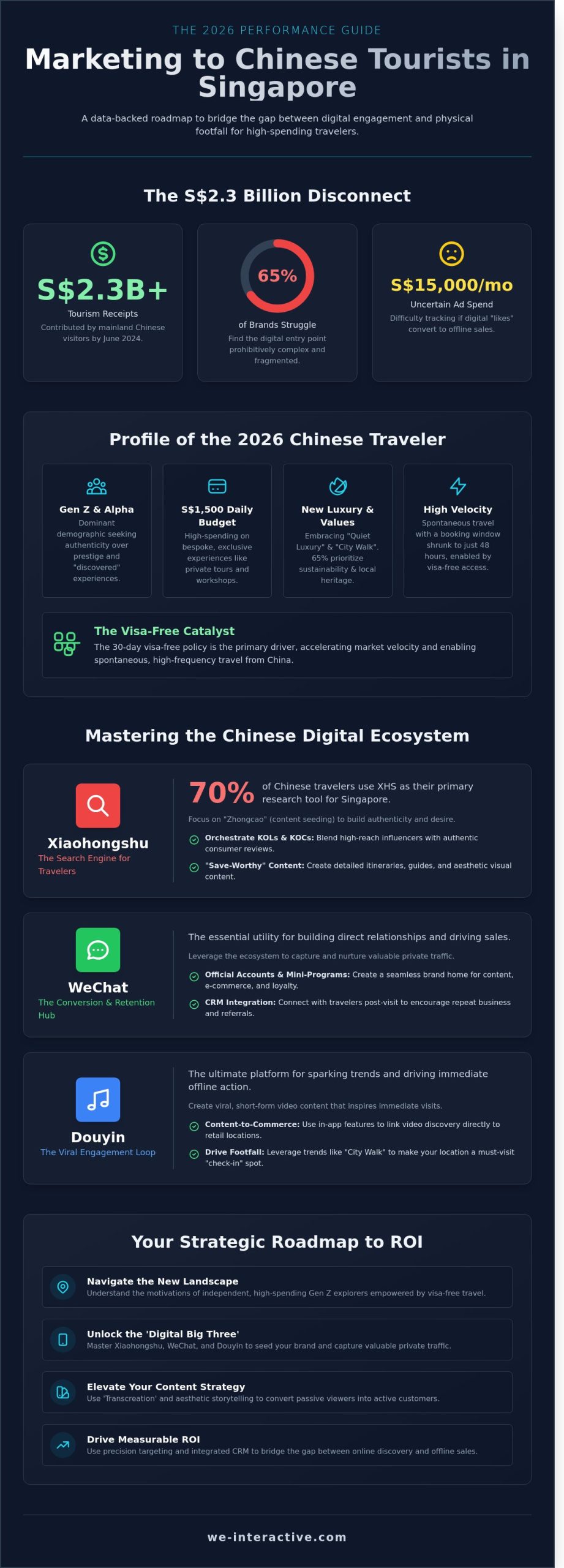
The “New Chinese Traveler” seeks depth over distance. They’re moving away from the “check-in” culture of the past and embracing “Quiet Luxury” and “City Walk” trends. In 2026, luxury isn’t just about the price tag; it’s about exclusivity, privacy, and cultural intellectualism. These travelers spend their S$1,500 daily budgets on bespoke gin-tasting sessions in Chinatown or private architectural tours of Interlace rather than just luxury handbags. They rely on a digital “infrastructure” that’s invisible but omnipresent. If your brand isn’t integrated into the WeChat, Alipay, and Xiaohongshu ecosystem, you effectively don’t exist in their itinerary.
- Spontaneous Arrivals: The booking window has shrunk from weeks to just 48 hours.
- Value Alignment: Sustainability and local heritage are now primary decision drivers for 65% of Tier 1 city travelers.
- Digital First: Content-to-commerce loops on Douyin drive immediate footfall to Singaporean retail spots.
Demographic Shifts: Gen Z and Alpha Travelers
The 2026 market is dominated by Gen Z and the emerging Alpha generation who travel with their affluent parents. These youngsters value authenticity over prestige. They don’t want the polished version of Marina Bay Sands; they want the “hidden” Singapore. They’re searching for “niche” experiences like artisanal coffee shops in Tiong Bahru or vinyl listening rooms in Geylang. The ‘City Walk’ phenomenon has redefined 2026 retail by turning Singapore’s historic backstreets into lucrative touchpoints where spontaneous discovery drives premium consumer spending. Brands must capture this demographic by telling a story that feels “discovered” rather than “pushed.”
The Visa-Free Catalyst and Market Velocity
Reduced friction has accelerated the market’s velocity to unprecedented levels. With no visa hurdles, a resident from Shanghai can decide on a Thursday to spend the weekend in Sentosa. This spontaneity demands an “always-on” digital presence. You can’t rely on seasonal campaigns anymore. Success in 2026 depends on real-time engagement and data-driven agility. To stay ahead, many brands are leveraging China market entry services to navigate this high-velocity landscape. It’s about being present in the right feed at the exact moment a traveler feels the urge to escape. When marketing to chinese tourists singapore, the goal is to turn digital impressions into physical footfall through seamless, one-click conversions.
Mastering the Chinese Digital Big Three: XHS, WeChat, and Douyin
Successfully marketing to chinese tourists singapore requires more than just translating your existing website into Mandarin. It demands a sophisticated presence within the digital ecosystems where these travelers live, breathe, and plan. The “Big Three”-Xiaohongshu, WeChat, and Douyin-form a closed loop of discovery, utility, and viral engagement. At WE Interactive, we help brands bridge this gap by turning digital touchpoints into high-conversion pathways. WE Interactive believe in growing together by balancing the art of social media with the science of marketing automation.
Xiaohongshu: The Search Engine for Travelers
Xiaohongshu (XHS) has evolved into the primary research tool for 70% of Chinese travelers visiting the city-state. It functions as a trusted peer-review platform where “Zhongcao” or content seeding creates immediate desire. Brands shouldn’t just post corporate updates; they need to orchestrate a mix of high-reach Key Opinion Leaders (KOLs) and “grassroots” Key Opinion Consumers (KOCs) to build authenticity. To win the XHS algorithm, focus on “save-worthy” content such as detailed 48-hour itineraries or “Instagrammable” guides to locations like Joo Chiat. High-quality vertical cover images and keyword-rich captions are essential for visibility in search results.
WeChat Ecosystem: Conversion and Retention
WeChat is the operational backbone for any brand targeting the Chinese market. It’s the “Super App” where “Siyu” (private traffic) thrives. Mini Programs are particularly vital, allowing users to book tickets, view menus, or access concierge services in Mandarin without ever leaving the app. This creates a frictionless user experience that mirrors the expectations of a digitally native audience. By integrating professional social media marketing, your brand can transform an official account from a simple broadcast channel into a robust loyalty hub. Consider these strategic moves:
- WeChat Pay as a Hook: Use payment-based marketing, such as offering a S$10 discount on the first transaction, to capture data and drive immediate sales.
- CRM Integration: Connect Mini Program data to your loyalty system to offer personalized rewards for returning visitors.
- Direct Communication: Use WeChat Work to provide one-on-one service, mimicking the high-touch hospitality Chinese tourists expect.
Douyin: Viral Awareness and Immersive Storytelling
While XHS is for research, Douyin is for inspiration. Short-form video allows for immersive storytelling that captures the “wow” factor of Singapore. A 15-second clip of the Rain Vortex at Jewel Changi or a cinematic montage of a luxury suite can trigger viral awareness that reaches millions. The goal is cross-platform synergy. You move users from a Douyin video to an XHS review for validation, and finally to a WeChat Mini Program for the booking. Data tracked by the Singapore Tourism Board shows that visitors increasingly seek these personalized, seamless journeys. WE Interactive specialize in aligning these platforms to move users from clicks to conversations, ensuring your brand stays top-of-mind throughout the travel cycle. If you’re ready to elevate your brand and unlock significant growth, it’s time to master these digital giants. Marketing to chinese tourists singapore is a journey of constant optimization, and we’re here to lead the way.
Content Strategies That Convert: From Clicks to Conversations
Effective marketing to chinese tourists singapore requires a shift from simple translation to deep transcreation. While translation swaps words, transcreation adapts the message to resonate with the cultural values and linguistic nuances of the 2024 Chinese traveler. A 2023 consumer report indicated that localized content sees a 40% higher engagement rate than generic translated ads. It’s about understanding that a traveler from Shanghai views a luxury stay at Marina Bay Sands differently than a local would. We focus on the emotional hook, ensuring your brand story feels native to the platforms where these conversations happen.
Visual storytelling is no longer optional; it’s the primary currency of the modern traveler. The “aesthetic” of a location or product determines its “Daka” (check-in) potential on Xiaohongshu. High-quality, vertically-oriented video and polished imagery are essential to bridge the trust gap. Brands must implement sophisticated marketing strategies for Chinese tourists to validate their offerings through social proof. Since 72% of Chinese travelers prioritize peer recommendations and live-streamed demonstrations over traditional corporate brochures, your content must feel lived-in and verified.
At WE Interactive, we balance the art of creative hooks with the science of data-driven distribution. It’s not enough to have a beautiful video; it must be served to the right user at the right moment of their booking journey. We use performance metrics to optimize every asset, ensuring your creative work delivers a measurable ROI. This methodology turns fleeting impressions into lasting brand loyalty, moving the needle from simple clicks to meaningful conversations.
The Power of Influencer Partnerships (KOLs)
Successful marketing to chinese tourists singapore relies on selecting Key Opinion Leaders (KOLs) based on conversion data rather than vanity metrics. While a celebrity might have millions of followers, a micro-influencer specializing in Singapore’s “hidden gem” cafes often yields a higher S$ return per post. For niche retail or F&B brands, a micro-KOL with 50,000 highly engaged followers is often more effective than a massive star. When we craft a content brief, we provide the brand pillars but allow for creative freedom. This ensures the influencer’s voice remains authentic, which is the only way to maintain trust with an increasingly skeptical audience.
Interactive and Immersive Digital Experiences
Immersive technology turns a passive viewer into an active participant. Using AR filters on platforms like WeChat or interactive maps that highlight S$ discounts in Orchard Road enhances the “on-ground” experience. Your website development must prioritize mobile-first, high-speed browsing to accommodate the expectations of Chinese users accustomed to the seamless integration of the Great Firewall-optimized ecosystem. If a page takes longer than three seconds to load on a roaming connection, you’ve already lost the lead. The deployment of 5G-enabled interactive content eliminates latency, allowing tourists to engage with high-fidelity AR tours that increase average dwell time at Singaporean landmarks by up to 25%.
From Impressions to ROI: Performance Marketing and CRM
Digital impressions mean nothing if they don’t lead to a swiped card at a boutique in Orchard Road or a check-in at a Sentosa resort. For brands focused on marketing to chinese tourists singapore, the challenge lies in bridging the gap between a user’s initial discovery in Beijing and their final transaction in Singapore. Success requires moving beyond vanity metrics to track the full traveler journey. By late 2023, data from the Singapore Tourism Board indicated that Chinese visitors were among the highest spenders, with per capita expenditure often exceeding S$3,800. Capturing this value demands a precision-engineered approach that treats every ad dollar as an investment in a measurable outcome. WE help you track these movements from the first click on a mobile screen to the final offline conversion.
Data-Driven Performance Marketing
Capturing high-intent traffic starts months before the traveler reaches Changi Airport. Baidu remains the dominant search gateway, handling over 600 million monthly active users. We focus on Baidu SEO and SEM to ensure your brand appears the moment a traveler searches for “Singapore luxury shopping” or “unique dining experiences in SG.” This isn’t just about visibility; it’s about capturing intent at the source. Programmatic advertising within the Chinese ecosystem allows us to target users based on real-time behaviors, such as booking a flight to Singapore or browsing travel itineraries on Mafengwo. Our performance marketing approach prioritizes conversion over clicks. We use sophisticated tracking to minimize “waste” spend, ensuring your budget reaches the top 20% of high-net-worth travelers who drive the majority of luxury retail revenue. This science of marketing ensures every interaction is a step toward a confirmed booking.
CRM and Loyalty for the Global Chinese Traveler
The “Private Traffic” revolution has changed how we view the tourist lifecycle. A single visit to Singapore shouldn’t be a one-off transaction. By implementing CRM & marketing automation through WeChat Mini Programs, we turn transient tourists into lifelong brand advocates. This involves capturing user data at the point of sale in Singapore and nurturing that relationship once they return home. We build global loyalty programs that recognize a user’s status regardless of geography. If a customer spends S$5,000 at your Singapore flagship, your CRM should ensure they receive personalized rewards via WeChat when they’re back in Shanghai. Measuring Customer Lifetime Value (CLV) across international borders allows us to optimize campaigns in real-time. We analyze which specific touchpoints led to the highest spend, then reallocate resources to those high-performing channels. WE believe in growing together with our clients by turning raw data into a competitive advantage. This strategy empowers your brand to move from broad awareness to precise, sustainable growth. By connecting strategy, creativity, and performance, we ensure your brand remains top-of-mind long after the flight home.
Ready to turn digital engagement into measurable revenue? Connect with our performance experts today to scale your impact in the Singapore market.
Elevate Your Brand: Why Partner with WE Interactive
Success in the Chinese market requires more than a translated brochure. It demands a partner who lives and breathes both cultures. Since 2009, WE Interactive has bridged the gap between Singaporean businesses and the Chinese digital landscape. We’ve delivered over 700 successful campaigns, helping brands turn their digital presence into a powerful force for growth. Our team doesn’t just provide services; we act as a strategic partner to ensure your brand stands out in a crowded marketplace.
Our “Growing Together” philosophy means we treat your ROI as our primary metric. We don’t settle for vanity metrics like simple “likes” or “follows.” While other agencies might track impressions, we focus on the transition from clicks to conversations and from impressions to conversions. We believe in the art of storytelling and the science of marketing automation. Your bottom line is our priority, and we’re committed to delivering significant, sustainable growth for your business.
The unique “WE” approach combines local Singaporean insight with deep China digital expertise. We understand the physical nuances of Orchard Road or Marina Bay Sands as well as the digital algorithms of WeChat, Douyin, and Xiaohongshu. This dual perspective ensures your strategy for marketing to chinese tourists singapore is both culturally relevant and technologically advanced. We empower your brand to speak the language of the modern Chinese traveler through data-driven strategies and creative innovation.
Our comprehensive services cover everything from initial China market entry to performance optimization. We provide the tools to unlock your brand’s potential, focusing on measurable results. Whether you’re a luxury retailer or a local attraction, we help you navigate the complexities of cross-border digital engagement with confidence and precision.
Our Proven Process for China Marketing
Phase 1 involves a deep-dive market research and audience segmentation. We analyze 2024 consumer data to identify high-value segments. We don’t guess; we use data to determine where your potential customers spend their time and money. This phase ensures your budget is targeted toward the travelers most likely to visit your Singapore location and spend their S$ here.
Phase 2 focuses on platform setup and localized content “transcreation.” This process goes beyond literal translation. We rewrite your brand story to resonate with the Chinese traveler’s aspirations while maintaining your unique Singaporean identity. We build your presence on platforms like WeChat or RED, ensuring every piece of content feels native, authentic, and engaging to the target audience.
Phase 3 is all about performance-led execution and continuous ROI optimization. We monitor campaigns in real-time, adjusting tactics to maximize impact. By analyzing conversion data daily, we ensure your marketing to chinese tourists singapore remains agile. We optimize every touchpoint to turn digital interest into physical footfall at your business, ensuring every S$1 spent works harder for you.
Ready to Take the Next Step?
Start your journey into the Chinese tourist market with a strategic audit of your current digital presence. In 2023, we helped a local Singaporean retail brand achieve a 42% increase in store footfall from mainland visitors within just six months. We didn’t just increase visibility; we drove high-intent shoppers directly to their counters. Unlock your brand’s potential in the Chinese market today.
Master the 2026 Chinese Traveler Experience
The roadmap to 2026 requires a shift from broad visibility to precision performance. Success in marketing to chinese tourists singapore depends on your ability to navigate the “Digital Big Three” while maintaining a seamless CRM loop that converts curiosity into loyalty. It’s not just about being seen on Xiaohongshu or Douyin; it’s about creating a data-driven journey where every S$ spent drives measurable ROI. Brands that fail to integrate their social strategy with performance marketing will likely find themselves left behind in an increasingly competitive Singaporean landscape.
At WE Interactive, we’ve spent over 15 years perfecting the art of digital growth. Our team has delivered 700+ campaigns, acting as a trusted strategic partner for iconic brands like Singapore Airlines and Starbucks. We combine creative storytelling with technical innovation to ensure your brand doesn’t just enter the market but leads it. From initial clicks to lasting conversations, we provide the expertise needed to unlock sustainable growth in the Lion City.
Elevate your brand and capture the Chinese travel market with WE Interactive
Let’s shape the future of your digital success together.
Frequently Asked Questions
Is Xiaohongshu (XHS) better than WeChat for marketing to Chinese tourists?
Xiaohongshu is currently superior for brand discovery and lifestyle inspiration, while WeChat remains the essential tool for CRM and loyalty. Data from 2024 shows 80% of Gen Z travelers use XHS to plan their Singapore itineraries. WE recommend XHS for top-of-funnel awareness and WeChat for conversion and after-sales service. This dual approach ensures you capture interest and maintain relationships throughout the entire visitor journey.
How much should a Singapore business budget for a Chinese marketing campaign in 2026?
A Singapore business should budget between S$5,000 and S$15,000 monthly for a mid-tier Chinese marketing campaign in 2026. This range covers content creation, platform management, and targeted ad spend. We anticipate a 12% rise in digital acquisition costs by 2026 due to increased competition in the Singapore tourism sector. Investing at this level allows for high-quality KOL collaborations that drive measurable footfall to your physical outlets.
Do I need a legal entity in China to run ads on XHS or Douyin?
You don’t need a mainland Chinese legal entity to run ads on XHS or Douyin. These platforms allow Singapore-registered companies to open official advertising accounts using their ACRA business profile. WE handle the verification process, which typically takes 5 to 10 working days. This streamlined access lets you launch your marketing to chinese tourists singapore strategy without the complexity of setting up a foreign-owned enterprise.
How do I track offline sales from Chinese social media ads?
Track offline sales by implementing unique QR codes and digital coupons tied to specific social media campaigns. When a tourist scans a WeChat Mini Program code or redeems an XHS-exclusive discount at your Singapore storefront, the transaction is logged in your CRM. Since 90% of Chinese visitors prefer mobile payments like Alipay or WeChat Pay, integrating these systems provides a direct link between digital impressions and physical conversions.
What is the difference between a KOL and a KOC in the Chinese market?
Key Opinion Leaders (KOLs) are professional influencers with followings over 100,000, while Key Opinion Consumers (KOCs) are everyday users with 1,000 to 10,000 followers. KOLs amplify your brand reach through high-impact storytelling and professional production. KOCs provide the social proof and authentic reviews that 75% of Chinese consumers look for before purchasing. Balancing both types of creators optimizes your ROI by blending mass visibility with grassroots credibility.
Can I use my existing English marketing content for the Chinese market?
You shouldn’t use existing English marketing content because direct translations often lose cultural nuance and emotional resonance. Effective marketing to chinese tourists singapore requires content tailored to local slang, aesthetic preferences, and platform-specific trends. Statistics show that localized campaigns achieve 3 times higher engagement rates than translated ones. WE transform your brand story into a narrative that speaks directly to the aspirations of the modern Chinese traveler.
What are the common legal pitfalls when advertising to mainland Chinese users?
Common pitfalls include violating the PRC Advertising Law, which bans superlative terms like “best,” “number one,” or “first.” Fines for non-compliance can exceed S$185,000 per violation. You must also adhere to the Personal Information Protection Law (PIPL) when collecting user data. Our strategic approach ensures every campaign remains compliant with both Chinese regulations and Singapore’s PDPA standards, protecting your brand reputation and bottom line.
How long does it typically take to see results from a China market entry strategy?
It typically takes 3 to 6 months to see significant, sustainable results from a China market entry strategy. While you’ll see initial engagement and clicks within the first 30 days, the algorithm requires 90 days of consistent data to optimize your ad performance. WE focus on building a long-term digital presence that turns initial curiosity into consistent footfall. This timeline allows for the testing and refinement necessary to maximize your ROI.