

Is the dream of a fully self-reliant marketing department actually sabotaging your 2026 growth targets? While keeping everything under one roof feels safe, the reality of the in-house marketing vs agency model debate is shifting as talent costs in Singapore continue to climb. You’ve likely felt the pressure of a competitive market where a single senior performance lead often commands over S$8,000 per month according to recent industry salary benchmarks. It’s an uphill battle to keep pace with weekly AI updates when your internal team is already buried in daily operations.
We believe that your marketing should be a powerful force for growth, not a drain on your resources. This guide unlocks a granular analysis of cost, capability, and scalability to help you determine which model drives the highest ROI for your brand. We’ll explore how to access specialized tools and cross-industry insights that lower your cost per acquisition and empower your business to scale with confidence.
Key Takeaways
- Uncover the “Salary Trap” by calculating why base pay is only 60% of an in-house employee’s true cost when factoring in S$ overheads and CPF contributions.
- Master the balance between the deep brand intimacy of internal teams and the specialized technical depth and cross-industry data provided by agency experts.
- Navigate regional scaling challenges across Singapore, Jakarta, and Bangkok by evaluating why briefing a partner is significantly faster than hiring local teams.
- Optimize your ROI by exploring a hybrid in-house marketing vs agency model that keeps core strategy internal while outsourcing high-speed execution.
- Elevate your brand through a strategic partnership that blends the art of creative storytelling with the science of data-driven performance.
Calculating the Total Cost of Ownership: In-House vs. Agency Fees
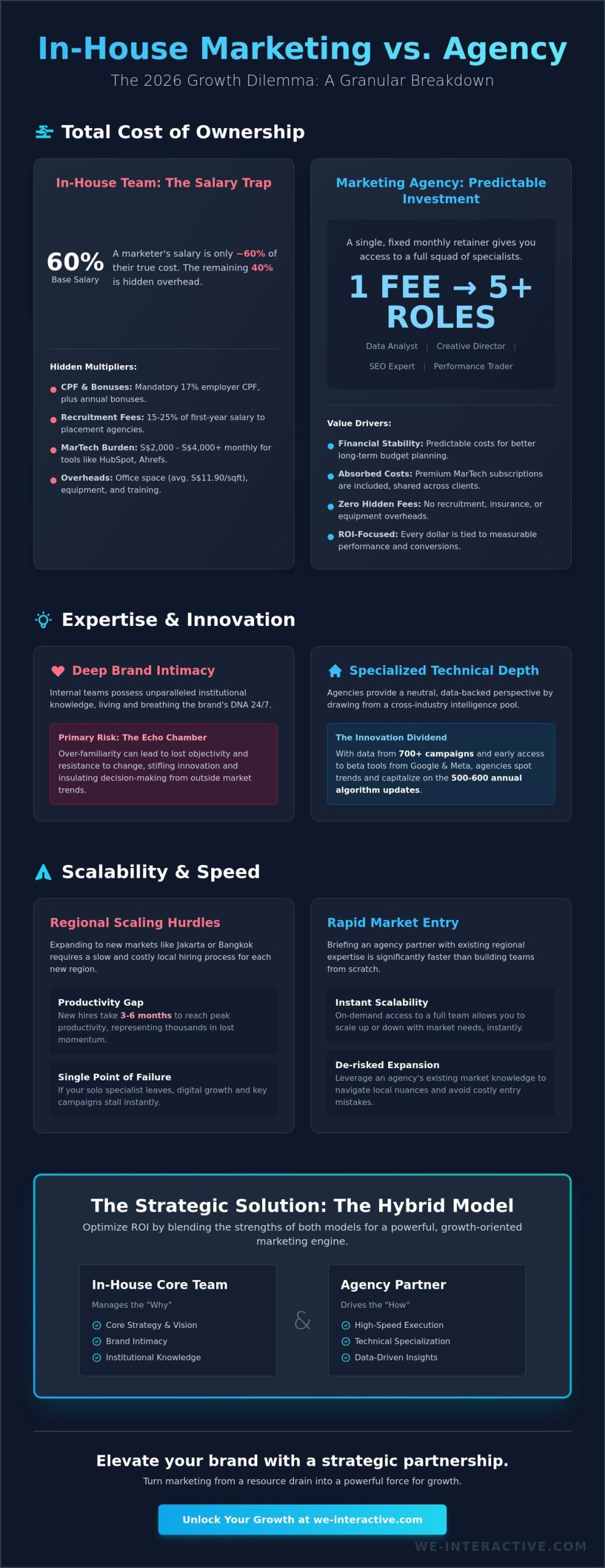
Deciding between an in-house marketing vs agency model requires looking past surface-level numbers. Most businesses fall into the “Salary Trap” by only considering base pay. In Singapore’s competitive talent market, a marketer’s base salary represents roughly 60% of their actual cost to your business. When you factor in the mandatory 17% employer CPF contribution, annual bonuses, and medical insurance, a S$75,000 annual salary quickly swells beyond S$100,000.
Office space and equipment add another layer of overhead. In late 2024, Grade A office rents in the CBD averaged S$11.90 per square foot. Every desk you fill carries this recurring cost. Then there is the “MarTech Burden.” To compete in 2026, your team needs premium subscriptions for SEO, CRM, and analytics platforms. Tools like HubSpot, Ahrefs, or Salesforce can easily cost S$2,000 to S$4,000 monthly. Agencies absorb these costs across their entire client base. Internal teams bear the full weight alone, often leading to fragmented toolsets that limit data visibility.
The Hidden Multipliers of Internal Teams
Recruiting top-tier talent is a significant capital outlay. Recruitment agencies in Singapore typically charge 15% to 25% of a candidate’s first-year salary as a placement fee. Once hired, a new marketer takes 3 to 6 months to reach peak productivity. This “productivity gap” represents thousands of dollars in lost momentum. You also face the “Single Point of Failure” risk; if your solo specialist leaves, your digital growth stalls instantly. Keeping internal staff updated on 2026 trends requires continuous investment in expensive certifications and workshops, adding further volatility to your budget.
Agency Pricing Models: Transparency and ROI
Gaining a clear understanding of what is a marketing agency helps clarify the value of the partnership. Instead of one generalist, you gain access to a “squad” of specialists including data analysts, creative directors, and performance traders for a single predictable fee. This model provides financial stability through fixed monthly retainers, allowing for better long-term planning. WE Interactive prioritizes Performance Marketing to ensure every dollar spent translates into measurable conversions. Our Performance Marketing Guide outlines how we use data-driven frameworks to drive ROI. We help brands turn their digital presence into a powerful force, moving from clicks to conversations and impressions to conversions through strategic precision.
Specialized Expertise vs. Brand Intimacy: Finding the Balance
Deciding between an in-house marketing vs agency model often requires a choice between depth and breadth. Brand intimacy is the deep, 24/7 understanding an internal team possesses. These employees live and breathe the product’s DNA; they understand every S$1 spent on local acquisition and the subtle nuances of the Singaporean consumer. They’re present for every hallway conversation and product pivot, creating a repository of institutional knowledge that’s hard to replicate externally.
Specialized expertise offers a different kind of power. While an internal team focuses on one brand, an agency draws from a cross-industry intelligence pool. WE Interactive utilizes data from over 700 campaigns to predict what works in the current market. This technical depth allows us to spot trends in consumer behavior across retail, finance, and tech before they become mainstream. It’s the difference between knowing one garden perfectly and understanding the entire ecosystem’s climate.
Internal teams frequently face the echo chamber risk. When you’re too close to the brand, you lose creative objectivity. Decision-making becomes insulated, and teams might stop questioning “the way we’ve always done it.” Agencies break this cycle by providing a neutral, data-backed perspective that challenges the status quo. They bring the necessary friction that sparks innovation.
The Innovation Dividend of Agencies
Agencies act as a beta test hub for the latest platform features on Google, Meta, and TikTok. Because we manage high-volume accounts, we often gain early access to tools that aren’t yet available to the general public. This is critical for maintaining a competitive edge in a fast-moving digital space. For instance, staying ahead of the 500 to 600 algorithm updates Google makes annually requires the dedicated focus found in professional SEO Services. We define the Expertise Dividend as the tangible value gained from an agency’s collective experience across hundreds of unique business challenges. This dividend ensures your brand isn’t learning from its own mistakes, but from the combined successes of many.
Maintaining Brand Soul in an Agency Model
You don’t have to lose your brand’s essence when working with external partners. Success depends on a rigorous onboarding strategy that ensures 100% alignment. We recommend these steps for a seamless integration:
- Shared access to internal Slack channels or communication hubs.
- Deep-dive workshops on brand voice and customer personas.
- Regular “pulse checks” to ensure creative output matches the brand’s core values.
Authentic Social Media Marketing is a key tool in this process. It requires a delicate balance of the art of storytelling and the science of engagement to build real conversations with your audience. WE Interactive uses a “Growing Together” philosophy to bridge the gap between external and internal teams. We don’t just function as a vendor; we operate as a strategic partner that empowers your brand to reach its full potential. If you’re looking to scale your impact while keeping your brand soul intact, exploring a performance-driven partnership could be your next strategic move.
Scalability and Speed: Navigating Global Markets in 2026
Speed is the primary currency for brands looking to dominate the Southeast Asian landscape. When comparing the in-house marketing vs agency model, the most glaring difference is the time required to achieve operational scale. Hiring a specialized team of ten experts in Singapore typically takes four to six months, considering recruitment cycles and notice periods. In contrast, briefing an agency allows you to activate a full-scale department in under 72 hours. This immediacy is vital when a competitor launches a disruptive campaign or a new market opportunity emerges in Jakarta or Bangkok.
Expanding across borders introduces layers of friction that internal teams rarely manage efficiently. A team based in a Singapore HQ often struggles to grasp the hyper-local nuances of Thailand’s LINE ecosystem or Indonesia’s social commerce habits. Regional success requires “boots on the ground” who understand local sentiment and regulatory shifts. Agencies provide this infrastructure instantly, offering a plug-and-play solution that bypasses the S$15,000 to S$20,000 monthly overhead of hiring senior local leads in every territory.
Cross-Border Marketing Complexity
The technical and cultural barriers of China Market Entry represent the ultimate test for any marketing structure. Internal teams often falter here because the Chinese digital ecosystem operates on entirely different protocols, from Douyin algorithms to WeChat’s private traffic rules. Relying on an agency’s existing network of native speakers is significantly more cost-effective than attempting to recruit a specialized in-house unit that understands the Great Firewall’s complexities.
Technical infrastructure must also adapt to these regional shifts. High-performance Website Development is not a one-size-fits-all task. A site optimized for Singapore’s 5G speeds might crawl in parts of Vietnam or the Philippines. Agencies ensure your digital assets are localized for latency, language, and user behavior from day one. This technical agility ensures your brand remains accessible and professional, regardless of where your customer clicks.
Agility in the Face of Disruption
Corporate approval cycles are the enemy of momentum. In an in-house setting, a strategy pivot often requires three rounds of stakeholder meetings and budget re-allocations. Agencies operate with a different clock speed, often pivoting entire campaign trajectories within 48 hours to capitalize on viral trends or mitigate PR risks. WE Interactive empowers brands to unlock new markets with speed and precision.
Scalability in 2026 is also driven by how you handle data. Leveraging sophisticated CRM & Customer Marketing systems allows brands to automate retention and personalize outreach without doubling their headcount. In the in-house marketing vs agency model standoff, the agency wins on agility by providing the latest automation tech and the specialists to run it, ensuring your growth is limited only by your ambition, not your payroll.
The Hybrid Marketing Model: The Strategic Third Way
The hybrid model represents a sophisticated evolution in the in-house marketing vs agency model debate. It allows Singaporean brands to retain core brand strategy and vision internally while outsourcing specialized, high-intensity execution to external experts. By 2026, 62% of mid-to-large enterprises in Singapore are expected to adopt this structure to maintain agility in a volatile digital landscape. This approach ensures you don’t lose your brand’s soul while gaining access to cutting-edge technical expertise.
Structuring a hybrid team for maximum efficiency requires a clear division of labor. The internal team owns the product knowledge and high-level goals. The agency acts as the engine room for execution. Brands often partner with a performance marketing agency to handle complex algorithmic bidding and multi-channel optimization, areas that require constant upskilling. This synergy allows your internal talent to focus on long-term growth rather than getting bogged down in daily campaign tweaks.
A “Single Source of Truth” is the foundation of this model. We advocate for using shared CRM data to align both teams. When the agency and the internal department look at the same real-time dashboard, friction disappears. This transparency ensures every dollar spent is visible and every lead generated is tracked from click to conversion, creating total accountability.
Building a Collaborative Ecosystem
Success in a hybrid setup depends on seamless integration. We utilize tools like Slack for real-time communication and Asana for project transparency to eliminate the “Us vs. Them” mentality. Our “Growing Together” philosophy ensures that shared KPIs, such as a 20% increase in lead quality or a specific reduction in Cost Per Acquisition (CPA), drive both teams. It’s about moving from impressions to conversions as a unified force.
When to Shift from In-House to Hybrid
Many internal teams hit a “Capacity Wall” where 65% of their day is consumed by administrative tasks rather than strategic innovation. If your ROAS has plateaued for three consecutive quarters or your team lacks the bandwidth to test new channels like TikTok or Xiaohongshu, it’s time to evolve. This shift unlocks the innovation needed to stay competitive in the Singapore market. You can find more details on how to vet the right partner in our Digital Marketing Agency Selection Guide.
Ready to unlock significant, sustainable growth for your brand? Partner with WE Interactive to build a high-performance hybrid team today.
Elevating Your Brand with WE Interactive: More Than Just an Agency
Deciding between an in-house marketing vs agency model isn’t just a choice of where your desks are located. It’s a strategic decision about your brand’s trajectory. At WE Interactive, we don’t operate as a distant vendor. We function as a high-level strategic partner. We build the frameworks that turn your digital presence into a formidable force in the Singapore market and beyond. We don’t just deliver work; we deliver work that speaks louder than words.
Our approach is a deliberate blend of art and science. We combine the emotive power of creative storytelling with the analytical precision of data-driven ROI. Since 2009, we’ve pushed boundaries to help brands achieve significant, sustainable growth. With over fifteen years of experience and a track record of 700+ successful campaigns across Asia, we’ve empowered iconic names like Singapore Airlines and Starbucks to unlock their full digital potential. We invite you to transform clicks into conversations and impressions into conversions.
Our Proven Process for Partnership
Success begins with our discovery phase. We don’t skim the surface. We absorb your brand DNA to understand your unique challenges and market positioning. This ensures every strategy we develop is rooted in your specific business objectives. We look at your current data to identify where we can amplify your existing strengths.
During the integration phase, we align seamlessly with your internal stakeholders. Whether you have a small internal team or a complex corporate structure, we ensure our workflows complement yours. This collaborative spirit is central to our “Growing Together” philosophy. We act as an extension of your team, providing the specialized expertise that an in-house marketing vs agency model debate often highlights as a gap.
The final pillar is ongoing optimization. This is the “Science” of our performance marketing strategy. We use real-time data to refine campaigns, ensuring your budget works harder every day. We focus on measurable results that impact your bottom line, not just vanity metrics.
Ready to Take the Next Step?
The choice for 2026 is clear. Don’t just choose a business model; choose a growth partner that values your success as much as you do. We provide the innovation, insight, and infrastructure needed to dominate the digital landscape. It’s time to move beyond the traditional agency relationship and start growing together.
Shaping digital success with insight, innovation, and a commitment to growing together.
Mastering Your Strategic Growth in 2026
Success in the modern market demands more than just choosing a side. It’s about finding the precise equilibrium between internal brand knowledge and external specialized power. Whether you prioritize the deep cultural alignment of a dedicated team or the rapid scalability of an expert partner, your decision determines how effectively you’ll capture Singapore’s evolving digital landscape. Navigating the in-house marketing vs agency model isn’t a one-time choice; it’s a strategic evolution that must adapt as your brand expands across Asian borders.
WE Interactive helps you bridge this gap with over 15 years of regional expertise and a portfolio of 700+ successfully delivered campaigns. We’ve empowered global leaders like Singapore Airlines and Starbucks to unlock new levels of performance through a blend of creative storytelling and data-driven precision. By connecting strategy with performance, we ensure your brand doesn’t just show up; it dominates. It’s time to turn your digital presence into a powerful force for sustainable growth. Partner with WE Interactive to scale your brand across Asia and let’s start growing together.
Frequently Asked Questions
Which is more cost-effective: in-house or agency marketing?
Agencies are typically more cost-effective for brands looking to scale without the heavy burden of fixed overhead. Hiring a single Marketing Manager in Singapore costs an average of S$8,500 per month according to 2024 Glassdoor data, excluding CPF contributions and benefits. An agency provides an entire team of specialists for a similar investment. This variable cost structure allows you to optimize your budget and focus resources on high-impact growth strategies.
What are the main disadvantages of an in-house marketing team?
The primary disadvantages are skill stagnation and the high cost of talent retention in a competitive market. Singapore’s 2023 labor reports showed a 3.1 percent turnover rate in professional services, making it difficult to maintain a consistent internal team. Internal staff often get bogged down in daily operations, which can lead to a lack of fresh, innovative perspectives. This “echo chamber” effect can slow down your digital transformation and limit your creative reach.
Can an agency really understand my brand as well as an internal employee?
A strategic partner understands your brand through deep immersion and data-driven insights that often surpass internal perceptions. WE Interactive uses a collaborative framework to align with your core values, ensuring every campaign resonates with your audience. We’ve delivered over 700 campaigns by treating our clients’ brands as our own. This external perspective helps us identify unique market opportunities that internal teams might miss because they’re too close to the product.
What is a hybrid marketing model and how does it work?
A hybrid marketing model combines a lean internal strategy team with an external agency for specialized execution and scale. This approach saw a 40 percent increase in adoption among Singaporean firms in 2023 to balance brand control with technical expertise. Your internal team manages the brand DNA while WE handle the complex science of marketing automation and performance. It’s a partnership where we’re growing together to turn digital presence into a powerful force.
How do I transition from an in-house team to an agency model without disruption?
The best way to transition is through a structured 90-day integration plan that prioritizes data continuity and clear communication. Start by auditing your current digital assets and setting specific KPIs for the first quarter. We recommend a 30-day handover period where your internal staff and our team co-manage active campaigns. This overlap ensures no loss of momentum and allows us to refine your strategies while we empower your brand for the next step.
Is an agency better for specialized services like SEO or China market entry?
Agencies are significantly more effective for specialized services because they possess niche tools and direct platform relationships that are too expensive for most internal teams. When evaluating the in-house marketing vs agency model, consider that 85 percent of Singaporean companies lack the native expertise required for complex China market regulations. We provide the specialized insight and innovation needed to navigate these landscapes. Our experience since 2009 ensures your brand enters new markets with confidence.
How do I measure the ROI of an external marketing agency vs. an internal hire?
Measure ROI by comparing the total Customer Acquisition Cost (CAC) and the resulting Lifetime Value (LTV) produced by each model over a 12-month period. Agencies often deliver a higher ROAS because they utilize advanced data-driven tools that internal teams rarely invest in. We track everything from clicks to conversations, providing you with transparent reports on how your investment translates into sustainable growth. This analytical precision ensures your marketing spend is an investment, not just an expense.