

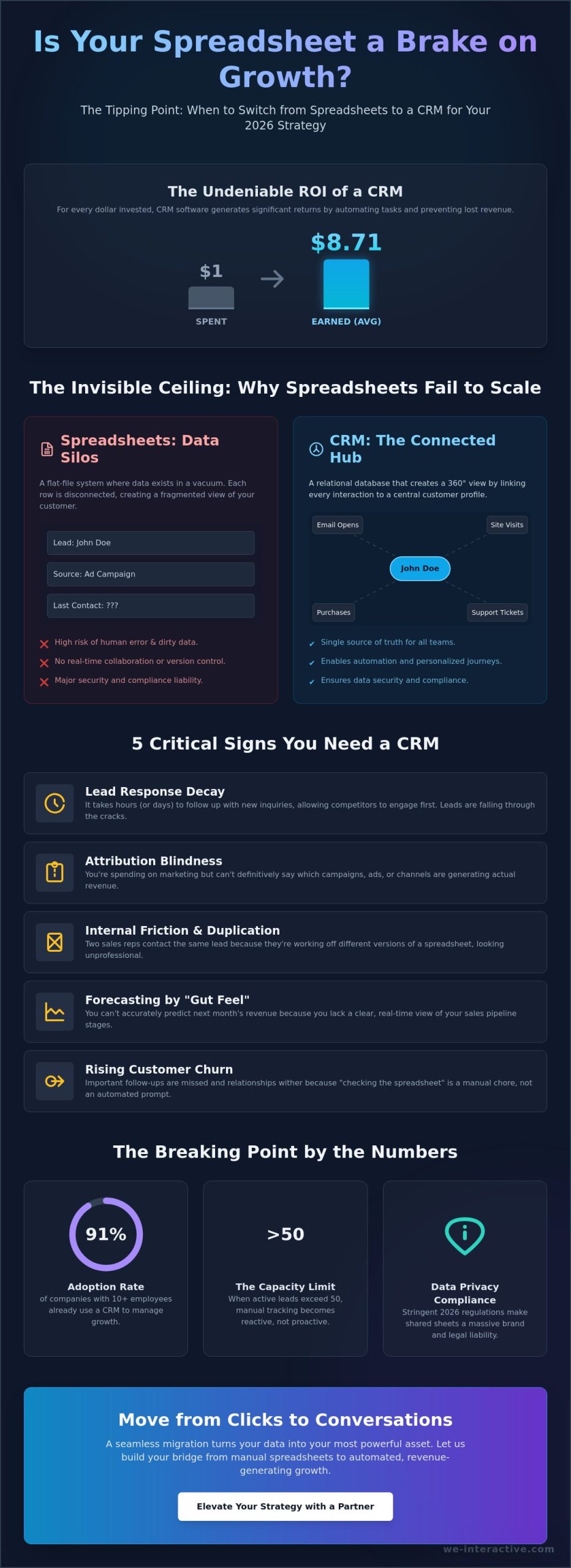
Businesses earn an average of $8.71 for every $1 spent on CRM software, yet many ambitious teams still lose hours every week to manual data entry. You likely started with a spreadsheet because it was flexible and free. It served you well in the beginning, but as your lead volume grows, those rows and columns become a digital graveyard for potential revenue. Determining when to switch from spreadsheets to a crm is the most critical decision you’ll make for your 2026 growth strategy. If you can’t see your marketing ROI or if leads are falling through the cracks, your current system isn’t just slow; it’s actively hurting your bottom line.
We believe that growth is about moving from clicks to conversations and from impressions to conversions. You deserve a single source of truth that turns your digital presence into a powerful force. In this guide, you’ll discover the exact tipping point where spreadsheets fail and how to unlock scalable sales processes that don’t rely on memory. We’ll preview the latest 2026 trends in AI-powered automation and new data privacy compliance to help you elevate your brand and achieve sustainable, data-driven success.
Key Takeaways
- Identify the structural limitations of flat-file systems and how relational databases unlock higher levels of data visibility.
- Recognize the critical performance bottlenecks, such as delayed lead response times, that signal exactly when to switch from spreadsheets to a crm.
- Learn to calculate the ROI of automated customer journeys and transition from manual record-keeping to revenue-generating lifecycle marketing.
- Master a seamless migration strategy by auditing existing data and mapping your unique sales process to a digital pipeline.
- Discover how a strategic partnership can empower your brand by balancing the science of marketing automation with creative insight.
The Invisible Ceiling: Why Spreadsheets Fail as Your Business Scales
Growth doesn’t happen by accident; it’s the result of strategic precision. Most businesses begin their journey with a spreadsheet because it’s familiar and flexible. However, there’s a hidden point where that tool stops being an asset and starts acting as a brake. This is the spreadsheet ceiling. It’s the moment manual data management caps your team’s output and blocks your path to significant, sustainable growth. Recognizing when to switch from spreadsheets to a crm is about realizing that your time is better spent closing deals than cleaning cells.
The technical reason for this ceiling is simple. Excel is a flat-file database. It records data in a vacuum, where one row has no inherent relationship to another. In contrast, Customer Relationship Management (CRM) systems are relational. They connect a single lead to their entire history: email opens, social media interactions, and past purchase behavior. Without this connectivity, you’re building data silos. Your sales team doesn’t know what marketing is doing, and your customer experience feels fragmented and impersonal.
Security is the final crack in the ceiling. As of May 2026, data privacy regulations in states like California, Indiana, and Kentucky have become significantly more stringent. A single shared Google Sheets link is a massive liability for your customers’ personal information. It lacks the cybersecurity audits, encryption, and granular access controls required for modern compliance. Moving to a professional system isn’t just about efficiency; it’s about protecting your brand’s reputation.
Data Integrity vs. Data Entry
Human error is the silent killer of ROI. A single typo in a spreadsheet cell leads to “dirty data,” which causes your team to miss follow-ups or send duplicate emails to the same lead. Version control becomes a nightmare when three different team members have three different “final” versions of a lead list. Because spreadsheets can’t track real-time customer interactions across channels, you’re always looking at the past rather than the present. This lack of insight prevents you from delivering the hyper-personalized experiences that modern buyers expect.
The Scalability Paradox
Adding more rows to a spreadsheet doesn’t add more value to your sales process; it only adds more noise. Data shows that 91% of companies with 10 or more employees have already moved to a CRM because they reached a breaking point. When your manual tracker exceeds 50 active leads, you’re no longer being proactive. You’re just reacting to whoever shouts the loudest. Transitioning to CRM & Marketing Automation allows you to move from reactive record-keeping to a proactive growth strategy that scales without relying on one person’s memory.
5 Critical Signs It’s Time to Move Beyond Excel and Google Sheets
Scaling a business requires moving from chaotic activity to structured growth. While spreadsheets are excellent for static records, they fail to capture the dynamic nature of modern sales. Recognizing when to switch from spreadsheets to a crm often comes down to identifying five specific friction points that signal your current tools are holding you back. If you experience these symptoms, you’ve reached the limit of manual management.
- Lead Response Decay: If it takes your team more than a few hours to reach out to a new inquiry, you’re already behind. Speed is the primary currency of trust.
- Attribution Blindness: You spend money on ads but can’t tell which specific campaign turned into a signed contract. This makes optimizing your budget impossible.
- Internal Friction: Two sales reps call the same lead on the same day because they’re working off different versions of a shared sheet. It looks unprofessional and wastes time.
- Forecasting by “Gut”: You can’t predict next month’s revenue because you don’t have a clear view of your active pipeline stages.
- Rising Customer Churn: Relationships wither when follow-ups are missed. If “checking the sheet” feels like a chore, your customers will feel the neglect.
Identifying these signs your business is ready for a CRM is the first step toward reclaiming your team’s productivity and elevating your brand’s market position.
The Lead Leakage Audit
Leads often “die” in an inbox before they ever make it onto your tracking sheet. In the highly competitive Singapore market, a 24-hour delay in response can decrease your conversion probability by over 400%. If your data isn’t captured automatically, you’re likely losing 15% to 20% of your potential revenue to simple administrative gaps. Lead leakage is the silent killer of marketing ROI. To fix this, you need a system that captures every interaction from the first click.
Visibility and Forecasting Gaps
Managing a remote sales team using only shared documents is a recipe for data fragmentation. Without a single source of truth, “gut feeling” forecasting becomes a dangerous liability for your cash flow. This lack of transparency also prevents you from effectively scaling your performance marketing efforts. When you can’t see the full journey from impression to conversion, you can’t optimize for growth. If you’re ready to stop guessing and start growing, exploring our CRM & Marketing Automation solutions is the next logical step in your digital evolution.
The Opportunity Cost: Calculating the ROI of Automated CRM Journeys
Viewing a CRM as a mere software expense is a mistake that limits your potential. In 2026, businesses earn an average of $8.71 for every $1 spent on CRM systems. This isn’t just about record-keeping; it’s about unlocking transformative actions that amplify your revenue. When you evaluate the limitations of spreadsheets for a growing business, the primary loss isn’t just time. It’s the missed opportunity to turn a one-time lead into a lifelong advocate through lifecycle marketing. This shift from reactive storage to proactive investment is what allows you to elevate your brand above the competition.
A spreadsheet is a static archive. A CRM is a living engine. By setting up automated triggers, you can instantly re-engage cold leads that would otherwise be forgotten in row 500. This is “found money”—revenue sitting in your database that requires zero additional ad spend to activate. Quantifying the impact is simple: removing manual data entry typically reclaims five to ten hours of work per employee every week. Understanding when to switch from spreadsheets to a crm means recognizing that those reclaimed hours should be spent on high-level strategy and shaping digital success with insight and innovation.
Connecting Strategy, Creativity, and Performance
We believe in balancing the art of social media marketing with the science of marketing automation. A CRM provides the behavioral insights needed to fuel more precise SEO strategies. Instead of guessing what content your audience wants, you can see exactly which search terms and pages drove a conversion. This synergy between creativity and performance is how we help you move from clicks to conversations and from impressions to conversions. Automated nurturing sequences allow you to stay top-of-mind without increasing your daily workload.
The Power of HubSpot for SMEs
For businesses bridging the gap from basic sheets, HubSpot remains the gold standard. It offers a sophisticated yet accessible suite of tools including real-time email tracking, visual deal pipelines, and automated task reminders that ensure no lead falls through the cracks. HubSpot centralises the customer journey from the first click to the final sale, providing the clarity needed to optimize every touchpoint. By moving away from fragmented documents, your team can finally work together in a unified environment, turning your digital presence into a powerful force for growth.
How to Transition Without Breaking Your Sales Process
Moving from a manual system to a strategic platform requires a structured methodology to avoid disrupting your current momentum. You’ve already identified the tipping point of when to switch from spreadsheets to a crm; now, the focus shifts to execution. A successful transition isn’t just a data export. It’s a transformative action that aligns your team’s daily habits with your long-term growth goals. By following a clear roadmap, you ensure that your digital presence becomes a powerful force rather than a source of administrative friction.
- Audit and Cleanse: Never import “dirty data.” Review your existing sheets to remove duplicates, bounce-prone emails, and incomplete entries.
- Process Mapping: Align your new CRM pipeline stages with your actual sales cycle. If your process has four steps, your CRM should mirror them exactly.
- Appoint a CRM Champion: Identify one team member to lead the adoption. This person acts as the internal expert, helping others move from clicks to conversations.
- Centralize Lead Sources: Integrate your website, social media ads, and email accounts directly. This eliminates the “Lead Leakage” we discussed in previous sections.
- Deploy Quick Wins: Set up basic automations, such as an immediate “Thank You” email for new inquiries. These small victories build team confidence and provide instant ROI.
Data Migration Best Practices
Standardizing naming conventions before the move is essential for long-term data integrity. Decide which historical data adds value and which should be archived to keep your new system lean and efficient. As of May 2026, Singapore’s PDPA regulations require even stricter data minimization and cybersecurity audits. Ensuring compliance during the transfer process isn’t just a technical step; it’s a commitment to protecting your customers’ trust. We recommend a “privacy by design” approach to every migration project.
Leveraging Singapore Digital Grants
Local SMEs have a significant advantage when it comes to digital transformation. You can utilize the digital marketing grant Singapore to offset the costs of CRM implementation and marketing automation. 2026 is a critical year for this transition, as regional competition is accelerating and manual processes are becoming a massive competitive disadvantage. A certified strategic partner can help you navigate the application process, ensuring you unlock the full potential of available funding while shaping your success with insight and innovation. If you’re ready to amplify your results, explore our CRM & Marketing Automation solutions to take the next step in your journey.
Elevating Your Strategy: Why WE Interactive is the Right Strategic Partner
Deciding when to switch from spreadsheets to a crm is a pivotal milestone for any ambitious brand. However, selecting a software platform is only half the battle. To truly elevate your brand, you need a strategic partner who understands that technology should empower people, not just process data. Since 2009, WE Interactive has been pushing boundaries to deliver significant, sustainable growth for our clients. We don’t just function as a service provider; we act as a high-level strategic partner dedicated to shaping your digital success with insight and innovation.
Our collaborative philosophy, “Growing Together,” ensures that your business goals are our primary focus. We believe in balancing the art of creative storytelling with the science of CRM automation. While a spreadsheet is a static archive of contacts, our integrated approach turns your digital presence into a powerful force. We bridge the gap between high-level strategy and measurable ROI; this ensures every automated touchpoint feels human, authentic, and results-driven.
Beyond Implementation: Strategic Growth
A CRM is the engine of your business, but even the most sophisticated engine stays idle without the right fuel. We provide that fuel through high-performance content and precision-targeted ads that resonate with your audience. By using real-time insights from your CRM, we pivot marketing strategies to capture emerging opportunities as they happen. We’ve delivered over 700 campaigns, turning clicks into conversations for major Asian brands. This data-driven precision allows us to amplify your impact from impressions to conversions, moving your business from simple tracking to advanced lifecycle marketing. We help you unlock the true value of your database by identifying the stories hidden within your customer data.
Ready to Take the Next Step?
Your business has outgrown the manual limitations of rows and columns. It’s time to unlock your true potential and start Growing Together with a team that has over fifteen years of experience in pushing digital boundaries. We invite you to a comprehensive CRM audit and growth consultation to map out your 2026 strategy. Stop managing cells and start managing success. Your brand deserves a sophisticated partner that moves beyond record-keeping to drive transformative action. Let’s turn your digital presence into a powerful force for growth and ensure your sales processes are as scalable as your ambition.
Empower Your Future with Strategic Automation
Scaling a business in 2026 demands more than just record-keeping; it requires a commitment to transformation. You’ve learned how spreadsheets create data silos that stifle collaboration and how manual entry drains hours of productivity every week. Understanding when to switch from spreadsheets to a crm is about choosing to stop reacting to the past and start shaping your future. By moving to a relational database, you unlock the ability to turn cold leads into lifelong advocates through automated lifecycle marketing.
As a certified HubSpot Solutions Provider with over 700 campaigns delivered since 2009, we specialize in helping businesses bridge the gap between simple tracking and sophisticated growth. We also help you navigate Singapore SME growth grants to ensure your digital evolution is as cost-effective as it is powerful. Ready to elevate your brand? Connect with WE Interactive for a CRM consultation today. Your journey toward significant, sustainable growth starts with a single strategic choice. Let’s build something remarkable together.
Frequently Asked Questions
Is a CRM worth it for a small team of 3-5 people?
A CRM is absolutely worth it for small teams because it prevents lead leakage and builds a foundation for growth. 91% of companies with 10 or more employees already use these systems to scale effectively. For a team of 3-5, a CRM automates the routine tasks that currently consume hours of your work week. It ensures your small team can deliver the same high-touch experience as a much larger enterprise.
How long does it typically take to switch from spreadsheets to HubSpot?
A standard migration from spreadsheets to HubSpot typically takes between two and four weeks. This timeline includes data auditing, cleansing, and mapping your sales pipeline stages to match your real-world process. More complex deployments involving custom integrations might extend to 12 weeks. We focus on delivering immediate wins during the first 14 days to ensure your team feels empowered by the new system right away.
Can a CRM integrate with my existing Singapore website development?
Yes, modern systems integrate seamlessly with professional website development projects through APIs or direct plugins. Whether your site is built on WordPress or a custom framework, we can connect your contact forms directly to your CRM. This automation ensures every inquiry is captured in real-time. It allows you to move from clicks to conversations without the risk of manual data entry errors.
What is the primary difference between a CRM and a spreadsheet?
The primary difference is that a spreadsheet is a flat-file database while a CRM is relational. Spreadsheets store static rows of data that don’t interact with each other. A CRM connects every interaction, email, and social media click to a specific customer profile. This connectivity is what helps you decide when to switch from spreadsheets to a crm to unlock lifecycle marketing and automated lead nurturing.
How much do CRM systems cost for SMEs in Singapore?
Costs for SMEs in Singapore vary based on your specific needs and user count. Entry-level tiers like HubSpot Starter or Zoho Standard range from $14 to $25 per user, per month. Professional or mid-tier plans typically cost between $50 and $150 per user. For implementation, basic setups often start around $5,000, while complex custom developments can reach $40,000 according to verified 2026 market data.
Will my team actually use a CRM, or is it too complicated?
Adoption is successful when the system is designed around your team’s actual habits rather than forced workflows. By choosing a CRM champion and focusing on no-code customization, you reduce the learning curve significantly. We prioritize intuitive layouts that make the software feel like a helpful partner rather than a chore. When your team sees a 29% increase in sales through better organization, they’ll embrace the change.
Can I use a CRM to manage my China market entry leads?
You can certainly manage international leads through a centralized system to maintain visibility. Our China market entry services often involve integrating specialized lead sources into a global CRM. This provides a single source of truth for your expansion efforts. You’ll have full visibility into your marketing ROI across different regions without juggling multiple disconnected documents or risking data loss during cross-border communication.
What happens to my old spreadsheets after the migration?
Your old spreadsheets should be archived as historical records once the migration is complete. The CRM must become your team’s only source of truth to prevent data fragmentation. Keeping the old sheets active often leads to version control nightmares and dirty data. Transitioning fully allows you to amplify your results and focus on shaping success with insight and innovation. It’s about moving forward, not looking back.