

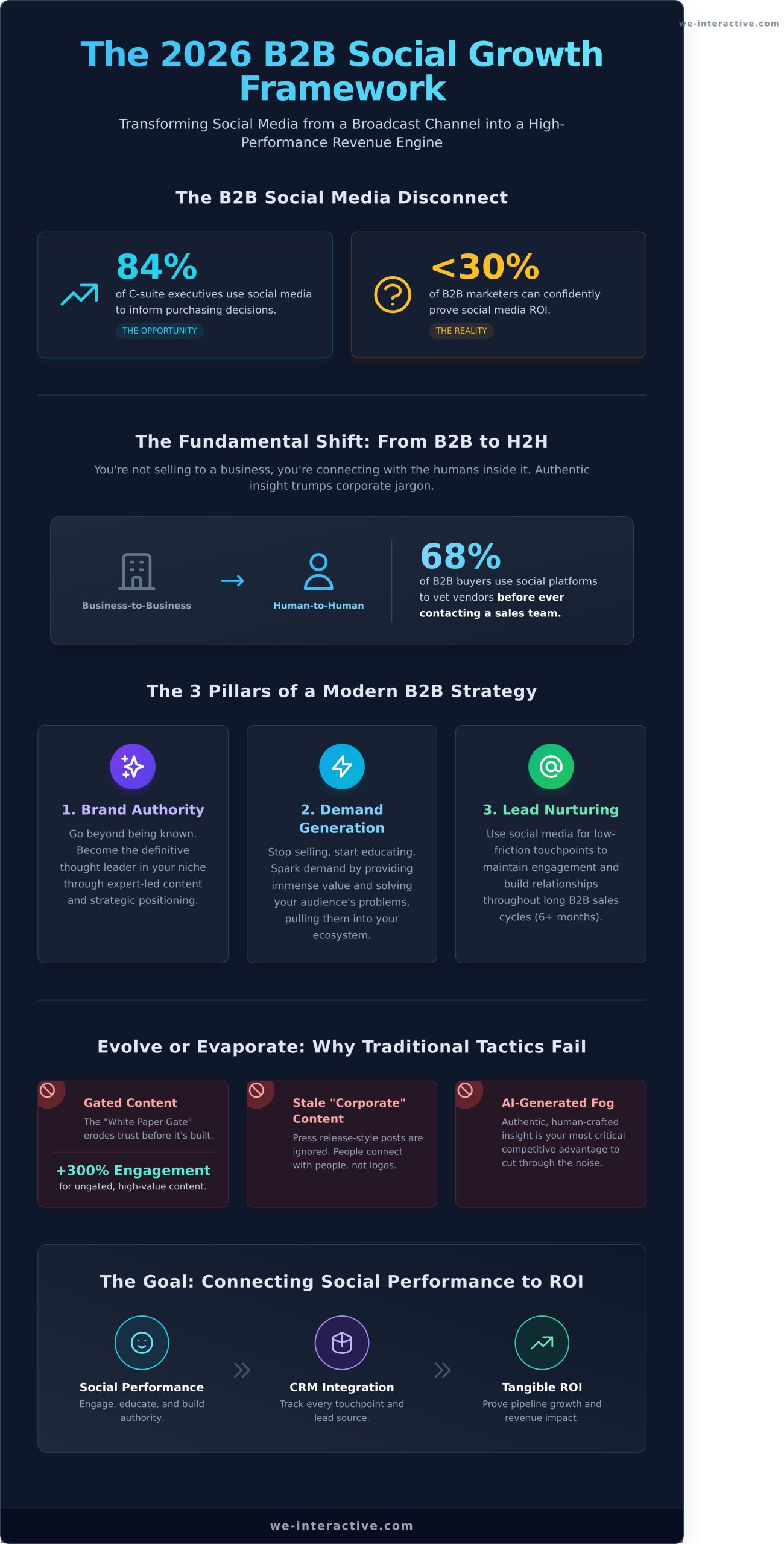
What if you could prove that every S$1 spent on LinkedIn generated S$5 for your sales pipeline? While a recent LinkedIn study found 84% of C-suite executives in Singapore use social media to inform purchasing decisions, a Gartner report from last quarter shows that fewer than 30% of B2B marketers can confidently prove social media ROI. This isn’t just a missed opportunity; it’s a critical growth gap.
It’s a frustrating disconnect. You’re meticulously crafting professional posts, but the path from a click to a signed contract feels long, blurry, and nearly impossible to justify in your quarterly reports. The engagement is low, and the leads feel disconnected from actual revenue.
It’s time to elevate your approach. This guide unlocks our 2026 Growth Framework, a clear and actionable b2b social media marketing strategy designed to transform your social presence from a broadcast channel into a high-performance lead generation engine. We’ll show you how to build unshakeable brand authority, shorten complex sales cycles, and seamlessly integrate your efforts with your CRM for significant, sustainable growth.
Key Takeaways
- Discover the ‘Human-to-Human’ (H2H) shift and why authentic connection, not corporate jargon, is the new cornerstone of B2B social success.
- Pinpoint the exact channels where your B2B audience in Singapore and SE Asia is active, from LinkedIn and YouTube to emerging powerhouses like WhatsApp and Telegram.
- Implement a full-funnel b2b social media marketing strategy that transforms passive scrollers into qualified leads with content mapped to every stage of their journey.
- Unlock advanced tactics like employee advocacy and ‘dark social’ to bypass gatekeepers and effectively influence C-suite decision-makers.
- Learn how to connect social performance directly to your CRM, proving tangible ROI and pipeline growth beyond simple vanity metrics.
What is a B2B Social Media Marketing Strategy in 2026?
Forget the old playbook of scheduled posts and corporate announcements. In 2026, a winning b2b social media marketing strategy is a sophisticated, multi-layered framework engineered to build trust and directly fuel your sales pipeline. It’s no longer about broadcasting; it’s about connecting. The fundamental principles of Business-to-business (B2B) marketing haven’t vanished, but their execution has been radically transformed by a simple, powerful truth: you’re always selling to humans.
This is the Human-to-Human (H2H) shift. Decision-makers in Singapore and across APAC don’t want more corporate jargon; they crave authentic insights and genuine connection. They use social media as a primary research hub. In fact, a 2024 Forrester study revealed that 68% of B2B buyers use social platforms to vet vendors and solutions long before they ever contact a sales team. Your social presence is their first impression and a key part of their due diligence.
To succeed, you must master the balance between creativity and analytics. At WE Interactive, we empower brands by fusing the art of compelling storytelling with the science of data-driven performance. This philosophy turns your social channels from a simple communications tool into a powerful engine for growth.
The Core Pillars of Modern B2B Social
An effective strategy is built on three interconnected pillars designed to move potential clients from awareness to advocacy:
- Brand Authority: This is about more than just being known. It’s about being known for something specific. We help you elevate your brand from just another vendor to the definitive thought leader in your niche through expert-led content and strategic positioning.
- Demand Generation: Stop selling and start educating. True demand isn’t created with a sales pitch; it’s sparked by providing immense value. We focus on creating and distributing insightful content that solves your audience’s problems, naturally pulling them into your ecosystem.
- Lead Nurturing: The B2B sales cycle in Singapore can often exceed six months. Social media provides critical, low-friction touchpoints to maintain engagement, build relationships, and keep your solution top-of-mind throughout this extended journey.
Why Traditional B2B Tactics are Failing
The digital landscape is littered with outdated tactics that now actively harm brands. The “White Paper gate,” where valuable content is locked behind a lead form, is rapidly losing effectiveness. A 2025 Content Marketing Institute report showed that ungated, high-value content generates over 300% more engagement. Why? Because modern buyers demand trust before they give you their contact details.
Stale, “professional” content is another casualty. Your audience ignores posts that read like a press release. Instead, they gravitate toward personality-led insights from your company’s experts. People connect with people, not logos. Finally, the explosion of AI-generated content since 2024 has created a digital fog. In this new reality, authentic, human-crafted insight isn’t just a bonus; it’s your most critical competitive advantage to cut through the noise and earn genuine trust.
Selecting the Right Channels: Where Your B2B Audience Lives
Crafting an impactful b2b social media marketing strategy isn’t about planting your flag on every platform. It’s about strategic precision. The digital landscape of 2026 and beyond demands a shift in thinking. Instead of asking “where do our customers buy,” we must ask, “where do they go to learn, to solve problems, and to build professional credibility?” The answer reveals where your brand truly needs to be.
A fragmented presence across five channels is a recipe for diluted impact and wasted resources. True growth comes from mastering one or two platforms where your ideal client profile is most engaged. It’s about depth, not breadth. From creating meaningful conversations to driving measurable ROI, a focused approach empowers your brand to build genuine authority and connect with decision-makers where it matters most.
LinkedIn: The Undisputed King of B2B
With over 94% of B2B marketers using it for content distribution, LinkedIn remains the cornerstone of professional engagement in Singapore and globally. It’s more than a network; it’s a high-intent ecosystem for thought leadership and targeted performance marketing. The key evolution is the shift from corporate megaphones to individual voices. Data from 2024 shows that posts from executive profiles consistently achieve up to 5x higher engagement than identical posts from a company page. Why? People connect with people. Empowering your leadership to share insights builds trust and authenticity that a brand logo simply cannot replicate. For precision targeting, LinkedIn Ads offer unparalleled capabilities for account-based marketing (ABM), allowing you to reach specific decision-makers at your target companies with tailored messaging.
The “Secondary” Channels: YouTube, TikTok, and XHS
Beyond LinkedIn, a select few platforms offer powerful, specialized avenues for connection. Your choice here should directly support your primary channel efforts.
- YouTube: The Educational Powerhouse. For complex SaaS solutions, intricate manufacturing processes, or in-depth financial services, YouTube is your digital library. Use it for long-form content like product demos, client case studies, and webinar recordings that educate and build trust over time.
- Short-Form Video (TikTok/Reels): The Humanizer. Don’t dismiss vertical video. Use it to showcase your company culture, share behind-the-scenes glimpses of your team, and offer quick, valuable tips. This isn’t about a hard sell; it’s about making your brand relatable and human.
- Xiaohongshu (XHS): The Niche Gateway. For Singaporean brands with ambitions in China, mastering China market entry via Xiaohongshu provides a unique, high-value channel to connect with an affluent and engaged audience.
While these platforms form a solid foundation, a holistic view of B2B social media platform strategies also accounts for regional nuances. In Singapore and Southeast Asia, platforms like WhatsApp and Telegram are critical for high-touch client communication and nurturing leads within exclusive communities. Selecting the right mix of primary, secondary, and communication channels is a critical step, a process we help our partners perfect to ensure every effort drives sustainable growth.
The Full-Funnel Content Framework: From Clicks to Conversations
A successful b2b social media marketing strategy doesn’t just chase vanity metrics. It builds a predictable pipeline. The key is to stop thinking about posts and start thinking about pathways. You must guide your ideal customer from a casual scroll to a closed deal. This is where the full-funnel framework transforms your approach, turning passive impressions into tangible business growth. It’s the art of connecting with the right people, at the right time, with the right message.
Every piece of creative must be engineered to stop the scroll. In a sea of digital noise, your content has less than three seconds to capture attention by speaking directly to a prospect’s most pressing pain points. It’s not just about being seen; it’s about being understood. This is how strategic social media marketing moves beyond awareness to generate measurable ROI. Looking ahead, a video-first approach will be non-negotiable. By 2026, research from Wyzowl indicates that over 90% of marketers will use video as a primary tool, simply because it builds trust and conveys complex value propositions faster than any other medium.
TOFU: Awareness and Insight-Led Content
At the Top of the Funnel (TOFU), your goal isn’t to sell; it’s to educate and provoke. Your content should challenge the status quo and deliver an “Aha!” moment that positions your brand as a thought leader. Instead of a sales pitch, share a data-driven infographic that simplifies a complex trend in Singapore’s logistics sector, or publish a LinkedIn article that questions a long-held industry assumption. Adopting a modern social media content framework here is essential, focusing on high-value, shareable insights that amplify your reach organically.
MOFU/BOFU: Building Trust and Closing the Gap
Once you have their attention, the Middle and Bottom of the Funnel (MOFU/BOFU) are about building confidence and prompting action. This is where you prove your impact. Showcase “Work That Speaks Louder Than Words” with detailed case studies demonstrating how you increased a client’s lead generation by 120% in the APAC region. Facilitate conversations with interactive content like LinkedIn polls or expert-led webinars on navigating Singapore’s latest data privacy regulations. Finally, use targeted direct response ads that offer undeniable value, such as a complimentary digital strategy audit (valued at S$750), to close the gap and turn engaged prospects into qualified leads.
This approach is effective across various B2B sectors. For instance, a company like Connectics gmbh, which provides IT infrastructure for new businesses, could offer a free ‘Startup IT Infrastructure Audit’ as a BOFU offer to attract highly qualified leads.
Advanced B2B Tactics: Advocacy, KOLs, and Dark Social
Once you’ve mastered the fundamentals, it’s time to elevate your strategy. Standard content and ads can build awareness, but they often fail to answer the most critical B2B question: “How do we reach the C-suite?” The answer isn’t always a direct line. It’s through building a powerful ecosystem of trust and influence around them. This is where you move from broadcasting to building genuine connections.
Decision-makers don’t operate in a vacuum. They trust their teams, their peers, and respected industry experts. A sophisticated b2b social media marketing strategy leverages these relationships through three powerful, interconnected channels: employee advocacy, key opinion leaders (KOLs), and the often-overlooked world of dark social.
Turning Employees into Strategic Partners
Your team holds more credibility than your corporate brand page. An employee advocacy program empowers them to become thought leaders, amplifying your reach authentically. To build a program that thrives, focus on enablement, not enforcement. Provide a content hub with pre-approved articles, case studies, and industry news. Equip your team with simple templates and talking points, making it easy to share insights in just 15 minutes a week. The result is a “halo effect”; according to a 2021 Social Media Today analysis, content shared by employees receives 8 times more engagement than the same content from official brand channels, directly boosting brand equity and trust.
The Rise of the B2B Influencer
Forget celebrity endorsements. In the B2B world, influence is built on expertise. Key Opinion Leaders (KOLs) are practitioners, analysts, and academics whose insights shape industry conversations. Identifying the right partners means looking beyond follower counts to find genuine alignment with your brand’s values and expertise. Instead of paying for simple “shoutouts,” co-create valuable assets. Partner with a fintech expert from the Singapore University of Social Sciences to develop a research paper, or host a joint webinar with a respected supply chain consultant. Don’t underestimate micro-influencers; a niche expert with 2,000 engaged followers in a specific vertical can drive more qualified leads than a generalist with 50,000.
The true power of these advanced tactics lies in navigating conversations where your brand can’t be present directly. A 2019 report from RadiumOne revealed that 84% of all online sharing happens through private channels like WhatsApp, Slack DMs, and exclusive LinkedIn groups. This is “dark social.” You can’t track it, but you can fuel it. By creating high-value, easily shareable content and empowering your advocates and KOLs, your brand becomes the asset that gets passed along in the very conversations that lead to major buying decisions.
Unlocking these advanced channels requires a nuanced, data-driven approach. Discover how WE Interactive can build an advocacy and KOL program that elevates your brand’s authority from the inside out.
Measuring Success: Connecting Social Performance to CRM and ROI
Likes and follows are encouraging, but they don’t fuel growth. A truly powerful B2B social media marketing strategy moves beyond vanity metrics to measure what genuinely impacts the bottom line: leads, pipeline, and revenue. The objective isn’t just to be seen; it’s to drive measurable business results. This requires a shift in perspective, transforming social media from a broadcast channel into an integrated, data-driven engine for growth.
The key is closing the loop between social activity and sales outcomes. By integrating your social platforms with your central nervous system for customer data, you unlock a new level of clarity. For instance, you can integrate social data with CRM systems like HubSpot to track a prospect’s entire journey. When a lead from a targeted LinkedIn campaign downloads a whitepaper, that source data is captured directly in their CRM profile. This allows you to attribute specific leads, and eventually revenue, back to the exact social post or ad that initiated the conversation.
In the complex B2B world, the sales cycle can span months. A prospect might first engage with a LinkedIn video, later click a retargeting ad, and finally convert through an email newsletter. Multi-touch attribution models are essential here. Instead of giving 100% of the credit to the final touchpoint, these models distribute it across the entire customer journey, revealing social media’s critical role in building awareness and nurturing consideration long before a deal is closed.
The Metrics That Actually Matter
To elevate your strategy, focus your reporting on performance indicators that connect directly to revenue. WE recommend tracking a core set of metrics that paint a clear picture of your social media ROI:
- Conversion Rate to MQLs: Track the percentage of website visitors from social channels who become Marketing Qualified Leads. A 5% conversion rate from a specific LinkedIn campaign is a far more valuable metric than 10,000 impressions.
- Cost Per Lead (CPL) and Customer Acquisition Cost (CAC): Calculate precisely what it costs to generate a lead through social. If a campaign in Singapore costs S$5,000 and generates 50 qualified leads, your CPL is S$100. Taking it further, if 5 of those leads become customers, your social media CAC for that campaign is S$1,000.
- Social Share of Voice (SOV): Measure your brand’s presence in the digital conversation against your top 3-5 competitors in the Singapore market. Tools like Brandwatch can quantify this, showing if your thought leadership is genuinely cutting through the noise.
Optimizing for the Long Game
Data isn’t just for reporting; it’s for refining. A successful b2b social media marketing strategy is a living one, constantly evolving based on performance insights. Use the questions and engagement trends from your social channels to inform your SEO strategies and website content, ensuring you’re creating assets that your audience actually wants. Continuously A/B test ad creatives, headlines, and calls to action to scientifically improve your performance, lowering CPL and increasing conversion rates over time. This is the philosophy of Growing Together: a continuous cycle of insight, action, and optimization that builds sustainable momentum.
Ready to take the next step? Elevate your B2B strategy with WE Interactive today.
Activate Your 2026 Growth Framework
The digital landscape is evolving, and your approach must evolve with it. The future of B2B social isn’t about chasing fleeting likes; it’s about building deep-rooted relationships across the entire customer journey. A successful b2b social media marketing strategy for 2026 requires a sophisticated blend of targeted channel selection, full-funnel content, and robust ROI measurement that connects directly to your CRM. It’s the critical difference between making noise and making a measurable impact on your bottom line.
This is where insight-driven strategy meets flawless execution. As a strategic partner in Singapore, Jakarta, and Bangkok since 2009, WE Interactive has a proven track record of delivering significant, sustainable growth. Our unique approach, blending the art of creative engagement with the science of performance marketing, has powered over 700 campaigns with measurable ROI for leading brands. We don’t just run campaigns; we build powerful growth engines for our partners.
Ready to turn clicks into conversations? Partner with WE Interactive.
Let’s unlock your brand’s potential and grow together.
Frequently Asked Questions About B2B Social Media
How is B2B social media different from B2C?
B2B social media prioritizes building long-term professional relationships and establishing industry authority, unlike B2C’s focus on broad brand awareness and direct-to-consumer sales. The B2B sales cycle can extend over 6 months, requiring content that nurtures leads with in-depth value, such as whitepapers and case studies. B2C strategies, in contrast, often leverage emotional appeals and promotions to drive faster, individual purchasing decisions. It’s a shift from transactional interactions to transformative partnerships.
Which social media platform is best for B2B lead generation in Singapore?
LinkedIn is the premier platform for B2B lead generation in Singapore, where over 60% of the local workforce is active. Its powerful targeting capabilities, including Sales Navigator, allow brands to connect directly with key decision-makers in specific industries. While LinkedIn is dominant, platforms like Facebook can be effective for reaching small business owners and specific professional communities through highly targeted ad campaigns. The key is to align the platform with your specific audience and business goals.
How often should a B2B company post on social media?
Aim for consistency over sheer volume; posting 3-5 times per week on a primary platform like LinkedIn is a proven benchmark for steady engagement. Quality is paramount. Each post must provide genuine value to maintain audience interest and build authority. For secondary platforms like Facebook or X (formerly Twitter), a frequency of 2-4 times per week is sufficient. This consistent rhythm ensures your brand remains top-of-mind without overwhelming your professional audience.
What is the role of video in a B2B social strategy?
Video is a powerful tool to humanize your brand and articulate complex value propositions with clarity and impact. According to a 2023 LinkedIn report, video posts generate 5 times more engagement than other content formats. Use it for client testimonials, product demonstrations, and thought leadership interviews to build trust faster than text alone. It transforms abstract solutions into tangible, relatable stories, accelerating the journey from impression to conversion for your B2B audience.
How do you measure the ROI of B2B social media marketing?
A data-driven b2b social media marketing strategy measures ROI by tracking metrics directly linked to revenue. Go beyond vanity metrics like likes and follows; focus on Cost Per Lead (CPL), lead conversion rates from social channels, and the Customer Lifetime Value (CLV) of those leads. By using UTM parameters and integrating your CRM, you can attribute specific sales back to social campaigns. For example, if a S$5,000 campaign generates 10 clients with an average CLV of S$2,000 each, your ROI is clearly positive.
Can TikTok really work for B2B companies?
Absolutely. TikTok offers a unique opportunity for B2B brands to build awareness and showcase their human side. It’s not for direct lead generation but for top-of-funnel engagement. Companies like Adobe successfully use it to share design tips and connect with a creative professional audience. Use short-form video to simplify complex topics, highlight company culture to attract talent, or share behind-the-scenes content. It’s about building brand affinity with the next generation of decision-makers.
How do I start an employee advocacy program?
To launch an employee advocacy program, begin by setting clear goals, like increasing content reach by 30% in one quarter. Equip your team with simple guidelines and a library of pre-approved content to make sharing effortless. Use tools like Bambu or a dedicated Slack channel to distribute content. Most importantly, empower your employees by providing training on professional branding and recognize top advocates to foster a culture of shared success. It’s about amplifying your message through your most trusted asset: your people.
What is Dark Social and why should B2B marketers care?
Dark social is traffic from private sharing channels like WhatsApp, email, or Slack that web analytics can’t trace. B2B marketers must care because studies show over 80% of sharing happens here; it’s where key decision-makers discuss and vet solutions internally. This untracked influence is a critical part of a modern b2b social media marketing strategy. You can illuminate this traffic by implementing robust share buttons with unique tracking codes and adding a “How did you hear about us?” field to your lead forms.