

Building a Business Case for a New CRM: A Strategic Guide for 2026
How much is a fragmented view of your customer costing you in lost revenue every single day? In Singapore's fast-moving digital economy, 2024...
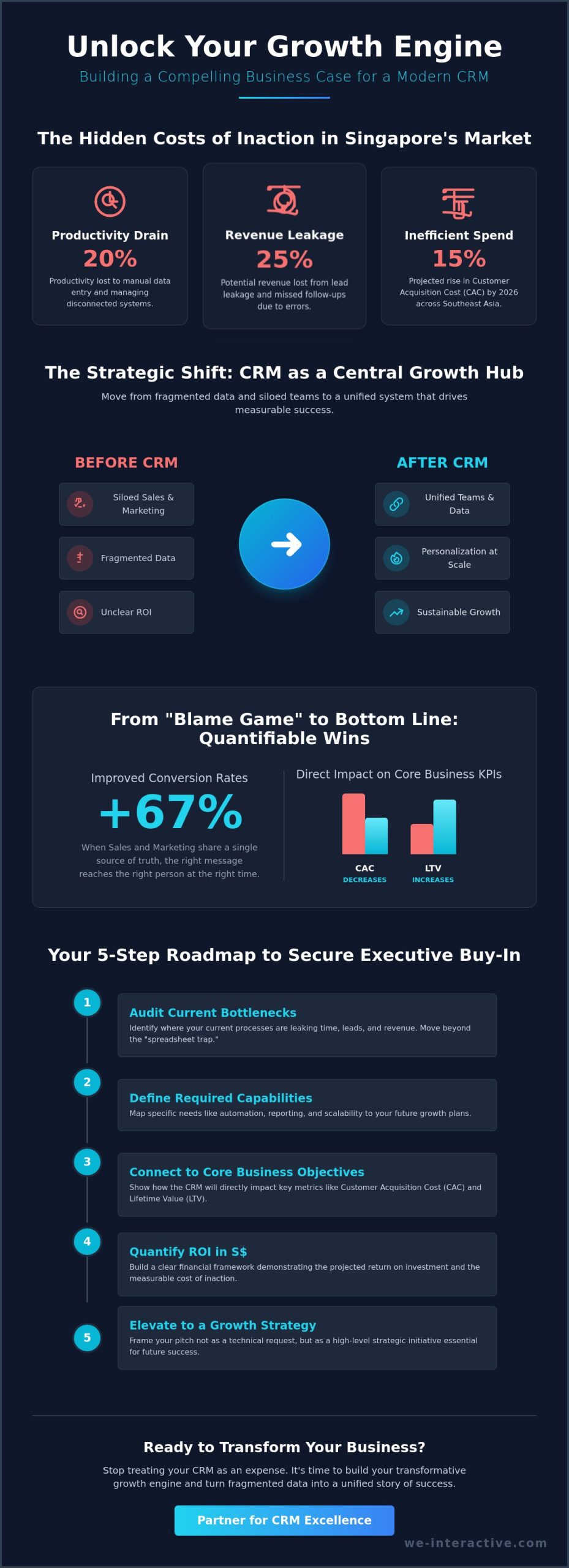
How much is a fragmented view of your customer costing you in lost revenue every single day? In Singapore's fast-moving digital economy, 2024 industry reports indicate that companies lose up to 20% of their productivity to manual data entry and disconnected systems. You likely feel the weight of managing high-value relationships via spreadsheets or the frustration of failing to track marketing ROI accurately. It's time to stop treating your CRM as a software expense and start positioning it as a transformative growth engine that empowers your brand.
WE believe that your technology should work as hard as your team. This guide focuses on building a business case for a new CRM that secures executive buy-in by translating technical needs into a compelling growth strategy. You'll gain a clear roadmap to win budget approval, a data-driven framework to calculate projected ROI in S$, and the insights needed to align your sales and marketing teams. We'll show you how to turn fragmented data into a unified story of success, moving your brand from clicks to conversations and from impressions to conversions.
Key Takeaways
- Learn how to elevate your proposal from a technical request into a high-level growth strategy that resonates with the C-suite’s focus on revenue and efficiency.
- Master the financial framework of building a business case for a new CRM by quantifying ROI in S$ and identifying the specific costs of inaction within the Singapore market.
- Discover how to map CRM capabilities directly to core business objectives, transforming metrics like Customer Acquisition Cost (CAC) into measurable drivers of success.
- Follow a strategic roadmap to audit your current bottlenecks and define required capabilities that empower your team to scale beyond the "spreadsheet trap."
- Understand why CRM excellence is a continuous journey of optimization, blending creative strategy with data-driven performance to ensure long-term, sustainable growth.
Table of Contents
- What is a CRM Business Case and Why is it Critical in 2026?
- Strategic Alignment: Connecting CRM to Core Business Objectives
- The Financial Framework: Quantifying ROI and Cost of Inaction
- A Step-by-Step Roadmap to Building Your CRM Pitch
- Beyond the Software: Partnering for CRM Excellence
What is a CRM Business Case and Why is it Critical in 2026?
Building a business case for a new CRM isn't a mere administrative hurdle; it's a strategic blueprint for survival. By 2026, the gap between companies using intelligent automation and those stuck in the "spreadsheet trap" will become an unbridgeable chasm. A business case justifies your investment by mapping out specific value, identifying risks, and projecting a clear ROI. It transforms a software purchase into a high-level strategic initiative that aligns your entire organization.
Modern Customer Relationship Management (CRM) has moved far beyond the digital rolodex of the past decade. In 2026, your CRM must function as an automation powerhouse that drives every customer touchpoint. We believe in "Growing Together," a philosophy where internal teams unite under a single source of truth to deliver seamless experiences. Without this unified data, your departments remain siloed, and your growth remains capped by manual limitations.
The High Cost of the Status Quo
Sticking with legacy systems or manual tracking carries "hidden taxes" that drain your S$ bottom line. We see Singaporean firms lose up to 25% of potential revenue due to lead leakage and manual entry errors that result in missed follow-ups. When data is fragmented, it's impossible to accurately measure performance marketing ROI, leading to wasted ad spend and inefficient scaling. Cost of Inaction is the measurable revenue lost by delaying digital transformation.
CRM as the Foundation of Customer Lifecycle Marketing
A modern CRM enables the perfect blend of art and science. It allows your team to combine creative storytelling with hard data to influence the entire customer journey. This foundation is essential for nurturing leads from social media clicks to conversions, ensuring that no prospect falls through the cracks after the initial engagement. Platforms like HubSpot have set the benchmark for this, offering user-friendly interfaces and high-impact automation that empower teams to work smarter. By centralizing these interactions, you unlock the ability to personalize at scale, turning impressions into long-term brand advocates.
Strategic Alignment: Connecting CRM to Core Business Objectives
When building a business case for a new crm, your proposal must move beyond technical specifications and feature lists. It needs to speak the language of the C-suite. Decision makers in Singapore don't just want a database; they want a mechanism for revenue growth, operational efficiency, and risk mitigation. By 2026, the cost of customer acquisition is expected to rise by 15% across Southeast Asia, making the ability to maximize every single lead critical for survival.
Strategic alignment means mapping CRM capabilities directly to KPIs like Customer Acquisition Cost (CAC) and Lifetime Value (LTV). If your current system leaks data, your CAC inevitably increases. A modern CRM unlocks the ability to track the entire customer journey, ensuring you spend S$1 to earn S$5, not S$4. Finding internal champions across departments provides the social proof needed to push the investment through. WE don't view a CRM as a data entry chore; we see it as a platform for shaping digital success with insight and innovation.
Bridging the Gap Between Sales and Marketing
The "blame game" ends when data becomes transparent. A unified CRM provides clear attribution for every dollar spent on a high-performance campaign. Automated hand-offs ensure that marketing leads aren't left to wither in an inbox or a spreadsheet. Business alignment is the secret sauce that turns a fragmented team into a powerhouse of sustainable growth. When marketing and sales share a single source of truth, conversion rates can improve by as much as 67% because the right message reaches the right person at the right time.
Future-Proofing Your Growth Strategy
Scalability is a non-negotiable requirement for the 2026 business landscape. Your platform must handle a 30% surge in lead volume without breaking or slowing down your team. Modern systems leverage AI and predictive analytics to identify which prospects are ready to buy before they even speak to a human. This level of foresight is essential if you're looking at entering the China market or expanding across regional borders. A robust system empowers you to scale with confidence. If you're ready to modernize your stack, exploring specialized CRM and customer marketing services can provide the tactical edge you need to stay ahead.
The Financial Framework: Quantifying ROI and Cost of Inaction
Every strategic investment starts with a balance sheet. When building a business case for a new CRM, you're translating technical features into fiscal outcomes that resonate with the C-suite. A modern system involves direct costs like monthly licensing fees, which typically range from S$150 to S$350 per user for enterprise-grade solutions. However, the indirect costs often catch stakeholders off guard. You must account for the 40 to 60 hours of productivity lost per employee during the initial migration and training phases. We view these not as expenses, but as the necessary foundation for a more profitable future.
The true value emerges when you calculate the efficiency gain. By implementing CRM automation, sales teams in Singapore report saving an average of 6.5 hours per week on manual data entry and lead routing. This reclaimed time allows your consultants to focus on high-value relationship building rather than administrative friction. When you amplify this across a team of twenty, you're effectively gaining 130 hours of selling power every single week without increasing your headcount.
Revenue growth is the ultimate metric. A 5% increase in customer retention can lead to a profit surge of 25% to 95%. By reducing churn through automated follow-ups and personalized engagement, your CRM becomes a revenue engine. To soften the blow of the initial capital outlay, savvy SMEs are looking toward the Digital Marketing Grant Singapore. These subsidies significantly lower the barrier to entry, allowing you to deploy world-class technology while maintaining healthy cash flow.
Building the ROI Calculator
A 3-year ROI projection is essential for building a business case for a new CRM that wins approval. Start by defining the "Value of a Lead" by dividing your total annual revenue by the number of leads generated. If a 10% improvement in lead-to-close rates adds S$200,000 to your bottom line, the software pays for itself within months. Use the comparison below to visualize the shift from manual processes to automated precision.
Leveraging Government Grants (Singapore Context)
Singapore’s commitment to digitalization offers a unique advantage. The Productivity Solutions Grant (PSG) and the Enterprise Development Grant (EDG) remain the primary vehicles for offsetting implementation costs. We've observed that 2026 is a pivotal year for utilizing digital marketing grants. As the government shifts focus toward more niche AI-driven initiatives, the broad-based support for standard CRM adoption may see tighter eligibility criteria in the coming seasons.
Subsidized innovation carries a powerful psychological weight. When the board sees that 50% to 70% of the qualifying costs are covered by national grants, the perceived risk of the project plummets. This financial safety net empowers your leadership to choose the best solution for your brand's growth, rather than just the cheapest option available. It's about moving from a mindset of "cost saving" to "strategic scaling" with the support of a robust digital ecosystem.
A Step-by-Step Roadmap to Building Your CRM Pitch
Success in building a business case for a new CRM starts with a forensic audit of your current "Muddling Through" process. Many Singaporean enterprises still rely on fragmented spreadsheets and manual data entry, which often results in a 20% loss in lead response efficiency. You must identify these specific friction points. Document exactly how many hours your sales team wastes on administrative tasks instead of closing deals. This data forms the bedrock of your argument, transforming a software request into a strategic necessity.
Once the pain points are clear, define your "Required Capabilities" list through structured stakeholder interviews. Don't just list features; focus on outcomes. Select two or three platform options for a weighted comparison. For instance, you might weigh HubSpot’s user friendly interface against Salesforce’s deep customization capabilities. In the Singapore market, where agility is a competitive advantage, the ability to integrate with local payment gateways or accounting software like Xero can be a deciding factor.
The executive summary is the "Art" of your pitch. It should inspire confidence by framing the CRM as a catalyst for sustainable growth rather than a simple expense. You'll need to present a clear "Time to Value" projection. Boards are often wary of long implementation cycles, so your roadmap should highlight how the system begins paying for itself within the first six months of deployment.
Stakeholder Mapping and Buy-In
Winning approval requires identifying three key roles: the "Economic Buyer" who controls the budget, the "Champion" who pushes the vision, and the "User" who lives in the tool daily. Address the primary objection head-on: "Our team won't use it." You can counter this by presenting a robust Adoption Plan. Shift the narrative from "Surveillance" to "Empowerment." Show users how the CRM automates their most tedious tasks, allowing them to focus on high value activities that drive their commissions and career growth.
The Implementation Blueprint
A phased approach is safer for business continuity. We recommend a "crawl, walk, run" strategy that prioritizes immediate impact. Set specific "Quick Win" milestones for the first 90 days, such as automating lead distribution or cleaning 100% of existing customer data. This proves the system's value early and builds momentum for more complex integrations later.
Partnering with a strategic digital partner ensures your technical setup aligns with your long term business goals. This collaboration helps avoid the common pitfalls of DIY implementation, such as poor data mapping or broken API links. When you present a blueprint backed by experts, you demonstrate that you've accounted for every risk, making the decision to move forward an easy one for leadership.
Ready to transform your customer data into a powerful growth engine? Explore our CRM and Customer Marketing solutions to see how we can help you build a winning strategy.
Beyond the Software: Partnering for CRM Excellence
A CRM platform is a powerful tool, but it's just an empty shell without a robust strategy. Most businesses fail to see ROI because they view software as a standalone solution rather than a strategic enabler. When you're building a business case for a new crm, you aren't just buying software licenses; you're investing in a new way to manage relationships. Success requires a shift from transactional thinking to a lifecycle-focused approach that puts the human experience at the center of every data point.
Optimization never ends. A CRM is a journey, not a destination. Market conditions in Singapore change rapidly; consumer behaviors shift, and data regulations like the PDPA evolve. We ensure your system adapts to these changes. By integrating your platform with SEO insights and performance metrics, we transform your CRM into a holistic growth engine. This means every search query and every click informs how you nurture a lead. It ensures your sales team focuses on high-intent prospects, turning raw data into actionable intelligence.
Our approach balances the art of creative storytelling with the science of marketing automation. We don't just track leads; we help you understand the "why" behind customer actions. This deep insight allows you to create personalized experiences that resonate. It's about moving from simple clicks to meaningful conversations, ensuring your brand remains relevant in a competitive digital environment.
The WE Interactive Advantage
WE Interactive brings over 15 years of experience in "Connecting Strategy, Creativity & Performance." Since 2009, we've delivered over 700 campaigns, helping brands "Elevate" their customer journeys through specialized HubSpot expertise. Our "Growing Together" philosophy ensures we act as a strategic partner, working alongside you to achieve shared goals. We don't just implement tools; we empower your team to unlock significant, sustainable growth through insight and innovation.
Ready to Take the Next Step?
Don't let your technology investment go to waste. If you're currently building a business case for a new crm, we can help you refine your pitch with a professional Business Case Review. Book a consultation for a comprehensive CRM audit to identify gaps in your current process and find hidden opportunities for automation. Let's move your brand from impressions to lifelong customers. Contact us today for CRM & Marketing Automation services that drive real, measurable impact.
Seize the Competitive Edge in 2026
Success in Singapore’s evolving digital economy depends on more than just software; it requires a data-driven transformation. Building a business case for a new crm is your first step toward unlocking measurable ROI and eliminating the high cost of manual inefficiencies. By aligning your CRM strategy with core business objectives and quantifying the specific financial gains expected by 2026, you turn a technical upgrade into a strategic growth engine. It's about moving from fragmented data to unified customer experiences that drive long-term loyalty.
At WE Interactive, we've spent over 15 years in Singapore helping brands navigate this journey. As a HubSpot Certified Partner with a track record of 700+ successful digital campaigns, we bridge the gap between complex marketing automation and creative storytelling. We don't just implement tools; we partner with you to ensure your investment delivers significant, sustainable results. Let’s turn your digital presence into a powerful force for growth. Ready to build your growth engine? Let’s grow together with a custom CRM strategy.
Your path to digital excellence starts with a single, informed decision today.
Frequently Asked Questions
How long does it typically take to see ROI from a new CRM?
Most businesses see a return on investment within 6 to 18 months. A 2023 Salesforce report indicates that 52% of companies achieve full ROI in under 12 months when they prioritize data quality. This timeline depends on your implementation speed and how quickly your team adopts automation. WE help you accelerate this by focusing on high-impact workflows early; it's about turning setup costs into sustainable growth.
What is the most common reason CRM business cases are rejected?
The most common reason for rejection is a failure to demonstrate clear financial impact. Executive teams often decline proposals that focus on software features rather than bottom-line results. A 2024 Harvard Business Review study found that 43% of digital initiatives fail without a data-backed strategy. When building a business case for a new CRM, you must quantify how the tool solves specific revenue bottlenecks to win approval.
How do I choose between HubSpot and Salesforce for my business case?
Choose HubSpot if you prioritize user adoption and a seamless marketing-to-sales handoff. It's ideal for mid-market firms looking for an intuitive, all-in-one interface. Salesforce is better for enterprises requiring deep customization and complex data architectures. Both platforms can elevate your brand, but the right choice depends on your specific operational scale. We recommend auditing your current tech stack before making a final commitment.
Can I use a digital marketing grant to fund my CRM implementation in Singapore?
You can use the Productivity Solutions Grant (PSG) to offset up to 50% of your CRM implementation costs. Eligible Singaporean SMEs can access this funding for pre-approved solutions to enhance their digital capabilities. For larger transformations, the Enterprise Development Grant (EDG) offers support for core capabilities and innovation. These grants empower local businesses to modernize their operations without heavy initial capital expenditure; they help us grow together.
What are the hidden costs of CRM I should include in my business case?
Hidden costs usually include data cleansing, staff training time, and third-party API integration fees. Many firms overlook the S$5,000 to S$15,000 typically required for professional data migration from legacy systems. You should also budget for annual seat price increases, which often average 5% to 10% in the SaaS industry. Including these specific figures ensures your financial projections remain realistic and transparent for your stakeholders.
How do I convince my sales team to actually use the new CRM?
Convince your sales team by demonstrating how the CRM reduces their administrative burden. Show them that automated lead scoring can increase their closing rates by 30% based on industry benchmarks. We believe in a collaborative approach, so involve your top performers in the selection process early. If they see the tool as a way to hit their targets faster, adoption happens naturally and helps the whole team succeed.
Is a CRM necessary for a small business with a limited marketing budget?
A CRM is essential for small businesses because it centralizes customer data that would otherwise be lost in spreadsheets. Even with a limited budget, using a CRM can increase lead conversion rates by up to 29%. It serves as the foundation for your marketing automation, allowing you to amplify your reach without hiring more staff. Starting early prevents the data debt that often hampers future growth.
What happens if we don't build a business case and just buy the software?
Skipping the business case often leads to shelfware, where you pay for software that nobody actually uses. Research shows that 70% of CRM projects fail to meet objectives when they lack a strategic roadmap. Without building a business case for a new CRM, you risk purchasing features that don't align with your actual sales process. This leads to wasted S$ and missed opportunities for significant, sustainable growth.