

How to Measure Social Media Marketing ROI: The 2026 Performance Guide
Total global spending on social media advertising is projected to reach $317.33 billion in 2026, yet many marketing teams still struggle to explain...
Total global spending on social media advertising is projected to reach $317.33 billion in 2026, yet many marketing teams still struggle to explain where that capital goes when the C-suite asks for hard results. You likely feel the pressure of justifying a campaign when ad costs have climbed by up to 25 percent since 2024. It's frustrating to watch your budget increase while the path from a TikTok view to a CRM lead remains a mystery. Learning how to measure social media marketing roi isn't just about spreadsheets; it's about proving your strategic value.
We believe that significant growth happens at the intersection of creative storytelling and rigorous data science. This guide will empower you to master the art of quantifying your social impact and turning digital conversations into measurable business success. You'll discover a clear reporting framework for leadership, learn to align your social efforts with your CRM, and gain the insight needed to optimize your budget based on actual performance. We're moving beyond vanity metrics to unlock the transformative numbers that drive your brand forward.
Key Takeaways
- Shift your strategic focus from vanity metrics like likes and shares to value-driven KPIs that directly impact your business growth.
- Discover a comprehensive framework on how to measure social media marketing roi by aligning S.M.A.R.T. goals with your total investment, including labor and tools.
- Navigate the complexities of the attribution lag to accurately map the digital customer journey from the first social touchpoint to final revenue.
- Learn to balance the art of creative storytelling with the science of performance data to optimize your social media budget in real-time.
Proving the Value: Why Measuring Social Media ROI is Essential in 2026
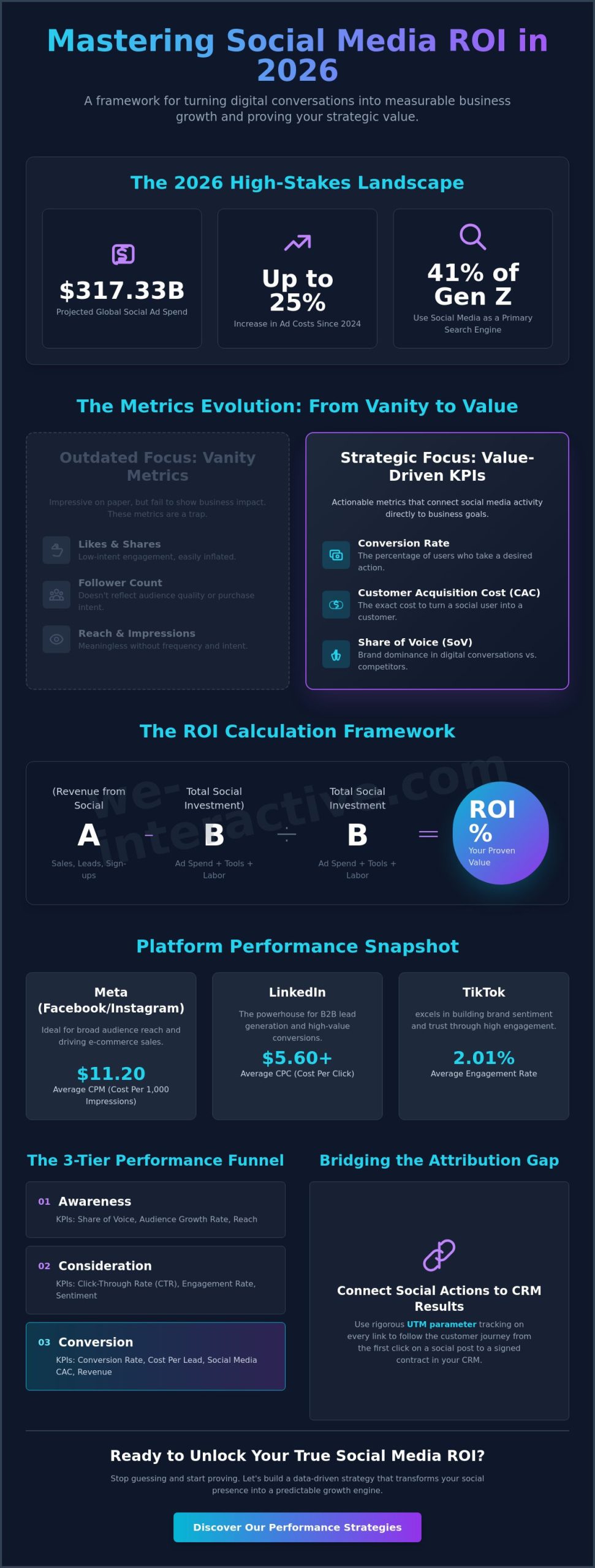
Global spending on social media advertising is projected to hit $317.33 billion in 2026. With Meta CPMs averaging $11.20 and LinkedIn CPCs climbing past $5.60, the financial stakes have never been higher. Understanding how to measure social media marketing roi means looking at the sum of all social actions that generate tangible business value. It's the difference between reporting on a graph of follower growth and proving that digital conversations lead to signed contracts. We believe that every dollar spent should be a seed for future growth, turning your social presence into a powerful force for your brand.
Many marketing teams currently face an "Aspiration vs. Reality" gap. They want to be data-driven, yet they struggle to connect a TikTok comment to a CRM lead. This measurement gap is dangerous. When you master how to measure social media marketing roi, you gain the power to protect your budget from cuts and elevate your department from a cost center to a strategic growth engine. It's about showing leadership that social isn't just a creative playground; it's a precise science that delivers significant, sustainable growth.
The 2026 ROI Landscape: Beyond the Like Button
The C-suite no longer cares about double-taps or vanity metrics. They want to see how social media fuels performance marketing goals. In 2026, we utilize AI-driven predictive modeling to forecast returns before a single campaign goes live. This allows us to balance immediate conversions with the long-term brand equity that keeps customer acquisition costs manageable. Since 41 percent of Gen Z now uses social media as their primary search engine, your ROI must account for discovery and intent, not just the final click. We help you bridge this gap by connecting strategy, creativity, and performance.
Why 'Soft' Metrics Still Matter for 'Hard' Results
Numbers don't tell the whole story, and ignoring sentiment is a mistake. Quantifying brand sentiment is essential because it directly impacts customer lifetime value and long-term loyalty. High engagement on TikTok, which currently averages 2.01 percent, is a signal of trust that often leads to sales weeks later. We use these insights to guide product innovation and China market entry services, turning raw social data into a roadmap for expansion. This holistic approach is a core part of a modern Return on Marketing Investment strategy. Social ROI is the strategic blend of immediate financial gains and the long-term growth of your brand’s digital authority.
Defining the Metrics: From Vanity to Value-Driven KPIs
To truly master how to measure social media marketing roi, you must first strip away the noise. Not every metric deserves a seat at your boardroom table. We categorize performance into three distinct tiers: Awareness, Consideration, and Conversion. This structure ensures your data tells a coherent story of growth rather than just listing disconnected figures. In 2026, the focus has shifted toward high-intent actions that signal a genuine move toward a purchase.
Reach is often a trap. While it looks impressive on a report, reach is a vanity metric unless it's paired with frequency and intent. If you reach a million people but none of them see your message enough to remember it, your investment is wasted. In competitive markets like Singapore, "Share of Voice" becomes a critical indicator. It measures your brand's dominance in digital conversations compared to your rivals. Knowing your Customer Acquisition Cost (CAC) specifically for social channels is the only way to maximize social media ROI in 2026. This figure tells you exactly what it costs to turn a scroll into a sale.
Conversion Metrics: The 'North Star' of ROI
Click-through rates (CTR) are a start, but actual conversion rates are what pay the bills. In the B2B space, we prioritize lead quality over sheer quantity. A single high-value lead from a $5.60 LinkedIn click is worth more than a hundred low-intent clicks from cheaper platforms. Precise tracking requires the rigorous use of UTM parameters. These tags allow you to follow a user from a specific post through to your checkout page. If you want to see how these numbers translate into actual growth, our performance marketing strategies can help you bridge the gap between clicks and revenue.
Engagement and Sentiment: Measuring Brand Health
Engagement has evolved. We now look for Meaningful Social Interactions (MSI), such as shares and long-form comments, rather than simple likes. With TikTok engagement rates sitting at 2.01 percent compared to Instagram's 0.30 percent, the platform choice dictates the expectation. Sentiment analysis allows us to predict potential churn or growth before it hits your bottom line. Positive community engagement doesn't just build trust; it also reduces customer support costs by creating a self-sustaining ecosystem of brand advocates. This is where the art of social media meets the science of marketing automation, helping us grow together with our clients.
The Attribution Challenge: Mapping the Customer Journey to Revenue
Measuring ROI isn't a straight line. It's a complex web of interactions that often spans weeks or months. If you want to master how to measure social media marketing roi, you must first confront the attribution lag. In high-consideration industries, a potential client might engage with your LinkedIn content today but won't convert until they've seen three more ads and a testimonial video. This delay often leads to undervalued social budgets because traditional models fail to capture the long-term influence of brand storytelling.
We compare three primary models to find the truth behind your data. First-touch attribution rewards the platform that introduced the user to your brand. Last-touch attribution, while simple, often unfairly credits a final Google search for work your social content did weeks prior. Multi-touch attribution is our preferred approach. It distributes value across every touchpoint, from the initial TikTok discovery to the final checkout. This holistic view is essential for any brand aiming for significant, sustainable growth.
Tracking has become increasingly difficult since the shift to iOS 14+ and the privacy-first regulations of 2026. Cookies are no longer reliable. To solve this, WE implement server-side tracking and advanced data modeling to bridge the gaps. Many brands find that partnering with a performance marketing agency singapore is the most effective way to navigate these technical hurdles. It allows you to move beyond guesswork and base your budget decisions on verified performance data.
Multi-Touch Attribution in a Fragmented Market
Users don't stay in one lane. They move from Instagram stories to messaging apps and finally to search engines. In the Asian market, 'Dark Social'-the private sharing of content via apps like WhatsApp or WeChat-represents a massive blind spot for most marketers. We use Marketing Mix Modeling (MMM) to account for these invisible influences. This top-down statistical approach helps us see the big picture, ensuring your strategy reflects how people actually consume media in 2026.
Bridging the Gap Between Social and CRM
Your ROI report is incomplete if it lives in a silo. True insight comes when you connect your social data directly to your sales pipeline. By integrating platforms like HubSpot or Salesforce, we track the entire journey from a single 'Follower' to a 'Lifelong Customer'. This alignment allows you to see exactly which campaigns are driving high-value leads rather than just high-volume noise. It's about growing together by turning digital engagement into real-world revenue. Explore our CRM & Customer Marketing services to see how we can unify your data and unlock your brand’s full potential.
A Step-by-Step Framework for Calculating Social Media ROI
Moving from theory to practice requires a disciplined structure. To master how to measure social media marketing roi, you need a repeatable process that survives the scrutiny of financial directors. We help brands turn their digital presence into a powerful force by following a four-step framework designed for the 2026 landscape. This isn't just about counting clicks; it's about connecting every social interaction to your bottom line.
- Step 1: Define S.M.A.R.T. Goals. Your objectives must be Specific, Measurable, Achievable, Relevant, and Time-bound. If 60 percent of product discovery now happens on social media, your goal might be to increase social-sourced leads by 20 percent within the next quarter.
- Step 2: Calculate the Total Investment. This includes every cent spent to keep the engine running. We look at ad spend, content production costs, and the human capital required to manage the community.
- Step 3: Assign Value to Non-Monetary Conversions. Not every win is a direct sale. Assign a dollar value to newsletter signups, whitepaper downloads, or high-intent webinar registrations based on your historical conversion data.
- Step 4: Apply the ROI Formula. Use the standard calculation: (Return minus Investment) divided by Investment, then multiplied by 100 to get your percentage.
Ready to elevate your brand's performance? Partner with us for social media marketing that delivers measurable results and significant growth.
Calculating the 'I' in ROI: The Full Cost of Social
Most marketers fail because they only track ad spend. To understand how to measure social media marketing roi accurately, you must account for the 18 to 25 percent increase in ad costs seen since 2024. Your investment total must include the $2,000 to $7,500 monthly fee for a boutique agency or the $25 to $150 hourly rates for specialized freelancers. Don't forget the "hidden" costs of content production, such as professional video editing and graphic design. We believe in transparency, ensuring every resource is optimized for maximum impact.
Reporting to Stakeholders: Telling the ROI Story
The C-suite doesn't want a data dump; they want insights that drive decisions. Use interactive dashboards to visualize how social efforts feed your CRM. Focus on narratives that link creative choices to financial outcomes. For example, a strong report might state: "Our strategic 10 percent increase in TikTok ad spend, leveraging its 2.01 percent engagement rate, directly fueled a 15 percent growth in our sales pipeline." This approach demonstrates that social media is a precise science, allowing us to continue growing together through data-driven innovation.
Maximizing Your Returns: The WE Interactive Performance Strategy
Shaping digital success requires more than just a presence; it demands a partner who connects strategy, creativity, and performance. Since 2009, WE Interactive has been pushing boundaries to help brands turn their digital presence into a powerful force. We believe in the "Art and Science" of marketing, where creative storytelling is backed by rigorous data-driven precision. Our signature approach ensures your investment is never wasted. From clicks to conversations, from impressions to conversions, we optimize your ROI in real-time to deliver significant, sustainable growth.
A common mistake in modern marketing is leaving social data in a silo. We bridge this gap by integrating your social performance directly with CRM platforms like HubSpot and Salesforce. This integration allows us to track lead quality and lifetime value instead of just surface-level engagement. Understanding how to measure social media marketing roi becomes effortless when you can see exactly which LinkedIn campaign or TikTok video led to a high-value contract in your sales pipeline. We empower your team with the insights needed to amplify what works and pivot away from what doesn't.
Customized ROI Frameworks for Diverse Markets
Measurement isn't one-size-fits-all, especially within the complex Asian digital ecosystem. A strategy that thrives in the brand-conscious Singapore market requires a different measurement framework than one designed for the fast-paced platforms of Indonesia or Thailand. We provide insight-driven innovation for sustainable growth across these varied regions. For brands looking to expand their reach northward, our China Market Entry Services offer a specialized ROI framework that accounts for unique platforms like WeChat, Douyin, and Little Red Book. We ensure your data is accurate, regardless of the platform or territory.
Elevate Your Brand Today
Settling for "good enough" measurement is a recipe for a wasted budget. With social media ad costs rising by up to 25 percent since 2024, every decision must be analytically precise. You need the technical edge that only an experienced digital marketing agency singapore can provide to maintain your competitive advantage. We help you master how to measure social media marketing roi while building a brand that people truly feel a connection with. This balance of art and science is how we've delivered over 700 successful campaigns. Ready to unlock your true social potential? Let's start growing together.
Shaping the Future of Your Digital Success
Mastering how to measure social media marketing roi transforms your digital presence from a creative outlet into a powerful engine for business growth. By aligning S.M.A.R.T. goals with deep CRM integration and a rigorous analysis of your total investment, you move far beyond the surface-level noise of vanity metrics. You gain the clarity needed to optimize your budget in real-time and prove your strategic value to the C-suite. We believe that significant, sustainable growth is the only benchmark that truly matters.
Since 2009, WE have delivered over 700 successful campaigns for global leaders like Singapore Airlines and Starbucks. Our team blends the art of creative storytelling with the science of performance marketing and CRM automation to ensure you stay ahead in the 2026 landscape. Ready to take the next step? Elevate your brand's ROI with our expert Social Media Marketing services. Let's start growing together and unlock the transformative potential of your brand. You have the tools to turn digital conversations into measurable revenue.
Frequently Asked Questions
What is a good ROI for social media marketing in 2026?
A 5:1 ratio is generally considered a strong benchmark for established brands, meaning you earn five dollars for every one dollar spent. In 2026, with Meta CPMs averaging $11.20, achieving this target requires a sophisticated blend of performance marketing and high-impact creative. We focus on delivering significant growth that turns digital conversations into measurable business value for our partners.
How do you calculate ROI for organic social media vs. paid ads?
Paid ROI is calculated by subtracting ad spend and labor from revenue, then dividing by the total investment. Organic ROI is more complex; it requires assigning a monetary value to non-financial actions like community engagement or customer support savings. Both methods are essential components of how to measure social media marketing roi. We help you unify these data points to see the complete picture of your digital success.
Can you measure the ROI of brand awareness campaigns?
You measure brand awareness ROI by tracking branded search lift and the resulting decrease in long-term acquisition costs over time. While awareness doesn't always lead to an immediate sale, it builds the trust necessary for future conversions. This top-of-funnel impact is a critical part of shaping digital success through insight and innovation, ensuring your brand remains a powerful force in your industry.
What are the best tools for tracking social media ROI?
The most effective tools for 2026 are those that connect social interactions directly to your CRM, such as HubSpot or Salesforce. These solutions unlock the ability to see which specific posts drive revenue rather than just vanity metrics. We use these data-driven strategies to ensure your social media presence works as a strategic engine for growth. By linking social data to CRM automation, we help you grow together with your audience.
How do I explain social media ROI to a non-technical CEO?
Skip the technical jargon and focus on how social media serves as a strategic growth engine for the business. Explain that social isn't just about likes but about building a pipeline of high-intent leads that eventually turn into revenue. Show how your social strategy reduces the overall cost of sales by warming up prospects before they even reach your website. It's about demonstrating value in terms of market share and sustainable profit.
How long does it typically take to see a positive ROI from social media?
Paid campaigns can show a positive return in as little as 48 hours, but organic strategies usually require three to six months to mature. This timeframe allows for the attribution lag where users discover your brand on social but convert later via other channels. We partner with you to manage this journey from discovery to conversion. Our goal is to ensure your short-term wins support significant, long-term brand equity.
What is the difference between ROAS and ROI in social media?
ROAS measures gross revenue generated from ad spend, whereas ROI accounts for every expense, including agency fees, content production, and software costs. ROAS is a tactical tool for day-to-day campaign optimization. ROI is the ultimate strategic metric that determines if your social media marketing is truly profitable for the business. We provide the analytical precision needed to optimize both, ensuring your work speaks louder than words.